









































































Description
Salvador Dali – Temptation of St. Anthony
| Year of Creation: | 1946 |
| Original size: | 119.5 cm x 89.7 cm |
| Paint style: | Surrealism |
| Original technique: | Oil on canvas |
| Located: | Musée Royaux des Beaux-Arts, Brussels |
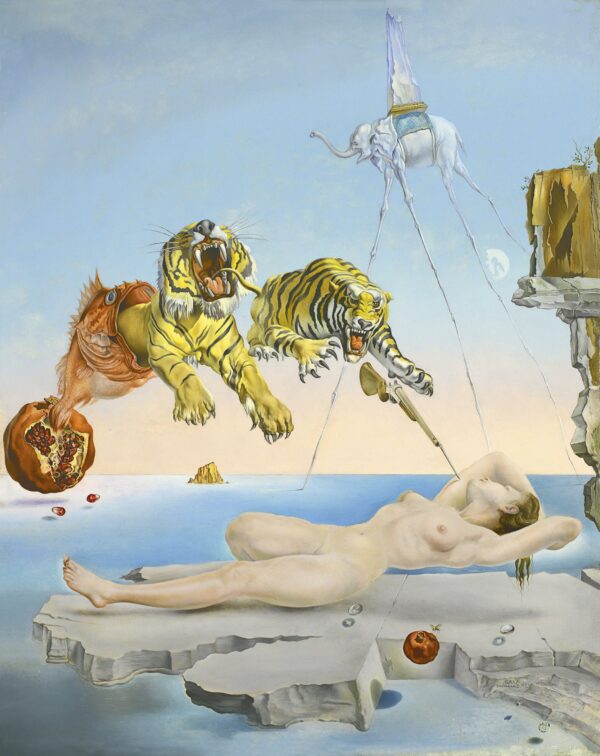
The Temptation of Saint Anthony by Salvador Dali is a surrealist masterpiece that showcases the artist’s unique and mysterious style. The painting depicts Saint Anthony, a Christian ascetic, in a desert setting, surrounded by various bizarre and fantastical elements. Both Dalí’s use of symbolism and his exploration of the subconscious can be seen in this painting.
The painting depicts a scene from the life of Saint Anthony, who is said to be tempted by various demons in the desert. Dali uses this narrative as a starting point, then adds his own unique interpretation of the story. The elements in the painting should not be taken literally, but as symbols of the subconscious.
One of the most striking elements in the painting is an elephant with long spindly legs reflected in the water in the foreground. The elephant is a recurring symbol in Dalí’s work, and in this painting it represents the power of the subconscious mind. The distorted reflection of the elephant in the water symbolizes how the subconscious mind can distort our thoughts and memories.
Other elements in the painting, such as the skull, ants and fish, also have symbolic meaning. The skull represents death and the finality of life, while the ants represent the insignificance of an individual’s life in the grand scheme of things. The fish, on the other hand, represents the unpredictable and chaotic nature of the subconscious mind.
In general, Salvador Dali’s painting “The Temptation of Saint Anthony” is full of symbolism and meaning. The painting shows Dalí’s mastery of the surrealist style and is still a source of inspiration for many artists and art lovers today. To learn more about this painting, you can visit the Salvador Dali Museum in St. Petersburg, Florida, which has one of the largest collections of Dali’s works. There are also many books and online resources available that offer a more detailed analysis of the image and its symbolism.