







































































Description
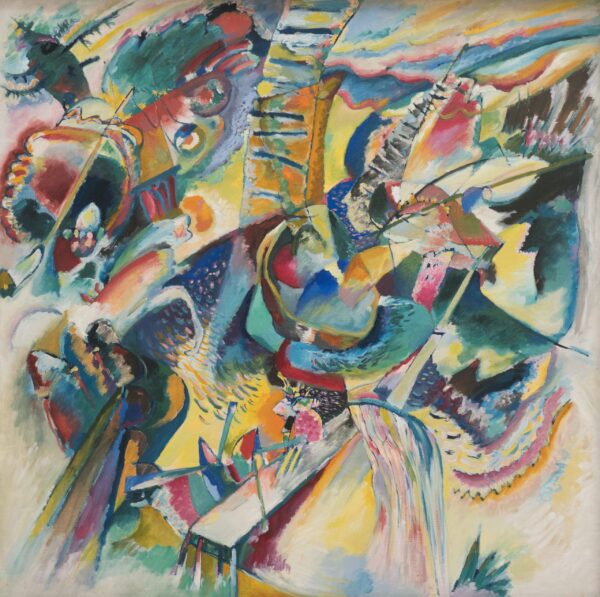
Wassily Kandinsky – Composition IV
| Year created: | 1911 |
| Original size: | 250.5 cm x 159.5 cm |
| Paint style: | Abstract Art |
| Original technique: | Oil on canvas |
| Located: | Kunstsammlung. North Rhine-Westphalia. Dusseldorf. |
Wassily Kandinsky, one of the most important figures in the development of abstract art, created many important works during his career. Among them is Composition IV, which is considered one of his most important works.
Completed in 1911, the painting is an excellent example of Kandinsky’s use of color and form to express emotion and movement. The painting consists of a dynamic and complex interweaving of geometric shapes and vibrant colors. The composition consists of large rotating shapes in shades of blue, red and yellow placed on a dark background. The shapes appear to be in motion, as if dancing or spinning around each other, creating a sense of movement and energy.
Kandinsky’s use of color in Composition IV is particularly striking. He uses bold, contrasting hues that create a sense of tension and drama. The blue and red shapes contrast with each other, creating a sense of movement and tension. The yellow shapes add a sense of light and warmth to the image, while the dark background gives the composition a sense of depth.
Composition IV is an excellent example of Kandinsky’s ability to express emotion and movement through color and form. It is a surprising and dynamic picture that still inspires and excites audiences today. This painting and many other paintings by Kandinsky can be seen in famous museums such as the Guggenheim Museum in New York, the State Hermitage Museum in St. Petersburg, and the State Tretyakov Gallery in Moscow.
This painting represents Kandinsky’s entire body of work well and is considered one of his most important works. It is an excellent example of how Kandinsky knew how to use color and form to express emotions and movement in his works.