



















Description
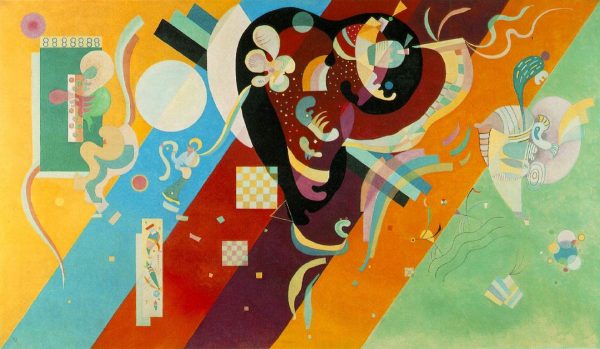
Wassily Kandinsky – Small Pleasures (Kleine Freuden)
| Year of Creation: | 1913 |
| Original size: | 119.7 cm x 109.8 cm |
| Paint style: | Abstract Art |
| Original technique: | Oil on canvas |
| Located: | Guggenheim Museum, New York |
Wassily Kandinsky’s painting Little Pleasures (Kleine Freuden) is a vibrant and striking painting that demonstrates the artist’s unique style and approach to abstraction. This work, painted in 1911, is considered one of Kandinsky’s most important works from his early period.
One of the characteristics of Kandinsky is the use of colors. In the work “Small Pleasures”, the artist used a bold and expressive palette that is both harmonious and dynamic. The image is dominated by a deep red background, accented by vibrant yellows, blues and greens. Colors are strung and blended so that they appear to dance across the canvas, creating a sense of movement and energy.
Another characteristic of Kandinsky’s art is the use of form. In this painting, the artist uses various geometric shapes such as circles, triangles and rectangles, which are arranged in a seemingly chaotic manner. These shapes seem to float in space, giving the image a sense of depth and movement.
One of the most interesting aspects of the painting “Small Pleasures” is the way in which it invites the viewer to engage with it. Using color and form, Kandinsky creates a sense of mystery and intrigue, inviting the viewer to take a closer look at the painting and explore its many layers.
Overall, “Small Pleasures” is an excellent example of Kandinsky’s early work, showing his unique style and approach to abstraction. It is a surprising and lively picture that still fascinates the audience today. With its bold use of color and form, it’s a great piece to add to any fine art collection, and it’ll also brighten up your home.



![Im Grau (Concert) (Impression III [Konzert]) - Vasilij Kandinski - reproduction of famous painting by famous artist, hand painted painting on canvas, oil painting.](https://svetslik.si/wp-content/uploads/2021/08/image_Im-Grau_680-600x436.jpg)