






Description
Paul Gauguin – Arearea (Joyousness) – The Pastoral of Tahiti
| Year of Creation: | 1892 |
| Original size: | 93 cm x 75 cm |
| Paint style: | Symbolism |
| Original technique: | Oil on canvas |
| Located: | Orsay, Paris |
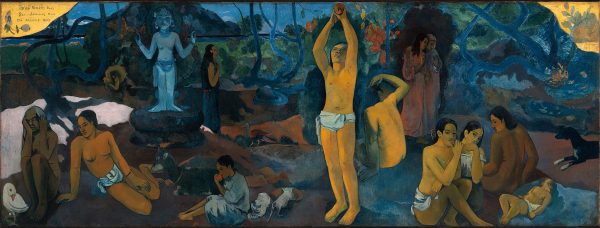
Oil on canvas Arearea is typical of Gauguin’s paintings, which he created during his stay in Tahiti, as the world of dreams and reality intertwine.
In the oil on canvas Arearea , several motifs are in the foreground, which undoubtedly come from the real world, as they appear in several Gauguin paintings from this period. An imaginary scene in the background of the painting shows several women worshiping the statue. Gauguin enlarged an otherwise small Maori statue to the size of Buddha and invented a religious custom. All these elements in the oil on canvas form a magical world full of harmony and melancholy, in which man, living in a luxurious natural environment, is protected by deities.
Tahiti is considered Gauguin’s spiritual home and many of Gauguin’s classic masterpieces are associated with or created in Tahiti. This work, “Pastoral Poem of Tahiti”, depicts the idyllic landscape of Tahiti, which is dreamlike and poetic. Two girls at work, one looks as if she has just returned from washing, the other plays the shepherd’s pipe, the trees are full of flowers, the greyhound is on the grass, everything seems calm and romantic. Here, Gauguin uses a flat rendering technique, the painting is full of exoticism and reveals a mysterious atmosphere, showing the simple beauty and decorative charm of oriental art.
Paul Gauguin (1848-1903), representative painter of post-impressionism. Gauguin was born in Paris, the son of a journalist and the daughter of a Peruvian writer. Gauguin’s paintings are unique in the history of Western modern art for their primitive and symbolic tendencies, as well as for their so-called “synthesis” style. Gauguin was a sailor and businessman in his early years. In 1871 he came to Paris to become a stockbroker. During this time, under the influence of his friend Schfnack, he became interested in painting. In 1883, Gauguin, who had always been an amateur painter, suddenly abandoned his promising and enviable banking position and decided to become a professional painter. He was 35 years old at the time. At first he was obsessed with impressionist painting and participated in several impressionist painting exhibitions. Later, driven by the aesthetic concept of symbolism, he left Impressionism and opposed the Impressionist artistic aspiration for the objective recreation of nature and advocated the distinction of artistic images. The objective image is at the same time full of subjective feelings of the artist.