





















Description
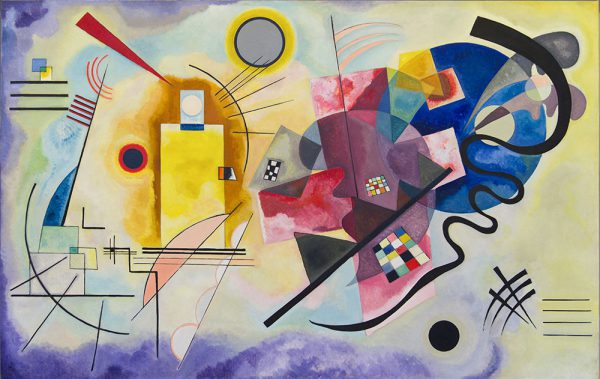
Vasily Kandinsky – Various Parts (Parties diverses)
| Year of creation: | 1940 |
| Original size: | 116 cm x 89 cm |
| Paint style: | Abstract Art |
| Original technique: | Oil on canvas |
| Located: | Städtische Galerie im Lenbachhaus, Munich. |
Wassily Kandinsky, also known as Wassily Kandinsky, was a Russian painter and art theorist who is considered one of the pioneers of abstract art. His painting “Parties diverses” is an excellent example of his abstract style, which emphasized the use of color, shape and form to express emotion and movement.
The painting “Diverses Diverses” is dynamic and surprising, rich in color and movement. The painting consists of various geometric shapes, including circles, squares and rectangles, arranged in a seemingly random but harmonious manner. The shapes are depicted in a bold and lively color palette, where shades of red, blue, yellow and green stand out on a black background.
Kandinsky believed that colors and shapes can evoke emotions and create a sense of movement in a painting. In the painting “Different Parts”, bold and contrasting colors and a dynamic composition create a sense of movement and energy that draws the viewer in.
The painting is also an excellent example of Kandinsky’s belief in the power of abstraction. He believed that abstraction allows for a more direct and emotional connection between the work of art and the viewer, as abstract shapes and colors are not tied to specific objects or representations.
The painting “Different Parts” is a powerful and striking painting that shows Kandinsky’s masterful use of color, form and abstraction. This painting is a must for anyone interested in the history of abstract art and the work of Wassily Kandinsky. The painting is currently in the collection of the Center Georges Pompidou in Paris, France.
As an additional note, Kandinsky was one of the first artists to use the term “abstract” for his works, but eventually came to be applied to all non-representational art. However, his work was not only about abstraction, but also about how art can create a sense of movement and emotion. He believed that the viewer should connect with the painting on a deeper level, and this idea is reflected in the work “Different Parts”.