
























































Description
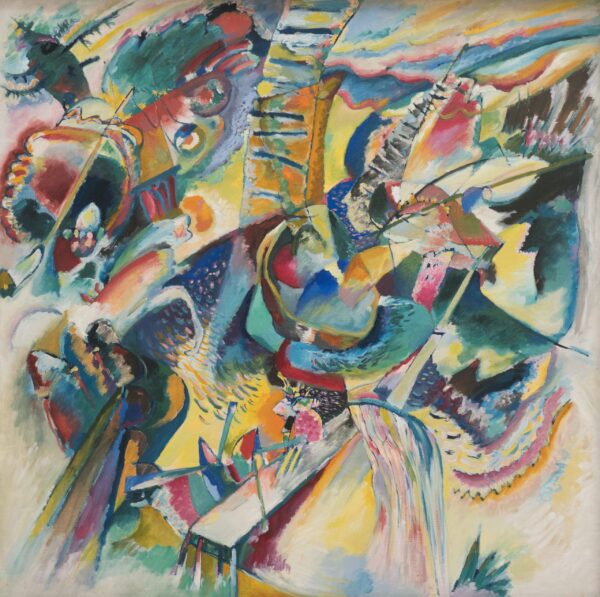
Wassily Kandinsky – White Cross (Weißes Kreuz)
| Year of creation: | 1922 |
| Original size: | 110.6 cm x 100.5 cm |
| Paint style: | Abstract Art |
| Original technique: | Oil on canvas |
| Located: | Guggenheim Museum New York |
Wassily Kandinsky’s White Cross is a powerful and striking painting that showcases the artist’s unique style and approach to abstract art. The painting, also known as “Weißes Kreuz”, was created in 1912, at the height of Kandinsky’s career as an abstract artist.
One of the most striking features of the “White Cross” painting is the use of color. The image is dominated by a large white cross that stands out against a dark black background. The cross is depicted in a bold, graphic style with sharp lines and angles that give it a sense of movement and energy. The contrast between the white cross and the black background creates a striking visual effect that immediately grabs the viewer’s attention.
Another important aspect of The White Cross is the way in which Kandinsky used the canvas as a surface for experimentation. A painting is not just a depiction of an object or a scene, but rather an exploration of the medium itself. The artist used the canvas to create a sense of movement and dynamism, with the white cross appearing to float on a black background. This is a technique that Kandinsky often used in his work and is one of the hallmarks of his style.
“The White Cross” is a powerful and stimulating painting that depicts the unique vision of one of the most important artists of the 20th century. The painting is a must-see for anyone interested in abstract art and a testament to Kandinsky’s lasting legacy as a master of the form.
In an art-historical context, this painting is considered one of Kandinsky’s most iconic works. It was painted at the height of his “abstract period”, in which the artist was strongly influenced by the work of theosophist Helena Blavatsky and mysticism. The painting is an excellent example of Kandinsky’s belief that art should be capable of evoking a spiritual and emotional response in the viewer, rather than simply being a representation of an object or scene.