


Description
Tahitian Women on the Beach – Gauguin’s first Tahitian canvas and two dresses
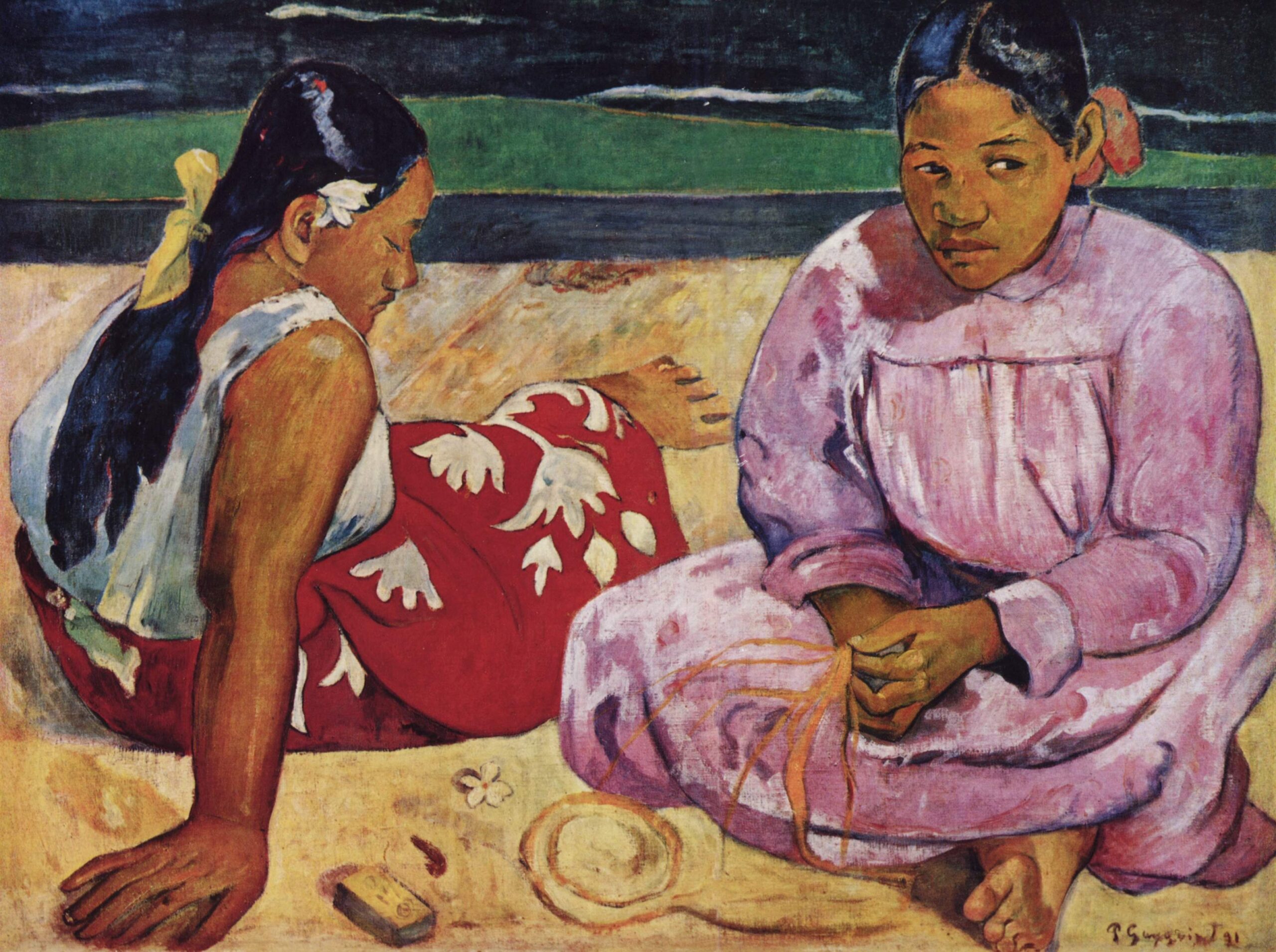
In November and December 1891, a few weeks after he landed on Tahiti, Paul Gauguin painted two women seated side by side on the sand. The one on the left is shown in profile, in a white top and a red pareu patterned with white flowers, a yellow ribbon and a white blossom in her hair. The one on the right looks straight out at the viewer, in a high-necked pink mission dress, plaiting a plant fibre in her lap. Behind them run a green band and a dark blue-green line; in front of them pale sand spreads out. The work is held by the Musée d’Orsay in Paris under accession number RF 2765. The format is landscape – the museum states height first and width second, so 69 x 91.5 cm.
Two dresses, one stretch of sand
The whole content of the work is in the clothing. The woman on the left wears the pareu, the traditional Tahitian wrap; the one on the right a long pink dress of European cut, brought to the island by the missionaries. They sit beside one another, on the same sand, with no story and no explanation. Gauguin did not paint a clash of two worlds; he simply set them side by side and left the viewer to see the difference.
Hands that work and hands that rest
The woman on the right is plaiting a pale plant fibre in her lap; her fingers are the only point of movement in an otherwise motionless work. The one on the left rests her palm in the sand and does nothing. It is that difference which holds the scene up: without it the two figures would be no more than decorative shapes on a field of colour.
The signature and the year on the canvas itself
In the lower right corner the signature P. Gauguin and the year 91 are painted in with the brush. Brush, not pen: the name and the year are paint like everything else on this canvas. We reproduce them the same way, laid into the picture rather than printed over it.
Where the original is, and what the sources say
The original is at the Musée d’Orsay, accession number RF 2765, oil on canvas, measuring 69 x 91.5 cm. The museum record dates the work to 1891, while the encyclopaedic record gives 1890. The museum’s figure governs here, but we state both openly; the year the painter put on the canvas itself agrees with the museum.
How a fine art reproduction is made
The reproduction is painted by hand, in oils on canvas, brushstroke by brushstroke. On this subject the sand is the hardest part: it has to look warm and light without looking empty, or the figures lose the ground beneath them. Before dispatch you receive a photograph of the finished piece for approval.
- Subject: two Tahitian women on the sand, the left in a red pareu, the right in a pink mission dress with plaiting in her lap.
- Technique: oil on canvas, broad quiet planes and decisive bands of colour.
- Sizes: landscape format, from 40 x 30 cm to 200 x 150 cm; the most frequently chosen are 80 x 60 cm and 100 x 75 cm.
- Of note: one of the first canvases Gauguin painted after arriving on Tahiti, carrying the year 91 on the canvas itself.
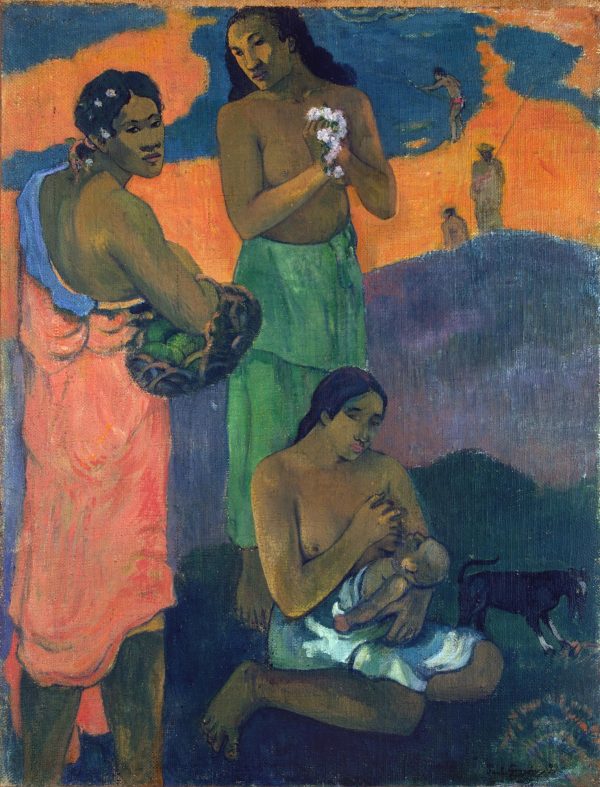
If the same period interests you, look also at Ia Orana Maria, Fatata te Miti (By the Sea) and Two Tahitian Women, where Gauguin likewise sets Tahitian figures in a quiet, flattened space.