



Description
Paul Gauguin – Fatata te Miti (By the Sea) – hand-painted oil painting reproduction
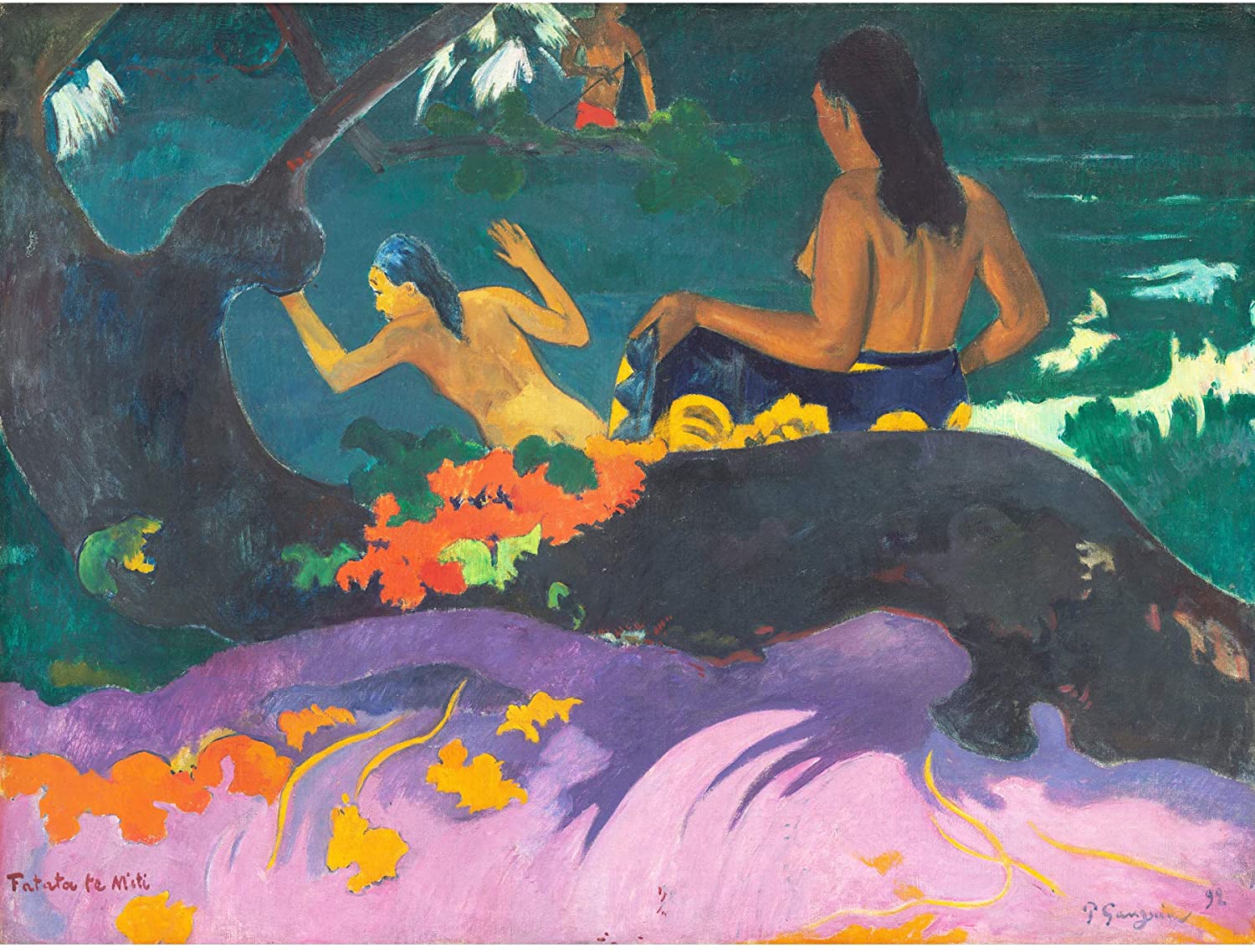
Two Tahitian women are seen from behind as they step into the water; their pareos are left on the shore, and behind them a man is fishing with a spear. The work was painted in 1892 during the first Tahitian stay, oil on canvas, 67.9 × 91.5 cm, and is held by the National Gallery of Art in Washington (Chester Dale Collection). Here that water and that sand are painted by hand: a hand-painted oil painting reproduction, oil on canvas, with no printing. The museum records the measurement as height by width, and the work carries accession number 1963.10.149.
The title says where we are
Fatata te Miti is Tahitian for “by the sea”, and the painting tells nothing more than that: two women walk into the water and a third figure fishes. The scene is ordinary; the surface is not. The colours are laid on unmixed and flat, held by a dark contour, so that depth gives way to pattern. The sand is not the volcanic brown it actually is but pink and purple – here colour is a decision, not an observation.
Wax over the finished paint
One detail of this picture is rarely mentioned: Gauguin laid a thin layer of clear wax over the finished surface to raise the luminosity of the colour. It was not a varnish for protection but part of the painting – the wax deepens the skin of the paint slightly and gives back the glow that oil loses as it dries. The detail says something about the painter: he was not only a hunter of subjects but someone testing what paint on canvas can actually do.
From a private collection into a museum
The painting belonged to the American collector Chester Dale, who bequeathed his collection to the National Gallery of Art in Washington in 1962. The fact matters because the work is still listed in places as the “Chester Dale private collection” – that has not been true for over sixty years. It is public and can be seen.
A hand-painted reproduction for your home
The sea and the sand carry this motif, and those two tones are the hardest to hit; above is our version of them. We paint the motif in eight sizes, and 92 × 68 cm is the nearest to the original; for a larger wall 120 × 90 cm is a frequent choice. The scene is bright and quiet, so it works in a bedroom or a bathroom. Another shoreline by the same painter is in Maternity (Women on the Seashore); from the same year 1892 comes Spirit of the Dead Watching, its night side, and Where Do We Come From? What Are We? Where Are We Going? gathers all of it into a single frieze.
- Subject: Fatata te Miti (By the Sea), Paul Gauguin, 1892
- Technique: hand-painted oil painting reproduction on canvas – never printed
- Original: 91.5 × 67.9 cm, National Gallery of Art, Washington, Chester Dale Collection
- Interesting fact: Gauguin laid a thin coat of clear wax over the finished paint to raise its luminosity