



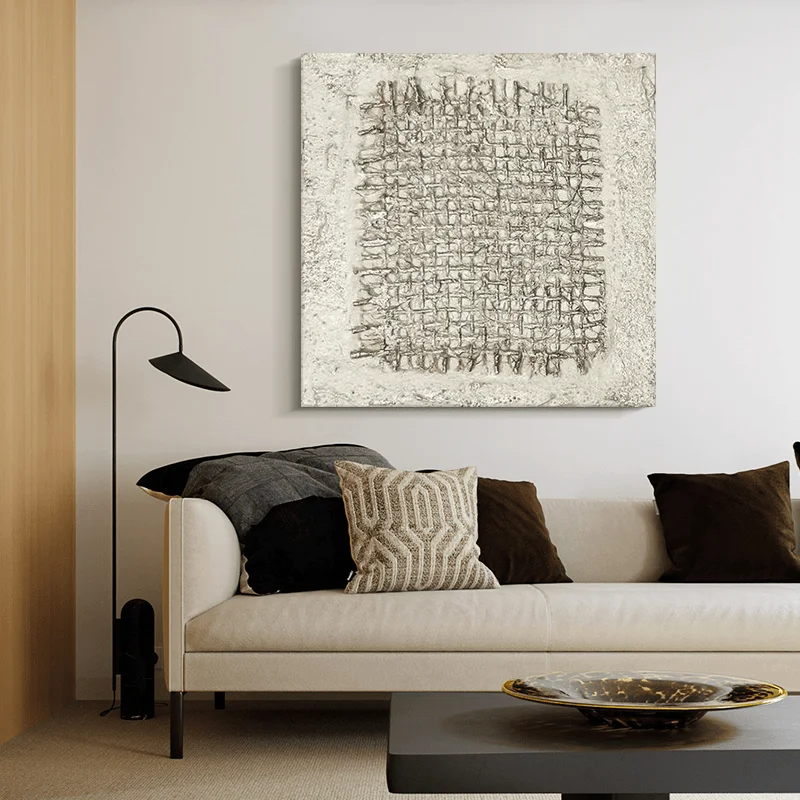
The painting you receive from us arrives without a frame: the canvas is stretched over a wooden stretcher and is ready to go straight onto the wall – no framer, no waiting, no extra cost.
What “without a frame” means on our shelf
An order asks for three things: the size, the stretcher and the frame. For the frame the default is Without Frame, across the whole range of hand-painted oil reproductions. The paint usually continues around the edge of the canvas, so the work reads as finished from every side.
This is not a saving in the making; it is a decision about how the piece looks. Hand-painted wall art without a frame reads lighter and less formal, which is why it sits better against a pale wall and against furniture that is not antique. A frame can still be added later.
With or without a stretcher
A stretcher is not a frame. The stretcher is the wooden structure the canvas is pulled over, and it is part of the painting; the frame is the ornament around it. A canvas on a stretcher arrives ready to hang; without one it arrives rolled in a tube.
If you are unsure, take the stretched version. A canvas has to be tensioned evenly, and that is work worth doing once and properly.
Hanging it, step by step
- Look at the back. A stretched canvas usually has its hanging point already prepared on the stretcher.
- Set the height. The centre of the painting belongs at roughly the eye level of a standing adult.
- Mark both edges with a pencil and a spirit level before drilling anything.
- Choose the fixing to suit the wall. Plasterboard, brick and concrete need different plugs; follow the load rating the plug manufacturer states.
- For large formats use two fixing points.
- Always hold the stretcher, never the canvas. Finger pressure leaves a mark that cannot be flattened out.
Famous paintings on canvas in large formats are surprisingly light, because almost all the weight is in the stretcher timber. The usual rule still applies: the fixing should be rated for more than the painting weighs.
Frequently asked questions
Can a canvas painting be hung without a frame?
Yes, and that is how it is intended. The canvas is stretched over a stretcher rigid enough to support itself, so the frame carries no load and is purely decorative. Without Frame is the default option on all of our hand-painted reproductions.
What is the difference between a frame and a stretcher?
The stretcher is the wooden structure beneath the canvas and is part of the painting; the frame is the border around it. They are two separate choices at checkout, so a painting can be ordered stretched and unframed – which is the most common combination.
How high should a canvas painting hang?
As a starting point, put the centre of the painting at the eye level of a standing adult. Above furniture the rule does not hold: there you measure upward from the back or the top surface.
How many fixing points does a large canvas need?
Two, for wide formats. A single point means the painting twists out of level at every touch; two hold it flat without further correction.
Can a frame be added later?
Yes. Because the canvas is already stretched over a stretcher of standard depth, a framer can fit it without re-tensioning it.
If you are still weighing up whether to frame it at all, we covered that separately: Should you frame the painting or hang it without a frame?.