



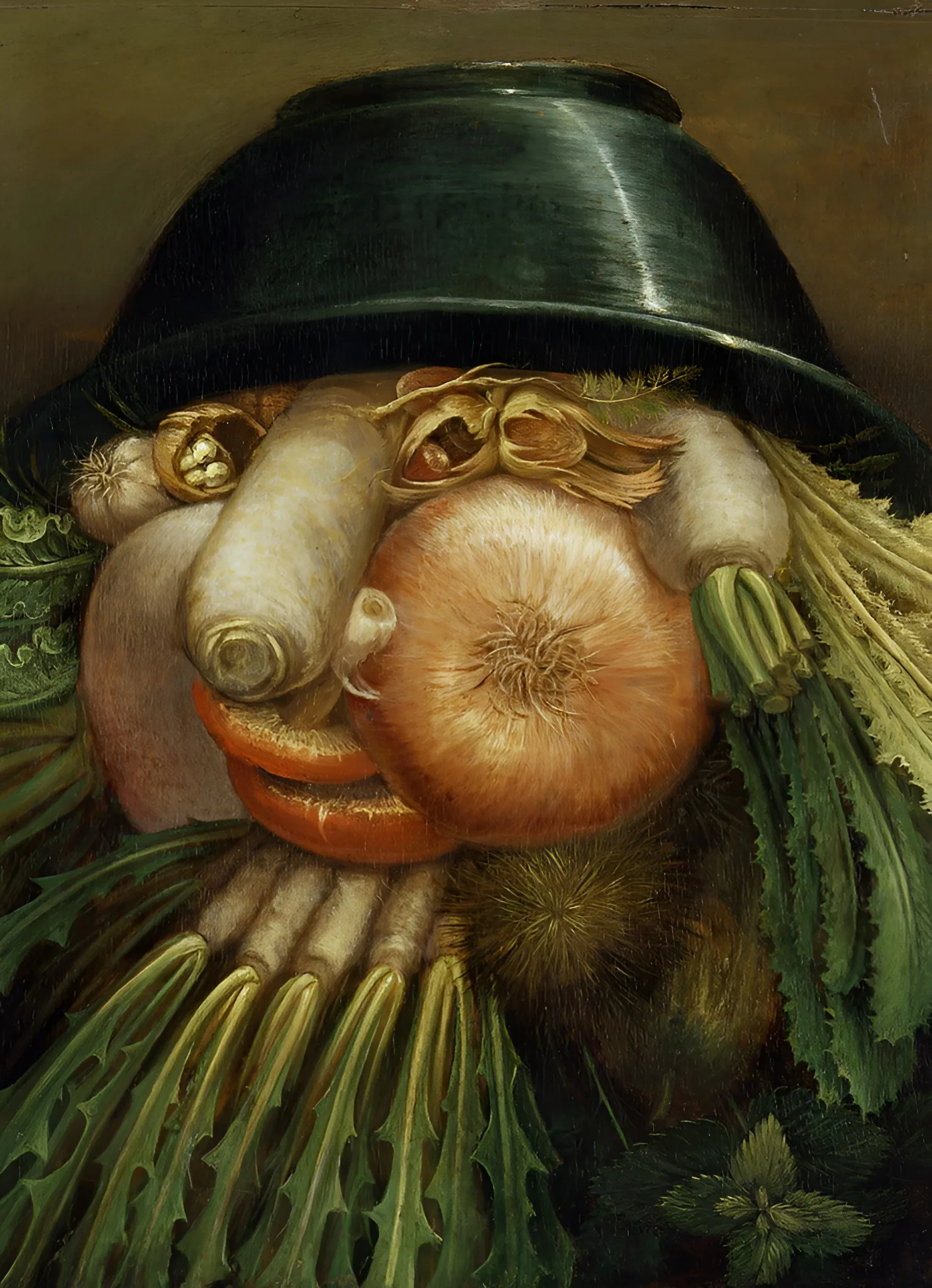
From a few steps away it is a head in profile. Come closer and the head falls apart into radish, onion, mushroom and chestnut, and you are suddenly standing in front of a still life. That switch is not a side effect; it is the actual subject of Arcimboldo’s painting. This piece uses four works to show how such a head is built and what rewards a close look.
A head assembled from things
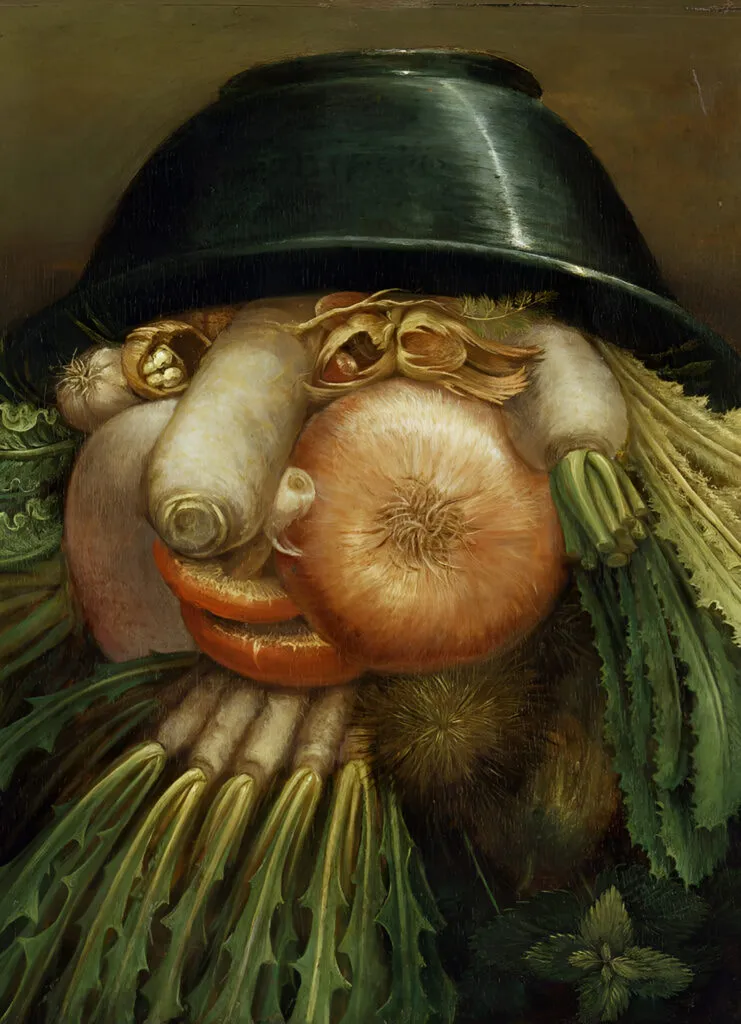
The method is plain to see in the Portrait with Vegetables, the Greengrocer. A shallow bowl of root vegetables sits on the man’s head as a cap. The collar beneath it is made of radishes standing outward like a ruff. Cheek and chin are onion and mushrooms; the eye is a chestnut in its opened husk.
What matters is that nothing is distorted. No vegetable is bent to look more like a cheek. Every piece stays exactly what it is, and the arrangement still produces a face. The likeness comes from position, light and outline alone – which is why the head holds together at a distance and dissolves back into ingredients up close.
Adam: a beard of interlocking bodies
Adam shows an old man in full profile facing left. Close up it becomes visible that forehead, cheek, hair and beard are not painted as skin and hair but as a mass of small, interlocking infant bodies. Arms and backs take the part of strands, a curved back becomes the brow, tangled limbs become a curl of the beard.
Where this work hangs today our record does not say, and we do not claim it. What can be described is what is on the canvas – and that is enough, because the whole invention sits in the detail.
Water and Fire: coral, octopus, flint
Water was made in 1566, measures 67 x 52 cm in the original, is oil on canvas, and the original hangs in the Kunsthistorisches Museum in Vienna. The head is assembled entirely from sea creatures: coral sits on top as a crown, an octopus forms the cheek, rays, shells and a lobster make up neck and shoulder. The string of pearls at the throat is the only piece that does not come out of the water.
Fire is from the same year, measures 67 x 51 cm, and also hangs in the Kunsthistorisches Museum in Vienna; unlike Water it is painted in oil on panel. The head is made of flint and steel, candles, wicks, oil lamps and a bundle of gun barrels forming the chest. The flame itself becomes the hair. Both belong to the Four Elements cycle, which we describe in a separate piece on the two sets of four.
Paintings that can be turned
Some of these heads work both ways up. The Greengrocer is the case usually cited: hung upright it shows a bowl of vegetables, a quiet kitchen still life. Turn the work over and the bowl becomes a cap, the radishes become a collar, and a face looks back at the viewer.
That is why the Greengrocer is kept and shown bowl upward: that is the orientation in which it reads as a still life, and the head is the surprise that appears only when it is turned. Anyone hanging the work at home is also choosing which of the two readings is seen first.
Read at court as wit
Arcimboldo did not paint these heads as a curiosity for its own sake but for a court that valued exactly this kind of double meaning. In 1562 he accepted an invitation from Emperor Ferdinand I to Vienna and Prague and stayed in service there, later under Maximilian II and Rudolf II. A head made of field produce was a compliment at the same time: it said that under this ruler the harvest succeeds and the elements are in order.
The double face was therefore joke and homage at once, and both were understood. Rudolf II later had himself painted as Vertumnus, the Roman god of the seasons, assembled entirely from fruit and grain. After the painter’s death the invention was forgotten until the Surrealists rediscovered it in the twentieth century. More about his life is in the piece on Giuseppe Arcimboldo.
Why hand-painting rewards a close look
A work that shows something different up close than from across the room asks the viewer to come near. That is exactly where it is decided whether the surface has anything to offer. On a printed sheet, stepping closer brings you to a screen of dots that has nothing to do with the vegetables. On a hand-painted canvas you meet paint that stands up, the edge of a brushstroke, light caught in the layer.
Every oil painting reproduction here is made in oil on canvas, stroke by stroke and to order. On a work whose whole point lies in close looking, that is not a detail at the margin but the reason the joke works at all.
You choose the frame on each work’s own page in 3D: you see the chosen moulding in real time on that exact work, and this view shows the frame and nothing else. How the work looks in your own room is a separate service – we carry out the visualisation of the painting in the room on its own. Where such a head belongs in the house is covered in the piece on the kitchen and dining room.
All of the painter’s works are in the Giuseppe Arcimboldo gallery.