




Description
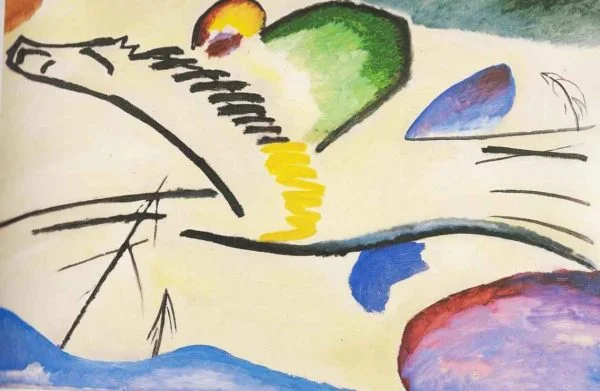
Fugue is a painting by Wassily Kandinsky from 1914: a square canvas on which coloured arcs, patches, striped bands and a white net over a dark grey form at the centre crowd together on a pale, yellowish white ground. The original is held by the Fondation Beyeler in Riehen, near Basel. We make it as a hand-painted reproduction in oil on canvas, in eight sizes or made to measure, and before dispatch you receive a photograph of the finished work to approve.
| Title: | Fugue |
| Other titles: | Fuga · Fuge |
| Painter: | Wassily Kandinsky (1866–1944) |
| Year: | 1914 |
| Original size: | 129.5 cm x 129.5 cm |
| Original technique: | Oil on canvas |
| Style: | Abstract art |
| Location: | Fondation Beyeler, Riehen near Basel (inv. no. 90.4) |
| Our reproduction: | hand-painted oil on canvas, 8 sizes from 60 x 60 cm to 180 x 180 cm, made to measure on request |
Fugue – Wassily Kandinsky
How is the painting built?
From the centre outwards. Almost everything that happens on the canvas gathers in a great whirl of forms filling the upper and middle part; towards the edges the painting thins out and opens into a pale, yellowish ground, greenish or bluish in places. The forms have no sharp borders: the paint is laid on in short, soft strokes that fray like feathers at their edges, so the patches melt into one another. Because the canvas is square, no direction dominates; the eye circles from the dark centre to the coloured arcs at the upper left, from there down the rainbow bands and back again. As an abstract painting it has no subject to recognise, but it has a clear tension between the dense, dark core and the light, open space around it.
What is on the canvas?
The centre is taken up by a broad dark grey, almost black form, like a mountain or the hull of a boat, with a white net of thin crossing lines stretched over it. From it a narrow black spike rises vertically almost to the top edge, and around it small red, yellow, green and blue forms scatter like a bouquet. At the upper left a large pinkish red arc spans the canvas, with smaller red crescents with jagged edges beneath it; in the top left corner stand blue and yellow triangles. On the left edge lies a dark brown oval like an eye, and lower down, left of centre, another dark ring. From the left towards the centre, curved rainbow bands of red, blue, green and yellow descend. On the right edge at the top there is a deep blue area, and below it a dark violet form shaped like a mushroom. In the lower half, striped bands like ladders run downwards in yellow, blue and red, and between them a pale bluish wedge points down to the right. In the bottom left corner there is a fine net of red and blue lines; in the bottom right, green and brown strokes and a small red drop.
Why is it called Fugue?
The museum lists the painting under the title Fuga, but publishes no interpretation of it. The word names a musical form in which the same theme enters in several voices one after another and those voices interweave. So the title comes from music; what exactly guided Kandinsky in this painting cannot be read from the museum’s record, and so we do not claim it either. In its exhibition history the museum lists Farben-Klänge, the exhibition the Fondation Beyeler devoted in 1998 to Kandinsky and the composer Arnold Schönberg, in which Fugue was also shown.
When was it painted and where was it first shown?
The museum dates the painting to 1914. The first exhibition in its exhibition history is Kandinsky. Gemälde und Aquarelle at the Der Sturm gallery in Berlin in 1916. The gallery was run by Herwarth Walden, who according to the museum’s record acquired the work directly from the artist and owned it by 1916 at the latest. Later Fugue appeared in several major Kandinsky retrospectives, among them in 1963 at the Solomon R. Guggenheim Museum in New York and the Musée National d’Art Moderne in Paris, and in 1970 at the Staatliche Kunsthalle in Baden-Baden.
Who has owned the painting?
The museum publishes the full provenance. It first belonged to the Berlin dealer Herwarth Walden, and by 1930 at the latest to the Galerie Ferdinand Möller in Berlin. In 1936 the American collector Solomon R. Guggenheim acquired it, and in 1937 he gave it to his museum in New York. The Solomon R. Guggenheim Museum sold it at auction at Sotheby’s in New York on 17 May 1990, where Fugue was lot 40. The same year it entered the Beyeler Collection in Basel, and since 1993 it has belonged to the Beyeler-Stiftung. Today the Fondation Beyeler in Riehen holds it under inventory number 90.4. The same museum also owns Improvisation 10, an oil on canvas by Kandinsky from 1910.
How is our hand-painted version made?
The painter works from a high-resolution reference and builds the painting up in layers, with brush and oil paint. With this subject what matters most is the soft, feathery stroke: the edges of the patches must not close into hard outlines, and the white net over the dark centre has to stay thin and translucent so that the grey beneath it can breathe. The pale ground is not a uniform surface but a mosaic of yellowish, greenish and bluish strokes that the painter builds up slowly. An oil painting reproduction keeps its colours for many years, because oil does not fade the way a print does. Since every reproduction is made individually, no two copies match down to the last detail; the subject, the proportions and the colours do.
Which size for which wall?
The original measures 129.5 x 129.5 cm; our 130 x 130 cm size is 5 mm wider and 5 mm taller. Because the painting is full of small forms, it shows them best at 100 x 100 or 110 x 110 cm, as a painting for the living room, above the sofa or on a wall of its own. The 60 x 60 and 70 x 70 cm sizes suit a desk or a hallway, 90 x 90 cm a bedroom, and 150 x 150 and 180 x 180 cm large walls and high rooms. The square format also works well above a chest of drawers or between two windows, where it has as much room in width as in height.
Custom sizes, stretcher and frame
If none of the eight sizes fits your wall, we paint this Kandinsky reproduction to your measurements; that is our painting made to measure. Because the original is square, for a rectangular size we tell you how the whirl of forms will be arranged on the longer canvas. Every canvas is stretched on a wooden stretcher. A frame is optional and not included in the base price.
Delivery and guarantee
Because every painting on canvas is painted only after the order, in our studio in Slovenia, allow 15 to 45 days depending on the size you choose. We ship protected, insured and tracked, within the EU without customs. If anything is wrong on arrival, get in touch and we will put it right. All our works by Kandinsky are collected in the Wassily Kandinsky gallery, and the painter is introduced in our article about Wassily Kandinsky. Related works we paint include Improvisation. Gorge, Composition VII and Moscow I.
Frequently asked questions
Where is the original?
It is held by the Fondation Beyeler in Riehen near Basel, Switzerland, where it belongs to the Beyeler Collection under inventory number 90.4. The museum’s record is on the Fondation Beyeler website.
How big is the original?
It measures 129.5 x 129.5 cm, so it is exactly square. Our 130 x 130 cm size is 5 mm wider and 5 mm taller.
When was the painting made?
In 1914. According to the museum it was first shown in 1916 at the Der Sturm gallery in Berlin.
What does the painting show?
Nothing figurative: coloured arcs, patches, rainbow and striped bands and a white net over a dark grey form, gathered into a whirl on a pale ground.
Is this a print?
No. It is a canvas painting, painted by hand in oil; the brushstrokes show in raking light and can be felt with the fingertips.
Which size should I choose?
For a living room 100 x 100 and 110 x 110 cm work best, for a desk or hallway 60 x 60 or 70 x 70 cm. Before deciding, tape a sheet of paper of the chosen size to the wall and leave it there for a day.
Can I have a size that is not on the list?
Yes. We also paint sizes outside the list, rectangular ones too, and tell you how the forms will be arranged.
How is it delivered?
Insured and tracked, within the EU without customs. Before dispatch you receive a photograph of the finished painting to approve.
Has the painting ever been auctioned?
Yes. According to the museum’s record the Solomon R. Guggenheim Museum sold it at Sotheby’s in New York on 17 May 1990; since then it has been in the Beyeler Collection.
Is the original for sale, and what is it worth?
It is not for sale and has no market price. It belongs to a museum collection and stays there; what we offer is a hand-painted copy, not the original, and we never confuse the two.
Is the painting suitable as a gift?
Yes, especially for someone who loves music and vivid colour. If you are unsure about the subject or the size, there is a gift voucher, and the choice stays with the person who receives it.
- Subject: coloured arcs, patches, rainbow bands and a white net over a dark grey form, gathered into a whirl on a pale ground
- Original: Fondation Beyeler, Riehen near Basel, inv. no. 90.4, 1914, 129.5 x 129.5 cm
- Our version: hand-painted oil on canvas, eight sizes from 60 x 60 to 180 x 180 cm, on a wooden stretcher, framed on request
- Worth knowing: in the Solomon R. Guggenheim Museum, New York, until 1990, then sold at auction at Sotheby’s