













Description
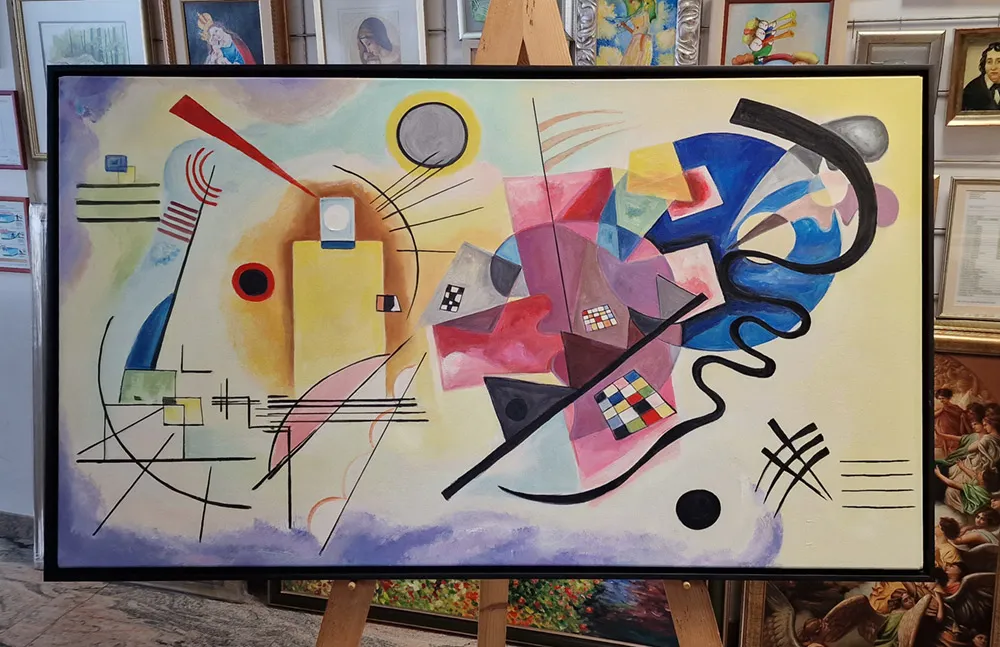
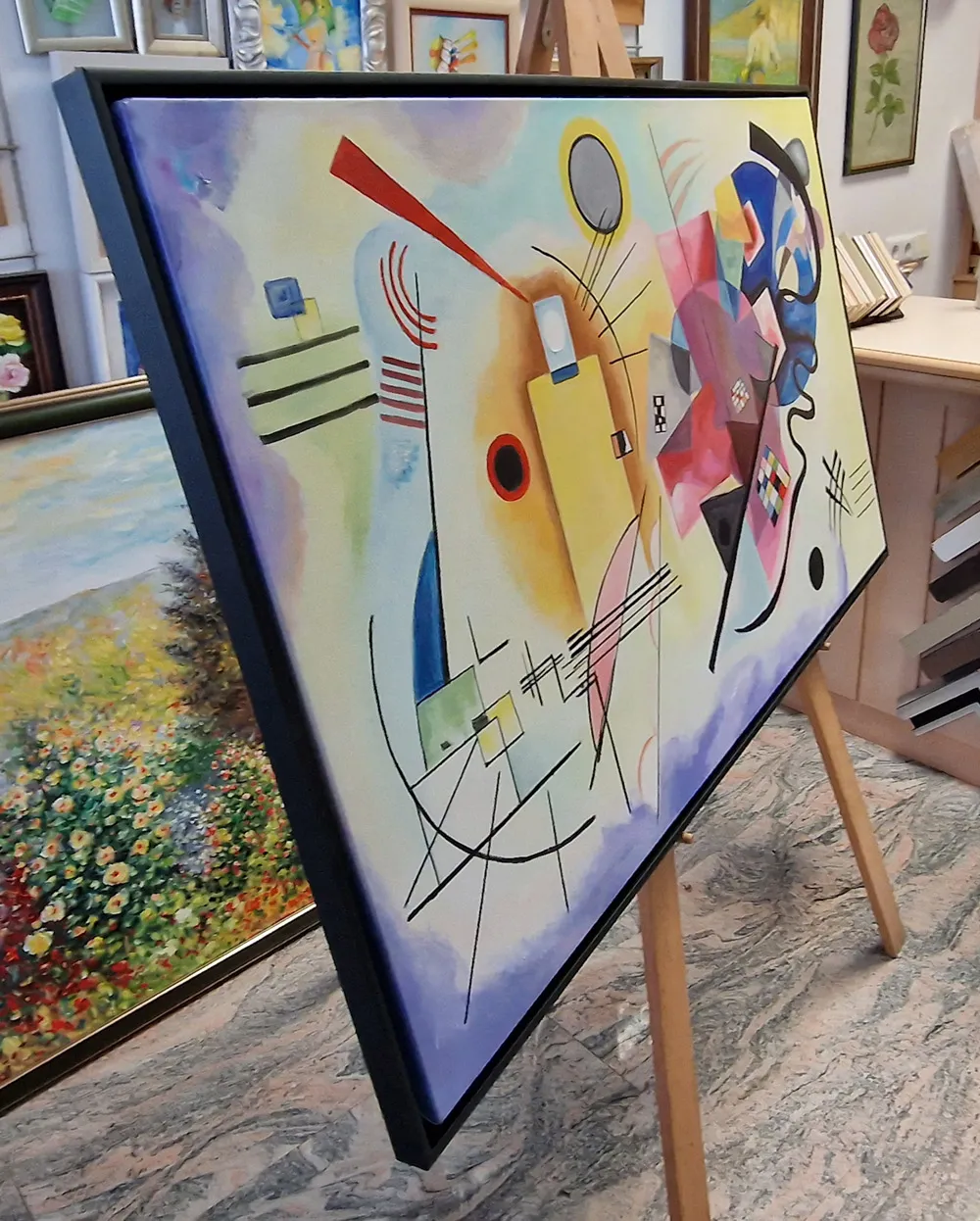
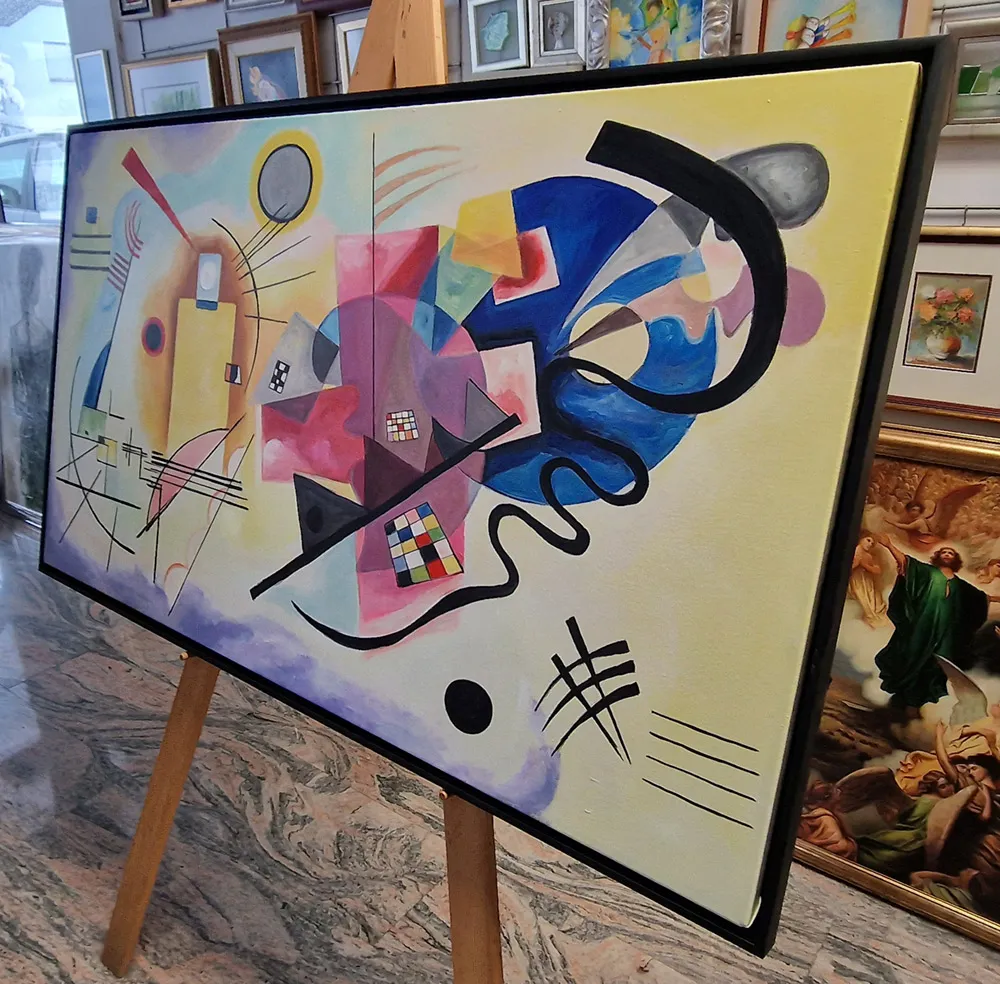
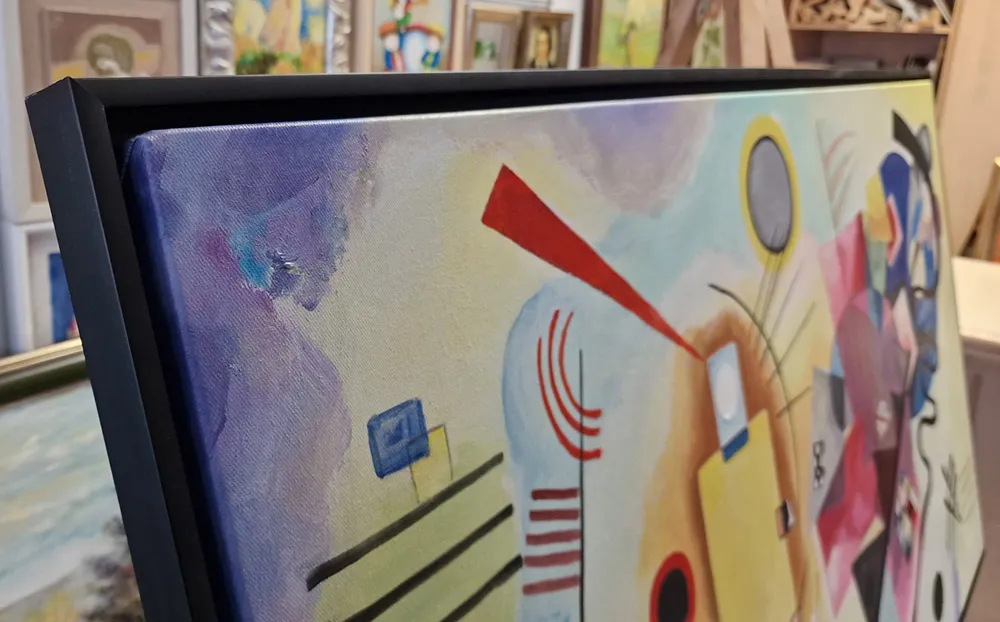
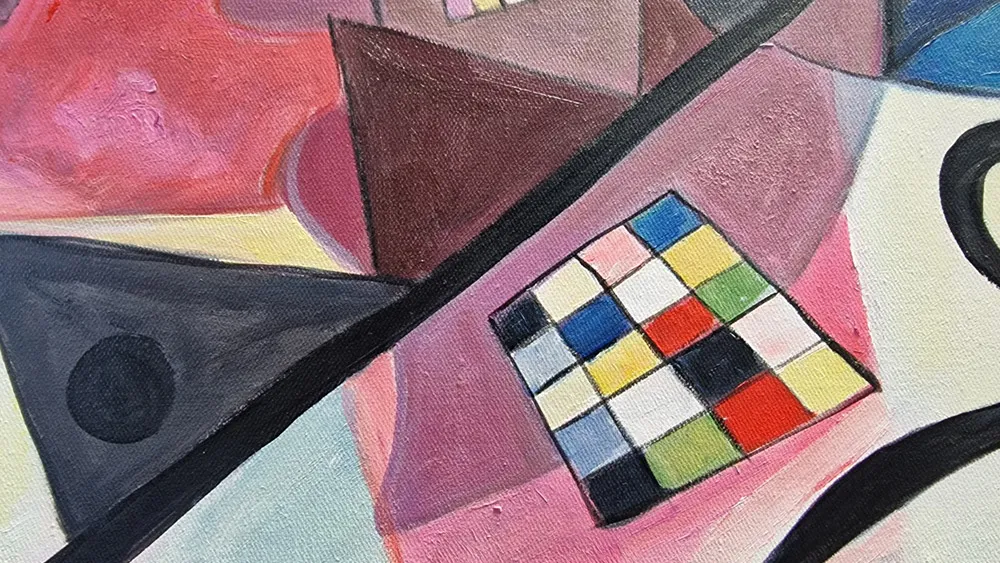
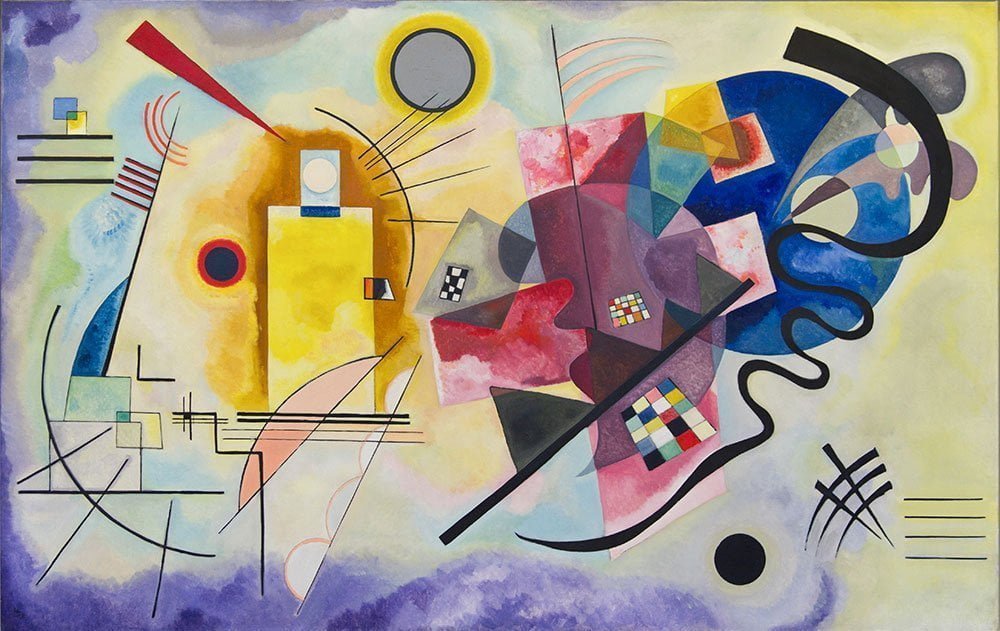
Yellow Red Blue is a work by Wassily Kandinsky from 1925: a broad landscape canvas that reads from left to right, from the yellow block and straight lines at the left to the dark blue circle and black waves at the right. The original is held by the Musée national d’art moderne at the Centre Pompidou in Paris. With us it is made as a hand-painted reproduction in oil on canvas, in nine sizes or to your measurements, and before dispatch you receive a photograph of the finished work for approval.
| Title: | Yellow Red Blue |
| Other titles: | Gelb-Rot-Blau · Jaune-rouge-bleu |
| Painter: | Wassily Kandinsky (1866–1944) |
| Year: | 1925 |
| Original size: | 201.5 cm x 128 cm |
| Original technique: | Oil on canvas |
| Style: | Abstract art |
| Location: | Musée national d’art moderne, Centre Pompidou, Paris (inv. AM 1976-856) |
| Our reproduction: | hand-painted oil on canvas, 9 sizes from 40 x 30 cm to 200 x 127 cm, made to measure on request |
Yellow Red Blue – Wassily Kandinsky
How does this painting read?
From left to right, like a line of text. The museum that holds it notes that the main emphasis falls on the three primary colours, and that it is they which articulate the composition from left to right. At the left stand straight lines and luminous colours, at the right sinuous forms and dark tints; the work rests on a balance of opposed but complementary elements. Once you know that, it stops being a collection of shapes and becomes a route: it begins in the yellow, passes through the red and ends in the blue.
What is on the canvas?
The canvas is wide, in landscape format, with a soft violet haze along its left and lower edges, and inside it the ground is light, yellowish and bluish. At the left stands an upright yellow block with a small white rectangle on top; above it hangs a grey circle in a yellow halo, with thin black lines falling from it. From the upper left edge a sharp red wedge descends towards the centre, and beneath it lie red arcs, one above the other, like tightened strings. On the left, at about half height, stands a blue triangle, and below it, at the lower left, a net of straight black lines and small squares. The middle is filled with overlaid pink, raspberry and grey-violet planes carrying dark triangles and three chequerboards, two coloured and one small black-and-white. At the right stands a large dark blue circle, crossed in a wide arc by a black line that continues downwards in a wave. Below the circle is a black disc, and along the right edge are sheaves of thin black lines. Across the middle at the right a thick black band runs diagonally.
What has this to do with the Bauhaus?
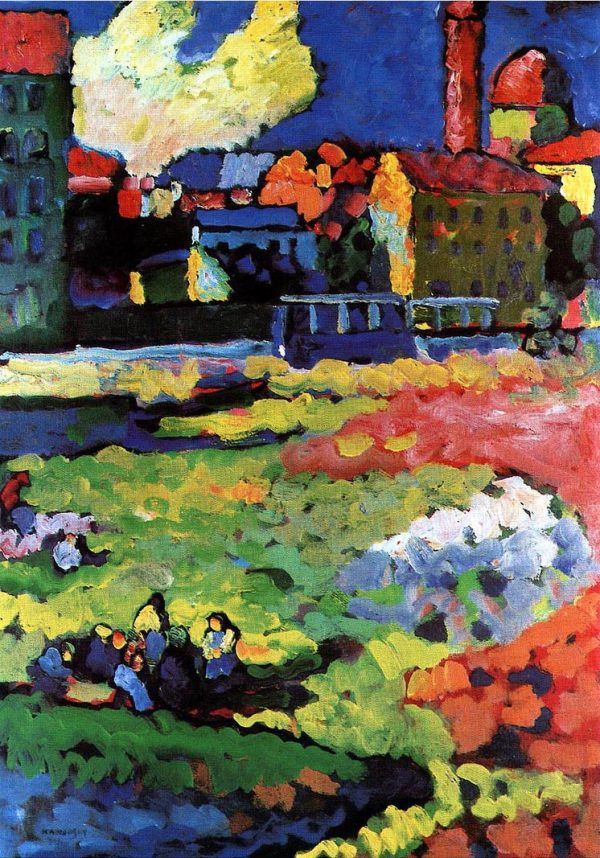
Everything. The museum explains that Kandinsky began teaching at the Bauhaus in 1922 and set out his conception of art there in Point and Line to Plane – and that this work appears to be its formulation in paint. The lyrical, spontaneous abstraction of his early years turns in the 1920s into a more rational, geometric language. Hence the circle, the triangle and the square, which the Impressions did not yet contain.
Why yellow, red and blue?
Because these are the three primary colours, and because Kandinsky gave each of them a character of its own. For him yellow is near, warm and insistent; blue withdraws and deepens; red stands between them and does not move. On the canvas you meet them in that order, one after another, and that is why the work behaves like a development rather than a scattering.
Why does this painting matter?
Because you can see in it how abstraction learned order. The museum describes it as built on the balance of opposites that complete one another: geometry against curve, light against dark, left half against right. As an abstract painting it belongs to the Bauhaus years, when Kandinsky moved the colour outbursts of his early work into a system.
How is our hand-painted version made?
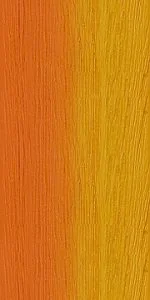
We paint it in oil on canvas, stroke by stroke, in our studio in Slovenia. The first photograph shows the finished work framed on the easel among other canvases in the studio: the whole surface edge to edge, with nothing cropped. The fifth photograph is taken close up and shows what a screen cannot – the chequerboard beside the thick black band, the weave of the canvas under the paint, and the slight ridges the brush leaves. The fourth photograph shows the upper left corner with the red wedge and the red arcs from close enough that the grain of the canvas is visible. Because each copy is painted singly, no two match down to the last detail; what matches is the subject, the proportions and the range of colour. The video on this page (0:30) first shows the painting Yellow Red Blue in a black frame on an easel among other paintings, then a close-up of a fine brush touching up thin lines and pink areas, then the whole framed painting and the edge of the frame, and finally a close-up of the chequered square, where the brushstrokes can be seen.
Which size for which wall?
The original measures 201.5 x 128 cm and is therefore very wide; our scale begins at 40 x 30 cm and keeps its landscape shape all the way up to 200 x 127 cm, the closest of our sizes, 15 mm narrower and 10 mm shorter than the original. Because the work reads from left to right it needs width: above a sofa or a long sideboard, 120 x 80 cm is the size at which the route from yellow to blue really opens out. As a painting for the living room it works best on a quiet, unpatterned wall. For narrower rooms and hallways choose 80 x 50 or 90 x 60 cm; the smallest sizes suit a desk.
Made to measure, stretcher and frame
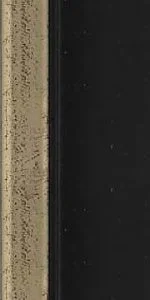
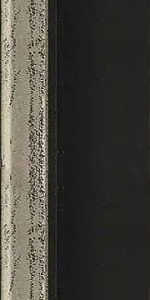
Every canvas is stretched on a wooden stretcher; when it travels stretched, it arrives ready to hang. The second photograph is taken from the side and shows the depth of the slim black frame the work is presented in; the third photograph shows the same canvas from the other side, so that the right half with the blue circle and the black wave is visible. A frame is optional and not included in the base price. When none of the nine sizes fits, we work to measure in the proportion your wall asks for, and tell you where the subject crops.
Delivery and guarantee
The work travels rolled in a tube or stretched on its stretcher, depending on size and destination, always insured and tracked. Because every canvas here is painted only after the order, delivery takes 15–45 days, as the size selector also shows. If something is wrong on arrival, write to us and we will put it right.
Frequently asked questions
Where is the original?
In Paris, in the collection of the Musée national d’art moderne at the Centre Pompidou, under inventory number AM 1976-856. Until 14 February 2027 it is on loan to the Kandinsky exhibition at Palazzo Bonaparte in Rome. It came to the museum in 1976 as a gift from the painter’s widow, Nina Kandinsky. The museum’s record can be read on the Centre Pompidou page.
How large is the original?
It measures 201.5 x 128 cm. We give the width first; the museum lists the work height first, as 128 x 201.5 cm. It is a large and decidedly landscape canvas.
When was it painted?
In 1925, while Kandinsky was teaching at the Bauhaus. The monogram and the date are at the lower left; on the back the painter also noted the work number and the title.
What does it show?
Nothing figurative. The museum’s description speaks of a balance of opposed but complementary elements: geometric lines and luminous colours at the left, sinuous forms and dark tints at the right, with the main emphasis on the three primary colours.
Is this a print?
No. This is a canvas painting: it is painted by hand in oil, the brushstrokes are visible in raking light and can be felt, and in the fifth photograph they are shown close up.
Which size should I choose?
For a living room 120 x 80 cm, for a narrow wall or hallway 80 x 50 or 90 x 60 cm, above a desk 50 x 30 or 60 x 40 cm. Since the subject is very wide, tape up a paper of the chosen size and leave it a day before deciding.
Can I have a size that is not on the list?
Yes. We paint sizes outside the scale, in the proportion your wall needs, and tell you where the subject crops and where it does not.
How is it delivered?
Insured and tracked, rolled in a tube or stretched on its stretcher.
What is it about, briefly?
Order. The three primary colours are set out from left to right, geometry stands against curve, and neither side defeats the other: the balance is the intention, not a stage on the way to something else.
Is the original for sale, and what is it worth?
It is not for sale. It belongs to a public museum collection and stays there; what we offer is a hand-painted copy, not the original, and we never confuse the two.
Does it work as a gift?
It does, especially for a long, empty wall; a Kandinsky reproduction is a present that stays on the wall rather than in a drawer. If you are unsure about the subject or the size there is a gift voucher, and the choice stays with the person receiving it.
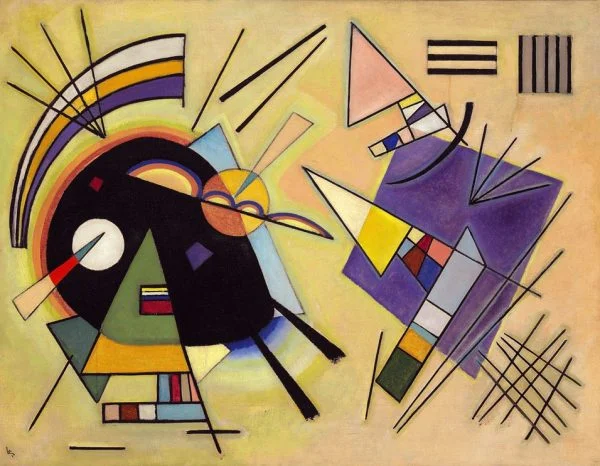
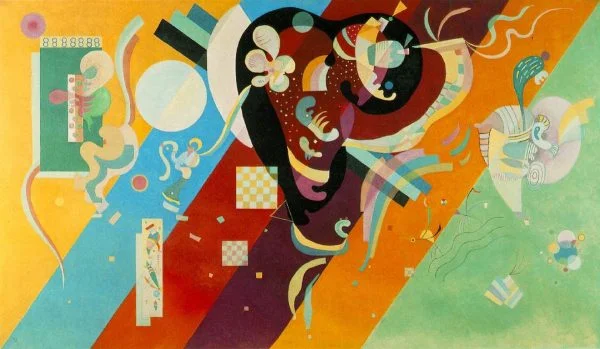
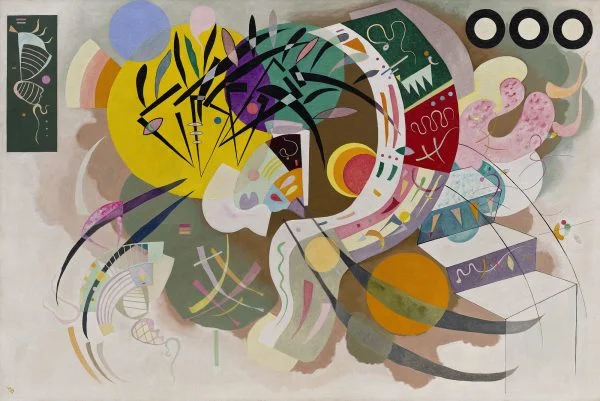
All of Kandinsky’s works here are gathered in our Wassily Kandinsky gallery: they include Composition VII, Several Circles, With the Black Arch and Impression III (Concert). The painter is introduced in an article about Wassily Kandinsky. The original of With the Black Arch is held by the same Paris museum (Mit dem schwarzen Bogen); it was painted thirteen years earlier, when his language was still all momentum. In changing daylight our oil painting reproduction of Yellow Red Blue keeps its clear primary colours.
- Subject: yellow block and straight lines at the left, pink centre, dark blue circle with a black wave at the right
- Original: Centre Pompidou, Paris, inv. AM 1976-856, 1925, 201.5 x 128 cm, gift of Nina Kandinsky 1976
- Our execution: hand-painted oil on canvas, nine sizes from 40 x 30 to 200 x 127 cm, stretched and framed on request
- Worth knowing: the museum reads the work as the formulation in paint of Point and Line to Plane