








Description
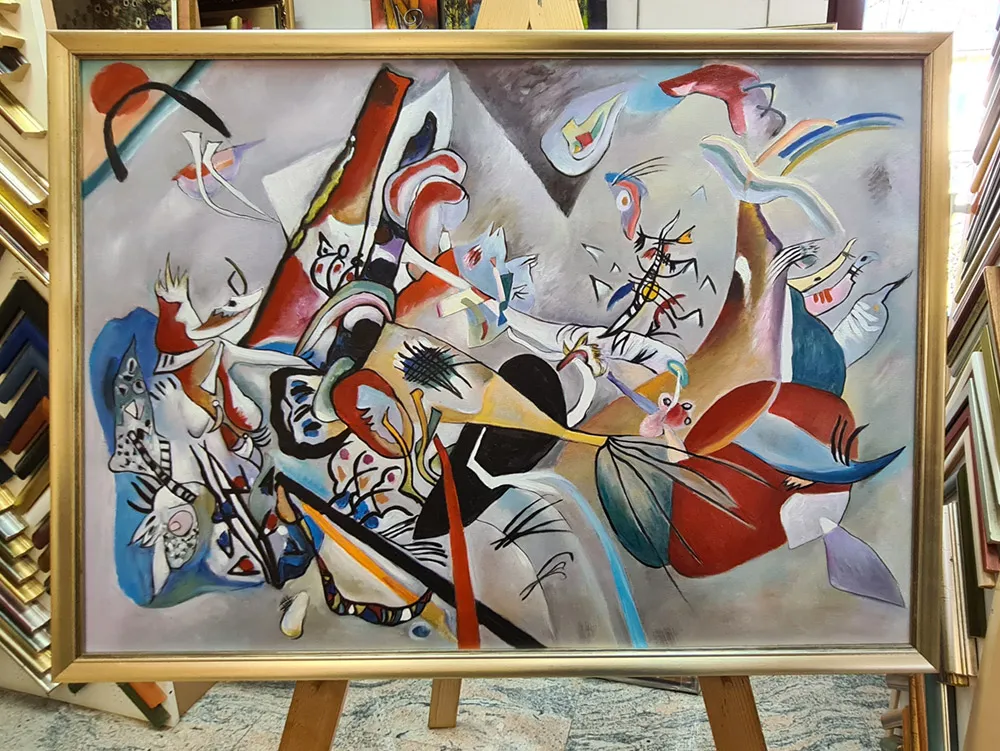
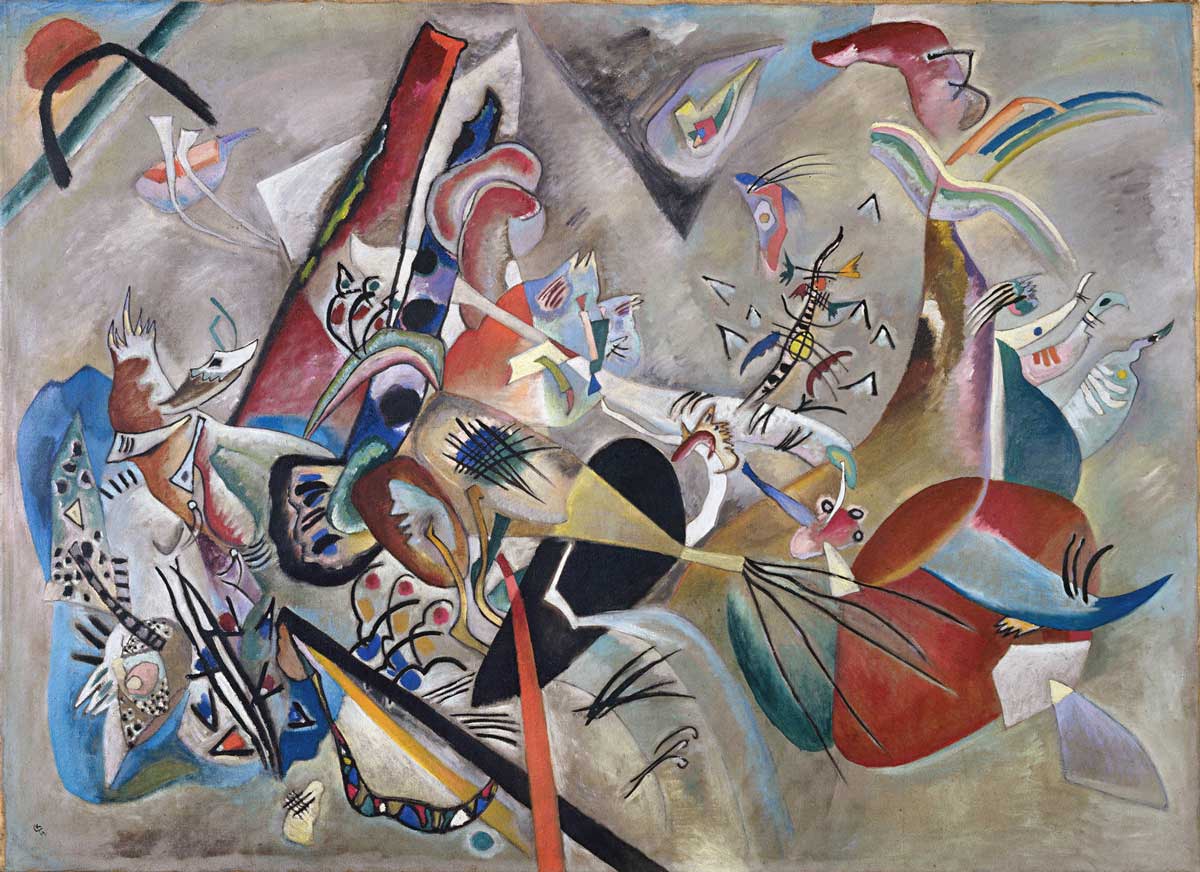
Im Grau is a painting by Wassily Kandinsky from 1919: a wide canvas on whose muted grey ground small organic forms, coloured arcs and pointed signs float, with a black arc over a red circle at the upper left. The original belongs to the Centre Pompidou in Paris and is on loan until 14 February 2027 to the Kandinsky exhibition at Palazzo Bonaparte in Rome. We make it as a hand-painted reproduction in oil on canvas, in eight sizes or made to measure, and before dispatch you receive a photograph of the finished work to approve.
| Title: | Im Grau |
| Other titles: | In Grey · Dans le gris · Painting with the Black Arc |
| Painter: | Wassily Kandinsky (1866–1944) |
| Year: | 1919 |
| Original size: | 176 cm x 129 cm |
| Original technique: | Oil on canvas |
| Style: | Abstract art |
| Location: | Centre Pompidou, Paris (inv. no. AM 81-65-43) |
| Our reproduction: | hand-painted oil on canvas, 8 sizes from 60 x 45 cm to 176 x 129 cm, made to measure on request |
Im Grau – Wassily Kandinsky
What can be seen in the painting?
The whole ground is a muted grey, and on it forms crowd together with no clear centre. In the top left corner is a red circle, a thick black arc spans over it, and beside it a turquoise band runs from the corner. Left of centre a long red slanting band with a white edge rises towards the top, and above the centre is a large dark triangle pointing downwards. At the upper right is a pinkish red form, with coloured arcs like a rainbow beside it. In the middle stands a black half-circle form, from which a fan of thin black lines opens to the right. On the right are large red and dark red areas with a blue, feather-like form. Along the left edge is a blue patch with small thorny figures, and at the lower left dotted and chequered forms. At the bottom a thick black bar runs at a slant, with a narrow vertical red strip, a slanting yellow strip and a coloured zigzag band beside it. Everywhere small pointed forms like birds and thorns are scattered. At the bottom left is a monogram.
Why is it called Im Grau?
Because of the ground: the museum describes a background in muted tones of grey on which organic elements float. Kandinsky first gave the painting another title and later struck it out: Kartina s tchernoï dougoï, Painting with the Black Arc. According to the museum a motif in the top left corner justifies it, the douga, a black arc whose shape evokes a celestial body. It is still missing from the pencil study, and clearly visible on the watercolour study.
When and where was it painted?
In 1919, in Kandinsky’s Russian period. The museum counts it among the last works of Kandinsky’s Russian period, painted shortly before he settled in Germany. He prepared the composition in several works on paper, among them a watercolour the same museum owns, the Study for Im Grau of the same year, watercolour and ink on paper, 25.6 x 34.4 cm. The organic forms floating on the grey here would soon, in the museum’s words, give way to more geometric ones. In the catalogue raisonné of Kandinsky’s paintings by H. K. Roethel and J. K. Benjamin it is number 663.
Why does this painting matter so much?
In October 1920, according to the museum, it hung in the place of honour at Kandinsky’s last retrospective in Moscow, in the rooms on Dmitrovka. It shared the wall with Flottements aigus of 1920, which Kandinsky had thought of ranking among his major works as Composition VIII. That painting had been lent in 1922 by the fine arts administration to the First Russian Art Exhibition at the Van Diemen gallery in Berlin. Flottements aigus is lost, and so Im Grau is, in the museum’s words, a rare and essential document of a period too readily called transitional. Will Grohmann already described it as extremely complicated and unsettling in its exuberance, and Christian Derouet counts it among Kandinsky’s masterpieces: complex, full of action and balanced by counterpoints, a work that plays with variations of tone, form and texture.
What did Kandinsky write about it?
In 1936, according to the museum’s record, he wrote to Hilla Rebay that Im Grau was the conclusion of his dramatic period, the time when he piled so many forms onto the canvas. The museum says nothing about the meaning of individual signs, and so we do not interpret them either; the painting speaks through what we see: the crowding of forms on the grey.
How is our hand-painted version made?
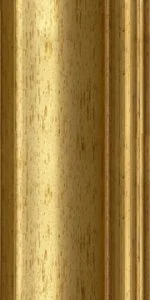
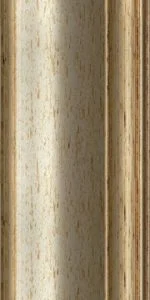
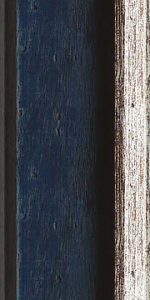
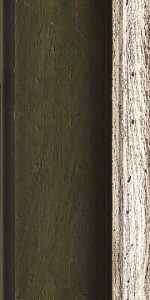
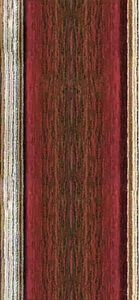
The painter works from a high-resolution reference and builds the painting up in layers, with brush and oil paint. With this subject what matters is the grey ground: it is not a uniform surface but a run of warm and cool greys on which the small coloured forms come alive. The first and only photograph at the top of the page shows our copy, painted by hand, in a gold frame on a wooden easel in the studio, among frame samples. An oil painting reproduction keeps its colours for many years, because oil does not fade the way a print does. Since every reproduction is made individually, no two copies match down to the last detail; the subject, the proportions and the colours do.
Which size for which wall?
The original measures 176 x 129 cm, and that is also our largest size: at 176 x 129 cm we paint it at its original size. As a painting for the living room it works best at 110 x 80 or 130 x 100 cm, where the small forms still show well. The 60 x 45 and 70 x 50 cm sizes suit a desk or a hallway, 80 x 60 and 90 x 70 cm a bedroom, and 150 x 110 cm a larger wall. Because the work is so dense, it wants a calm wall.
Custom sizes, stretcher and frame
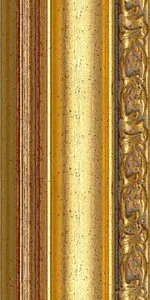
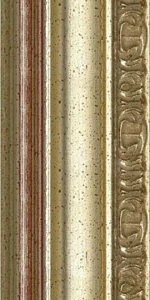
If none of the eight sizes fits your wall, we paint this Kandinsky reproduction to your measurements; that is our painting made to measure, and we tell you how the composition adapts to the new proportions. Every canvas is stretched on a wooden stretcher. A frame is optional and not included in the base price.
Delivery and guarantee
Because every painting on canvas is painted only after the order, in our studio in Slovenia, allow 15 to 45 days depending on the size you choose. We ship protected, insured and tracked, within the EU without customs. If anything is wrong on arrival, get in touch and we will put it right. All our works by Kandinsky are collected in the Wassily Kandinsky gallery, and the painter is introduced in our article about Wassily Kandinsky. Related works we paint include Moscow I, White Cross and Red Spot II.
Frequently asked questions
Where is the original?
It belongs to the collection of the Musée national d’art moderne at the Centre Pompidou in Paris, inventory number AM 81-65-43, a bequest of Nina Kandinsky in 1981. Until 14 February 2027 it is on loan to the Kandinsky exhibition at Palazzo Bonaparte in Rome. The museum’s record is on the Centre Pompidou website.
How big is the original?
It measures 176 x 129 cm. We give the width first; the museum puts the height first, 129 x 176 cm. Our 176 x 129 cm size is the original size.
When was the painting made?
In 1919, in Kandinsky’s Russian period. It is signed at the lower left with VK and the year 19.
What does the painting show?
Nothing figurative; as an abstract painting it shows small organic forms, coloured arcs and pointed signs on a grey ground, with a black arc over a red circle at the upper left.
Is this a print?
No. It is a canvas painting, painted by hand in oil; the brushstrokes show in raking light and can be felt with the fingertips.
Which size should I choose?
For a living room 110 x 80 and 130 x 100 cm work best, for a desk or hallway 60 x 45 or 70 x 50 cm. Before deciding, tape a sheet of paper of the chosen size to the wall and leave it there for a day.
Can I have a size that is not on the list?
Yes. We also paint sizes outside the list and tell you how the forms will be arranged.
How is it delivered?
Insured and tracked, within the EU without customs. Before dispatch you receive a photograph of the finished painting to approve.
What does the word douga mean?
The museum uses it for the black arc in the top left corner, which in its description evokes a celestial body. After it the painting was first called Painting with the Black Arc.
Is the original for sale, and what is it worth?
It is not for sale and has no market price. It belongs to a public museum collection and stays there; what we offer is a hand-painted copy, not the original, and we never confuse the two.
Is the painting suitable as a gift?
Yes, especially for someone who loves works full of small details. If you are unsure about the subject or the size, there is a gift voucher, and the choice stays with the person who receives it.
- Subject: organic forms, coloured arcs and pointed signs on a grey ground, with a black arc over a red circle at the upper left
- Original: Centre Pompidou, Paris, inv. no. AM 81-65-43, 1919, 176 x 129 cm; in Rome until 14 February 2027
- Our version: hand-painted oil on canvas, eight sizes from 60 x 45 to 176 x 129 cm, on a wooden stretcher, framed on request
- Worth knowing: Kandinsky first called it Painting with the Black Arc