




Description
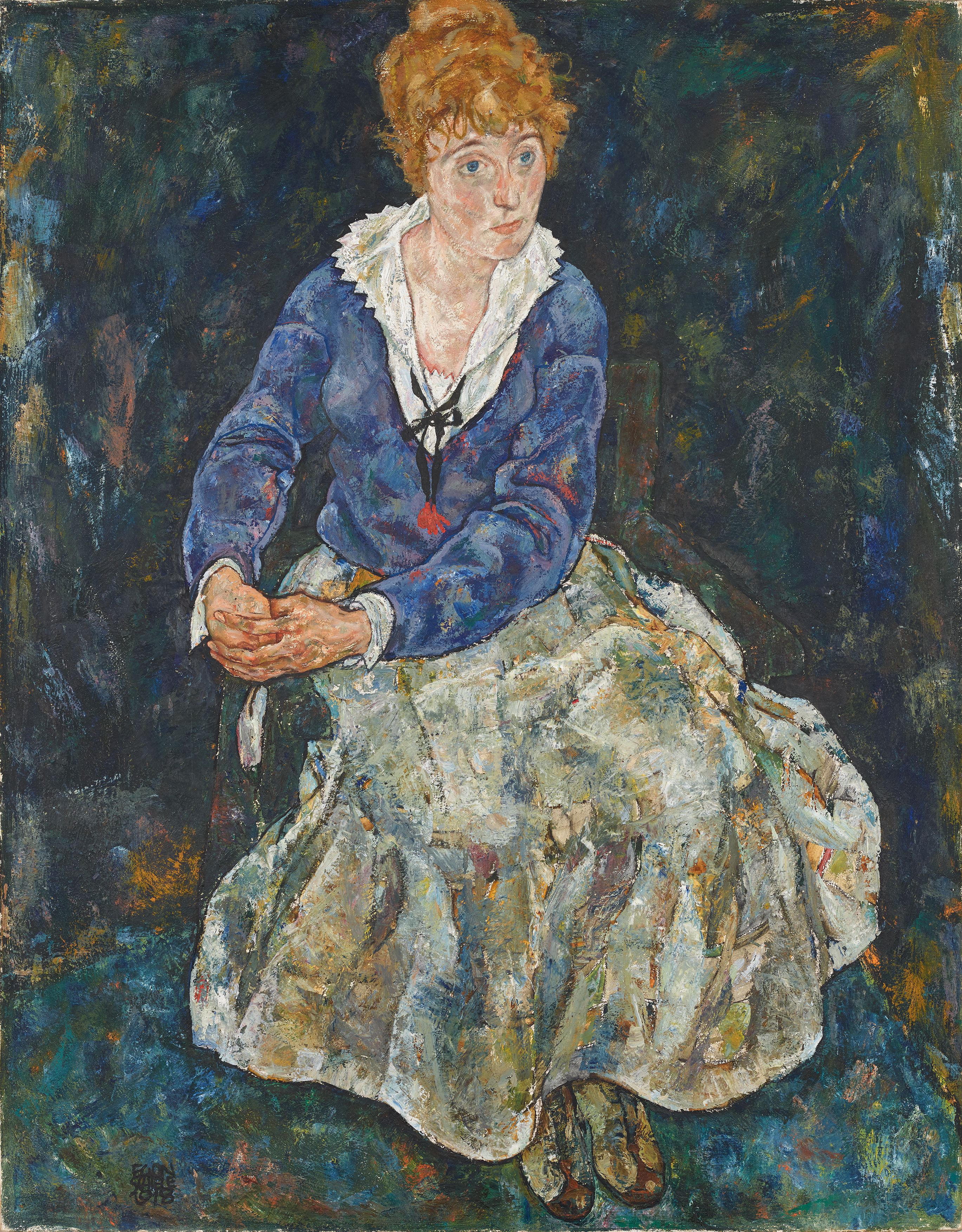
Portrait of the Artist’s Wife, Edith Schiele (Seated) is a painting by Egon Schiele from 1918: Edith Schiele sits on a dark chair, her hands clasped in her lap, in a blue blouse with a white lace collar and a wide pale skirt. We paint it by hand in oils at the size you choose, and before dispatch we send you a photograph of the finished work for approval.
| Title: | Portrait of the Artist’s Wife, Edith Schiele (Seated) |
| Other titles: | Bildnis der Frau des Künstlers · Portret umetnikove žene |
| Painter: | Egon Schiele (1890–1918) |
| Year: | 1918, signed and dated lower left “EGON / SCHIELE / 1918” |
| Original size (width × height): | 109.8 cm x 139.8 cm |
| Original technique: | Oil on canvas |
| Style: | Expressionism |
| Location: | Belvedere, Vienna |
| Our reproduction: | hand-painted oil on canvas, 13 sizes from 50 x 65 cm to 160 x 205 cm, or a made-to-measure size |
Portrait of the Artist’s Wife, Edith Schiele (Seated) – Egon Schiele
What does the painting show?
The Austrian painter shows his wife seated, from her head down to her shoes, against a dark ground. Her reddish-blonde hair is piled up high; her face is pale, her blue eyes look past us to one side, and her head leans slightly. The blouse is a deep blue, built from many small strokes of violet, red and green, with a white lace collar lying open at the neck and a narrow black ribbon that ends in a small red tassel. White cuffs show at the wrists, her hands are clasped above one knee, and a white handkerchief hangs from them. Below, a wide pale skirt fills most of the canvas, made of grey, cream, ochre and blue flecks. Two brown shoes show beneath the hem. The ground is a dark blue-green with flecks of orange and ochre, and the signature and year stand at the lower left.
Why do people love it?
Because of the contrast between calm and a lively surface. She sits still, hands clasped, yet hardly any area of the picture is still: the skirt, the blouse and the ground are all made of small, visible strokes. The strong blue of the blouse and the reddish hair carry the colour, while the pale skirt lights up the lower half of the canvas. It is a quiet, personal portrait rather than a dramatic one, which makes it easy to live with – in a living room, a bedroom or a hallway you walk through every day.
Where does it sit among Schiele’s works?
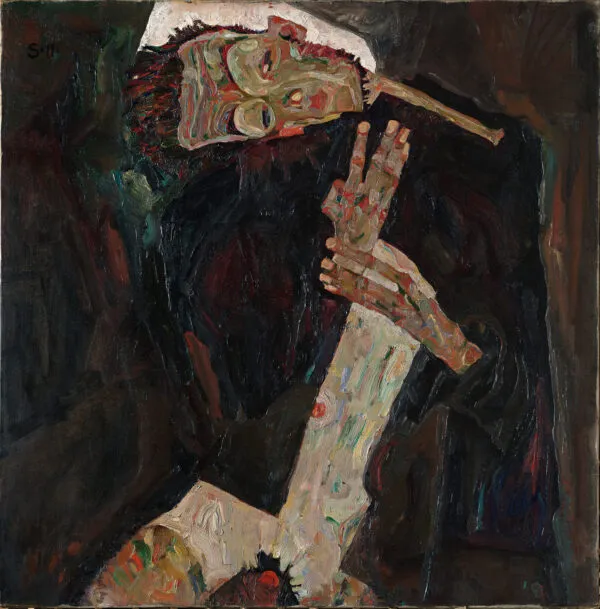
Among the other Schiele works in our shop, you can compare it with Portrait of Herbert Reiner (Reiner Boy), The Lyricist and Cardinal and Nun (Caress); if you are choosing between them, open them side by side. The full selection is in the Egon Schiele gallery, with more on his life in our article about Egon Schiele.
How is our hand-painted version made?
One of our artists paints it by hand in oils, stroke by stroke, for your order – it is not a print. Three places decide the result. The first is the skirt: it has to read as one pale mass and still be built from many small strokes, or it turns into a flat white patch. The second is the face, with its pale skin and the sideways look of the blue eyes; if the eyes shift even slightly, the expression changes. The third is the ground, which must stay broken up in blue, green and ochre instead of settling into an even dark colour. Any painter is tempted to smooth these surfaces; we keep them rough, as they are in the original. The original is oil on canvas, and so is ours. When it is finished we photograph it and send you the photograph for approval, and only then does it ship. This work has not yet been photographed in our workshop.
Which size for which wall?
Short answer: this is a whole figure with a wide skirt, so it suits a generous size. We offer it in thirteen sizes, from 50 x 65 cm to 160 x 205 cm. In a hallway or a bedroom, 60 x 75 cm or 70 x 90 cm; above a chest of drawers or a sideboard, 80 x 100 cm or 90 x 115 cm; above the sofa in a living room, 110 x 140 cm or 120 x 150 cm; on a large wall or in a stairwell, 140 x 180 cm or 160 x 205 cm. A canvas painting of this size needs some distance: close up you see the single strokes in the skirt and the ground, and the figure comes together from a few steps away. A hand-painted painting hangs best with its centre at eye level, roughly 145–150 cm from the floor; above a sofa, 15–25 cm above the backrest.
Custom size, stretcher bar and frame
If none of the thirteen sizes suits your wall, we paint the work to your own measurement. If you choose “YES” under the Stretcher option, the canvas comes stretched on a wooden stretcher bar, ready to hang. Our 3D application is for choosing a frame only, not for showing the work on your wall. The frame is chosen separately and need not be part of the order.
Delivery and guarantee
We paint to order and deliver to sixteen countries in the European Union, among them Slovenia, Croatia, Austria, Italy, Hungary, Germany and France; the United Kingdom and Ireland are not currently among them. The work travels protectively packed. Before dispatch we send you a photograph of the finished work to approve. Production time depends on the size and on the studio’s workload. Every order is covered by our Returns and Refund Policy.
Frequently asked questions
Who was Edith Schiele?
Edith Schiele, born Edith Harms (1893–1918), lived with her parents and her sister Adele in Hietzing in Vienna, across the street from Schiele’s studio. The two grew close in 1914 and married on 17 June 1915, shortly before he entered military service.
When did Schiele paint this portrait of Edith?
In 1918, three years after the wedding; it is signed and dated lower left “EGON / SCHIELE / 1918”. Schiele showed the first version at the 49th exhibition of the Vienna Secession in 1918, and it was sold soon afterwards.
Why did Schiele repaint Edith’s skirt?
The buyer, Franz Martin Haberditzl, director of today’s Belvedere, is said to have found the first version too arts-and-crafts and too bright, and to have asked for changes. The skirt, originally in warm colours with a checked pattern, became greyish blue and white, and the orange top turned a cool blue. A technical analysis in 2018 brought the first version to light again, and the Belvedere has reconstructed it.
Where is the portrait of Edith Schiele today?
In the Belvedere in Vienna. It was bought in 1918 through the Viennese art dealer Gustav Nebehay; Haberditzl was the first to acquire a painting by Schiele for an Austrian museum while Schiele was still alive.
What happened to Edith Schiele?
She died of the Spanish flu on 28 October 1918, six months pregnant. Egon Schiele caught the same illness and died three days later, on 31 October 1918, aged 28.
Does it work as a gift?
Yes; if you are unsure which size to choose, there is a gift voucher.