



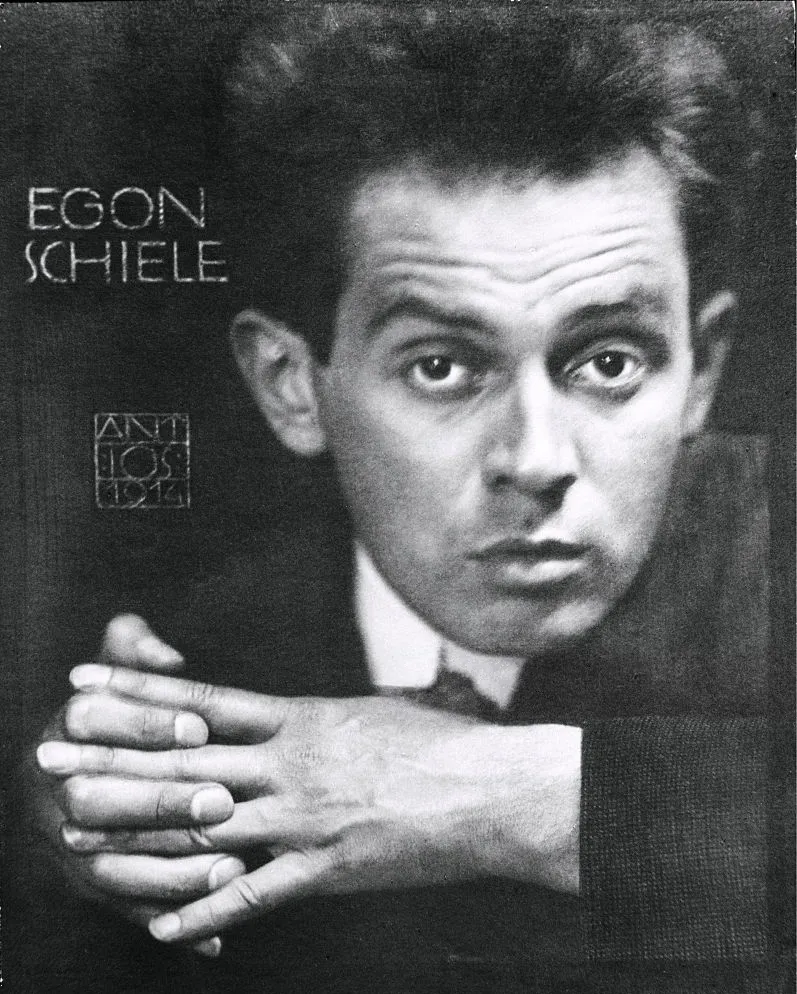
Egon Schiele (1890–1918) was an Austrian painter and one of the most important figures of Expressionism. In barely a decade of work he arrived at a style you recognise at once – a sharp, nervous line and a raw honesty that changed portrait painting for good. His motifs are among our hand-painted reproductions on canvas.
Every Schiele work here is hand-painted in oils on canvas, made to order, in any size you choose. Browse all hand-painted Egon Schiele reproductions on canvas.
Most searched Schiele paintings
- The Embrace – Lovers II (Die Umarmung)
- The Port of Trieste
- Portrait of Herbert Reiner (Reiner Boy)
- Portrait of the Artist’s Wife, Edith Schiele (Seated)
- Four Trees
- Cardinal and Nun (Caress)
- Reclining Woman
- Squatting Couple (The Family)
- The Lyricist
- Portrait of Wally Neuzil
- Town among Greenery (The Old City III)
- Young Mother
Life: from Tulln to Vienna
Schiele was born in 1890 in Tulln on the Danube. At sixteen he was admitted to the Academy of Fine Arts in Vienna, and in 1907 he met Gustav Klimt, who became his mentor and his advocate. In 1909, with like-minded friends, he founded the Neukunstgruppe and broke away from academic tradition. The frankness of his work made him controversial in his own time; today he is counted among the greatest draughtsmen in the history of art. He died in October 1918, only 28 years old, in the Spanish flu epidemic – three days after his wife Edith.
Style: the line as confession
Schiele’s style is unmistakable: a broken, taut line, angular bodies, emphatic hands, and gazes that do not let the viewer go. He used colour sparingly and deliberately – earth tones with sudden accents of red and ochre. His landscapes and townscapes carry the same language over to houses and trees: in Schiele’s hands a town is a portrait too.
Best-known works
Among Schiele’s best-known paintings are his self-portraits, the portrait of his wife Edith and of his friends, and landscapes such as Four Trees, Town among Greenery and the House Walls. The largest collection of his work is held by the Leopold Museum in Vienna, with important paintings at the Belvedere. The portraits of Wally Neuzil, Trude Engel and Paris von Gütersloh rank among the high points of Expressionist portraiture. For comparison with the most established names in painting, see our guide to the world’s most famous artworks.
Frequently asked questions about Egon Schiele
Who was Egon Schiele?
An Austrian Expressionist painter (1890–1918), Klimt’s protégé and one of the most influential portraitists of the 20th century. Despite his short life he produced more than three hundred paintings and thousands of drawings.
What did Schiele paint?
Above all portraits and self-portraits in his characteristically sharp line, together with landscapes and townscapes – among the best known are Four Trees, Town among Greenery and the House Walls.
Where are Schiele’s originals?
The largest collection is at the Leopold Museum in Vienna; important paintings are also held by the Belvedere in Vienna and by museums around the world.
Can I buy a hand-painted reproduction of a Schiele painting?
Yes. Our online gallery offers hand-painted reproductions of Schiele’s paintings on canvas in the size you choose.Before delivery you receive a photo of the painting for approval – on request we adjust it (colours, details) and ship only once you approve.