







































Description
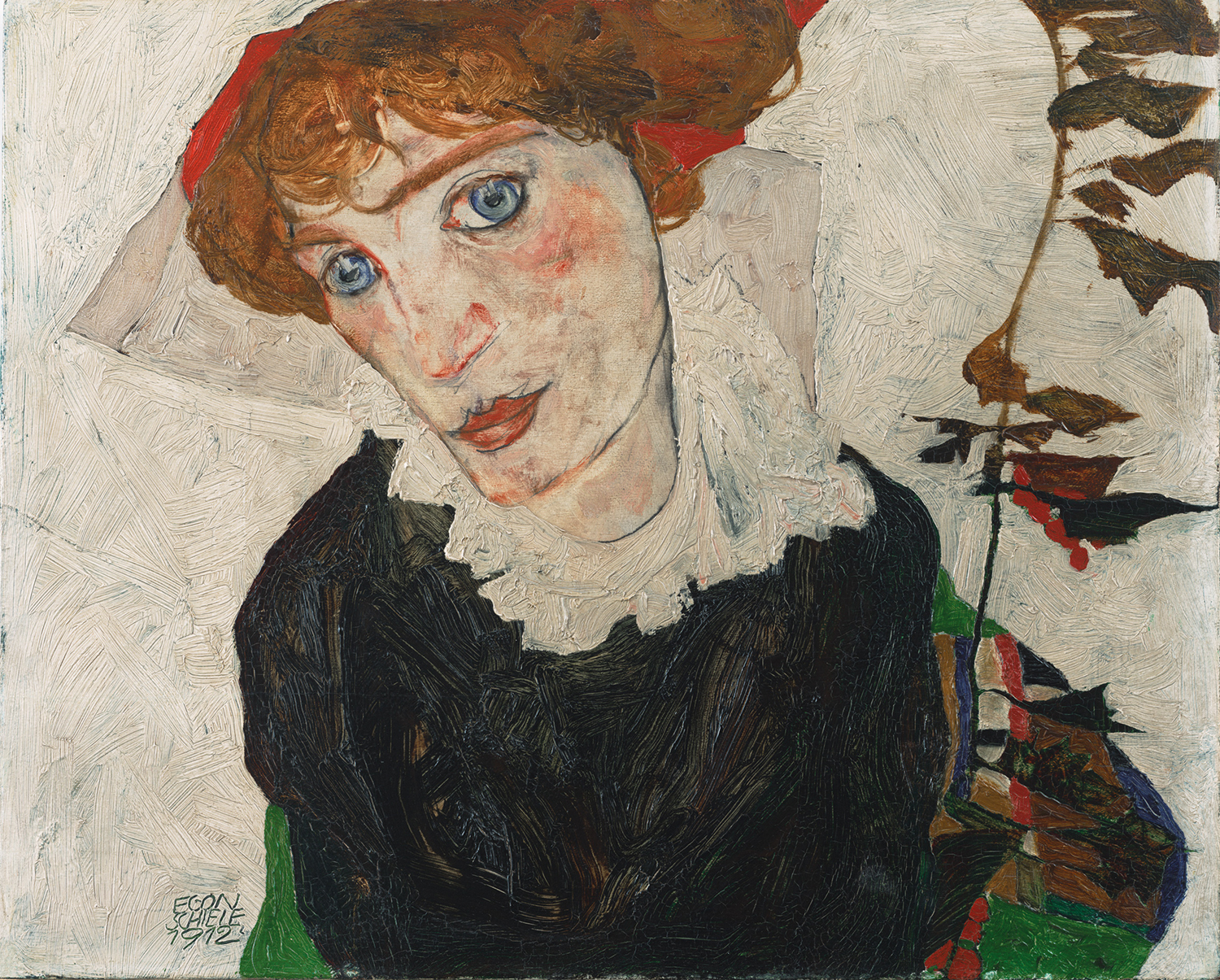
Portrait of Wally Neuzil is a 1912 work by Egon Schiele: a half-length portrait of his long-term partner on a small wooden panel, with large blue eyes, reddish-blond hair and a white frilled collar above a dark garment. The original is held by the Leopold Museum in Vienna under inventory number 453; it measures 39.8 x 32 cm and is in landscape format. We paint it by hand in oils, in fifteen sizes or to your own measurement, and before dispatch we send you a photograph of the finished work for approval.
| Title: | Portrait of Wally Neuzil |
| Other titles: | Bildnis Wally Neuzil · Portret Wally Neuzil · Weibliches Bildnis mit Blumenranke |
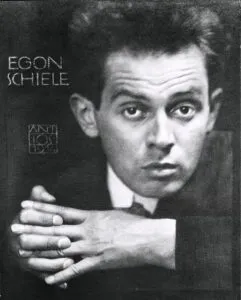
| Painter: | Egon Schiele (1890–1918) |
| Year: | 1912, signed and dated lower left “EGON SCHIELE 1912” |
| Original size (width × height): | 39.8 cm x 32 cm (the museum does not label the axes; landscape format) |
| Original technique: | Oil on wood |
| Style: | Expressionism |
| Location: | Leopold Museum, Vienna (inv. 453) |
| Our reproduction: | hand-painted oil on canvas, 15 sizes from 40 x 32 cm to 200 x 160 cm, or a made-to-measure size |
Portrait of Wally Neuzil – Egon Schiele
Who is in the painting?
Wally Neuzil, in full Walburga Neuzil (1894–1917), the long-term partner of Egon Schiele (1890–1918). The Austrian painter portrayed her on this panel in 1912. According to the museum’s text the two remained in touch until the spring of 1915, even though Schiele had already turned in 1914 to his future wife, Edith Harms (1893–1918).
What is on the wooden panel?
A young woman shown to the chest, her head tilted slightly to one side. Her hair is thick and reddish-blond, with two red patches showing through it at the crown. The eyes are disproportionately large and blue, ringed with a dark line; there are pink and reddish patches on the cheeks, nose and chin, and the lips are red and slightly parted. Below the neck is a white frilled collar, and under it a dark, almost black garment laid on in broad strokes. Down the right edge a thin tendril with pointed leaves in browns and olives runs from the top, dotted with small red and dark blue marks. The ground is creamy white, built entirely from short crossing strokes that stay visible. The tendril is no afterthought: the 1925 catalogue of the Vienna gallery Würthle, which the museum cites among its sources, lists the work as “Weibliches Bildnis mit Blumenranke” – a female portrait with a flowering tendril.
Why does this painting matter?
For two reasons. The first is the pair it belongs to. Schiele painted it as the counterpart to his self-portrait with Chinese lantern plants, also of 1912, also on wood and almost exactly the same size – 32.2 x 39.8 cm against 39.8 x 32 cm. The second is what happened to the panel after 1938. From 1998 to 2010 it was the subject of court proceedings in New York, which is why it is known well beyond art history.
What does the painting mean?
In the museum’s reading, it is about closeness. The portrait exudes intimacy and tender affection and so testifies to the close bond between the two lovers; the landscape format emphasises its connection with the self-portrait conceived as its counterpart, and therefore the connection between two people whose emotional expressions complement each other in the two compositions. The museum also points to form: with its attention to basic geometric shapes and its harmonious combination of colours, the work skilfully balances tension and calm. As an expressionist painting it exaggerates not the gesture but the eyes.
Where does the work come from, and why was it disputed?
The Leopold Museum publishes its own provenance research, listing the owners. It begins with Emil Toepfer and Richard Lanyi, both of Vienna, then the art dealer Lea Bondi Jaray (1880–1969), who held the work from before 1925 until 1939. Next come Friedrich Welz in Salzburg (1939–1944) and the Salzburg regional gallery (1944–1945). In 1945 the US occupying forces secured the panel, and in 1947, according to this chain, it was handed to the Province of Salzburg; the settlement text on the same page names the Austrian Federal Office for the Preservation of Historical Monuments for that step. Then come Dr Robert Rieger and Tana Berger in New York (1948), the Österreichische Galerie Belvedere (1950–1954), Dr Rudolf Leopold (1954–1994) and, since 1994, the Leopold Museum Private Foundation.
The museum also publishes the text agreed in the July 2010 settlement. The panel was the personal property of Lea Bondi Jaray, a Jewish art dealer and owner of the Galerie Würthle in Vienna. In April 1938 she was forced to hand the gallery over to Friedrich Welz, and in 1939 she fled the Nazis to London. The Leopold Museum lent the panel in 1997 to the Museum of Modern Art in New York; in 1999 the United States Government began a civil forfeiture action. In 2009 the United States District Court in New York concluded that the panel had been her property and was stolen from her in Vienna in the late 1930s by Welz, a member of the NSDAP, when he took over her gallery as part of “Aryanization”. The court also found that US forces seized the panel from Welz after the war and in 1947 delivered it to the Federal Office for the Preservation of Historical Monuments, together with works Welz had acquired from Heinrich Rieger, a Jewish collector murdered in 1942 at the Theresienstadt concentration camp. In 1950 that office delivered works to an agent for the Rieger heirs and included this portrait; the heirs sold their works to the Belvedere later that year, and in 1954 the Belvedere traded the panel to Rudolf Leopold. The case ended in 2010 with the settlement summarised in the note below; the sum of USD 19 million was announced by the United States Attorney for the Southern District of New York in a press release of 20 July 2010.
Provenance and a long dispute
Its provenance runs from the Vienna dealer Lea Bondi Jaray to the Nazi collector Friedrich Welz, who obtained it in 1939 during “Aryanization”, and later to Rudolf Leopold. In 1998 the painting was seized by US authorities while on loan to MoMA in New York; the dispute was only settled in July 2010, when the Leopold Museum paid the Bondi estate USD 19 million and kept the work.
Where does this work sit among Schiele’s works?
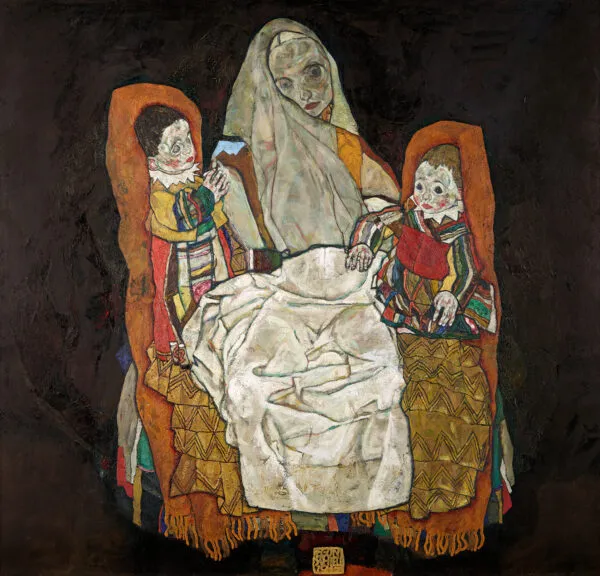
Among the small wooden panels of 1912. Closest to it is its counterpart, Self-Portrait with Physalis: the same year, the same support, almost the same size and today the same collection, where the museum lists it as Self-Portrait with Chinese Lantern Plant under inventory number 454. From the same year and the same collection comes Cardinal and Nun (Caress), though painted on canvas and considerably larger, at 70 x 80.5 cm. A year earlier, in 1911, came The Lyricist, and from 1917 the landscape Four Trees, which the Belvedere restituted in 2020 and which is now in private hands. The full selection is in the Egon Schiele gallery, with more on his life in our article about Egon Schiele.
How is our hand-painted version made?
A painter works every canvas in oils, stroke by stroke: a hand-painted copy made for your order, not a machine print. Two passages are the hardest here. The first is the eyes: large, blue and set a little differently from where anatomy would put them, and anyone who “corrects” them loses what the face is known for. The second is the ground, which is not smooth but built from short crossing strokes; those must stay visible at a large size, or a blank wall opens up behind the head. The original is painted on wood, our copy in oil on canvas; panel and stretched canvas behave differently, and we do not present them as the same. When the work is finished we photograph it and send you the photograph for approval, and only then does it ship. We hold no workshop photographs of this work yet; we will add them to this page once we have them. Like every canvas we send, it can arrive stretched on a wooden stretcher bar; you choose that under the Stretcher option.
Which size for which wall?
Short answer: the original is so small that choosing a size means deciding how close the face should be. Closest to the original is our smallest size, 40 x 32 cm: it is just 2 mm wider and exactly as tall. All the other sizes are larger than the original. Above a chest of drawers or a desk, 65 x 52 cm and 75 x 60 cm work; above a sofa in a living room, 100 x 80 cm or 125 x 100 cm; on a large wall, a stairwell or in a tall room, 180 x 145 cm and 200 x 160 cm. A canvas painting at these sizes needs distance: close up, the strokes of the ground read one by one, and the face only assembles from a few metres away. A hand-painted painting hangs best with its centre at eye level, roughly 145–150 cm from the floor; above a sofa, 15–25 cm above the backrest.
Custom size, stretcher bar and frame
If none of the fifteen sizes suits your wall, we paint the work to your own measurement. If you choose “YES” under the Stretcher option, the canvas comes stretched on a wooden stretcher bar, ready to hang. Our 3D application is for choosing a frame only, not for showing the work on your wall; seeing it on your wall is a separate service. The frame is chosen separately and need not be part of the order.
Delivery and guarantee
We paint to order and deliver to sixteen countries in the European Union, among them Slovenia, Croatia, Austria, Italy, Hungary, Germany and France; the United Kingdom and Ireland are not currently among them. Before dispatch we send you a photograph of the finished work to approve. Production time depends on the size and on the studio’s workload. Every order is covered by our Returns and Refund Policy.
Frequently asked questions
Who was Wally Neuzil?
Walburga “Wally” Neuzil (1894–1917) was Egon Schiele’s long-term partner and for several years his model; she was 17 when they met in 1911. According to the Leopold Museum, the two stayed in touch until the spring of 1915, although Schiele had already turned to his future wife, Edith Harms, in 1914. Neuzil died in December 1917, aged 23.
When did Schiele paint Portrait of Wally Neuzil?
In 1912: the panel is signed and dated lower left “EGON SCHIELE 1912”. It is painted in oils on wood and measures only 39.8 x 32 cm, in landscape format.
Where is Portrait of Wally Neuzil today?
In the Leopold Museum in Vienna, under inventory number 453. Its counterpart, Schiele’s Self-Portrait with Chinese Lantern Plant of the same year, belongs to the same collection under inventory number 454.
Why was Portrait of Wally seized in New York?
In 1998, while the panel was on loan to the Museum of Modern Art, US authorities seized it: it had belonged to Lea Bondi Jaray, a Jewish art dealer in Vienna, and was taken from her in the late 1930s by the NSDAP member Friedrich Welz. The dispute ended only in July 2010, when the Leopold Museum paid USD 19 million to her estate and kept the work. The story is told in the 2012 documentary Portrait of Wally.
What does Portrait of Wally Neuzil mean?
For the Leopold Museum it is a picture of closeness: it exudes intimacy and tender affection and testifies to the bond between the two lovers. Schiele painted it as the counterpart to his self-portrait of the same year, also on wood and almost exactly the same size, so the two panels are meant to be read together.
Does it work as a gift?
Yes; if you are unsure which size to choose, there is a gift voucher.
- Subject: a half-length portrait of Wally Neuzil, large blue eyes, white frilled collar, dark garment, a tendril at the right edge.
- Original: 1912, oil on wood, 39.8 x 32 cm, signed lower left, Leopold Museum, Vienna, inv. 453.
- Ours: hand-painted in oils, 15 sizes or made to measure, stretched on a stretcher bar if you choose Stretcher: “YES”.
- Worth knowing: the portrait was conceived as the counterpart to the self-portrait with Chinese lantern plants; the museum says the landscape format emphasises that link.