


Description
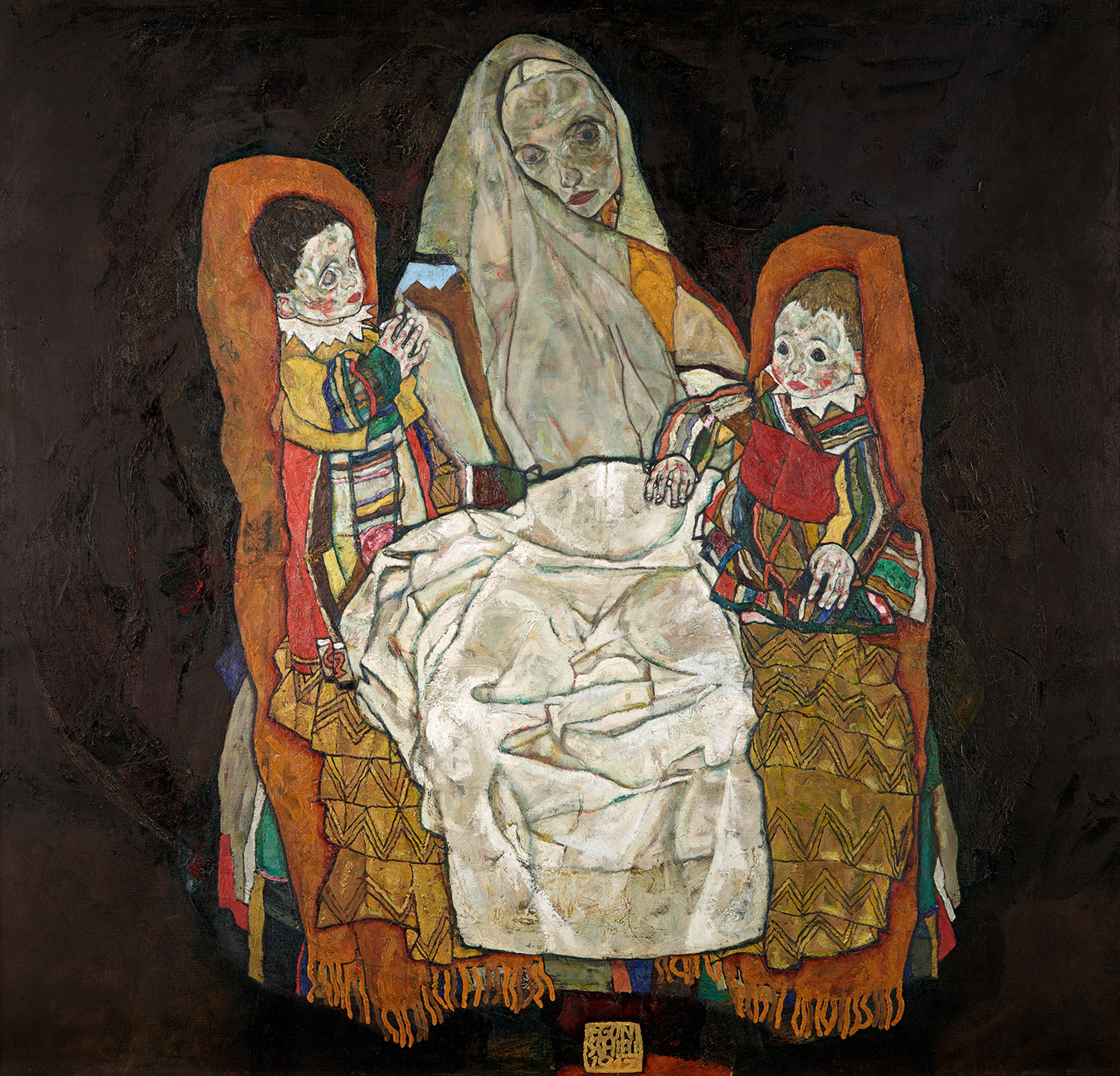
Mother with Two Children III is a large work by Egon Schiele, dated by the Belvedere to 1915–1917 and signed in 1917: a pale, veiled mother seated between two small children in brightly patterned clothes, against an almost black ground. The original is held by the Belvedere in Vienna under inventory number 4473; it measures 150 x 159.8 cm and is almost square. We paint it by hand in oils, in fourteen sizes or to your own measurement, and before dispatch we send you a photograph of the finished work for approval.
| Title: | Mother with Two Children III |
| Other titles: | Mutter mit zwei Kindern III · Mati z dvema otrokoma III |
| Painter: | Egon Schiele (1890–1918) |
| Year: | 1915–1917, signed and dated lower centre “EGON / SCHIELE / 1917” |
| Original size (width × height): | 150 cm x 159.8 cm (the museum does not label the axes) |
| Original technique: | Oil on canvas |
| Style: | Expressionism |
| Location: | Belvedere, Vienna (inv. 4473) |
| Our reproduction: | hand-painted oil on canvas, 14 sizes from 50 x 55 cm to 200 x 210 cm, or a made-to-measure size |
Mother with Two Children III – Egon Schiele
What does the painting show?
A mother and two small children, seen from the front and filling most of the canvas. The mother sits in the middle, wrapped in a pale grey veil that covers her head and shoulders, with a white cloth spread over her lap. On either side of her sits a child, each wrapped in a rust-orange shawl whose fringes hang down to the lower edge. The child on the left raises both hands in front of its chest and looks to one side; the child on the right looks straight out at the viewer. The Belvedere’s record names no sitters, and we name none either.
What is on the canvas?
Almost everything around the group is a dark, brownish black, laid on in loose strokes: no room, no furniture, no horizon. Against it the three figures form a single block of colour. The mother’s face is long and pale, with dark-ringed eyes and red lips; her head leans slightly to one side and her gaze falls downwards. Her veil is a thin greyish white, and the cloth over her knees is painted thickly, in creased white folds. The children’s faces are pale too, with red cheeks and lips, and each wears a white frilled collar. Their clothes are built from stripes and patches of red, green, yellow, blue and white; below them lie ochre and olive cloths patterned with zigzag lines. Behind the left child’s hands a small patch of light blue opens up. At the bottom centre, inside a small square, the signature and date stand in three lines – EGON / SCHIELE / 1917 – exactly as the museum records them.
Why does this painting matter?
For three reasons, each of them on the record. The first is its size: at 150 x 159.8 cm it is a large canvas, many times the size of the small wooden panels showing mothers that the Austrian painter made in 1910 and 1912 (see below). The second is its long public life. The Belvedere lists it in its own exhibitions from 1954 onwards: in the Austrian Gallery of the 19th and 20th Centuries in the Upper Belvedere, from July 1954; in “Egon Schiele Gemälde” in 1968; in the Schiele exhibition of 1990; in “Die Tafelrunde” in 2006; in the anniversary exhibition for 150 years of Gustav Klimt in 2012–2013; in “Klimt / Schiele / Kokoschka und die Frauen” in 2015–2016; and in the Schiele exhibition of 2018–2019. The third is its history: the question of whether it should be returned to the heirs of its former owner has been decided twice.
What does the painting mean?
The Belvedere’s object record gives no interpretation of this work, and we do not put one into the museum’s mouth. What the canvas itself sets out is a contrast. The mother is almost colourless – grey veil, white cloth, pale skin – while the two children carry nearly all the colour there is. Her eyes are lowered; one child turns aside and the other looks out of the canvas, so the three figures touch without meeting one another’s eyes. How much of that is meaning and how much is composition, the record does not say, and we leave the question open. What is on record is the dating: the museum gives 1915–1917, while the signature carries 1917 alone.
Where does the work come from, and why was it claimed back?
The Belvedere’s record gives the owners in three entries: Karl Grünwald in Vienna; from 1930 Jenny Steiner in Vienna; and in 1951 a purchase from Jenny Steiner, by then in New York. Between the second and the third entry lie the Nazi years and the painting’s return to Jenny Steiner in November 1950; the first note below sets out that part of the chain. After the sale her heirs asked for the work back, and Austria’s Art Restitution Advisory Board ruled on the claim twice, in 2000 and in 2010. In its decision of 8 October 2010 the Board recorded that Jenny Steiner never applied for an export licence and that the sale was not brought about by an export procedure. The second note below summarises what the Board decided.
A Jewish collection lost under the Nazis
The painting comes from the collection of the Jewish art dealer Karl Grünwald, who in 1930 sold it to Jenny Steiner, a Jewish collector and silk-factory owner in Vienna. After the annexation of Austria in 1938 Steiner was persecuted and her collection seized; this work carried the stigma of “degenerate art” and was held in Vienna in the custody of the Reich Chamber of Fine Arts. In November 1950 it was restituted to Jenny Steiner; she — then living in New York — sold it to the Belvedere in 1951 for 20,000 Schilling, having never applied for an export licence.
The restitution claim and the Board’s decision
The heirs of Jenny Steiner later claimed the painting back. The Austrian Art Restitution Advisory Board (Kunstrückgabebeirat) declined to return it — in 2000 and again on 8 October 2010 — finding that the 1951 sale rested on the owner’s free will and that the price was fair by the standards of the time. The painting remains in the Belvedere collection.
Where does this work sit among Schiele’s works?
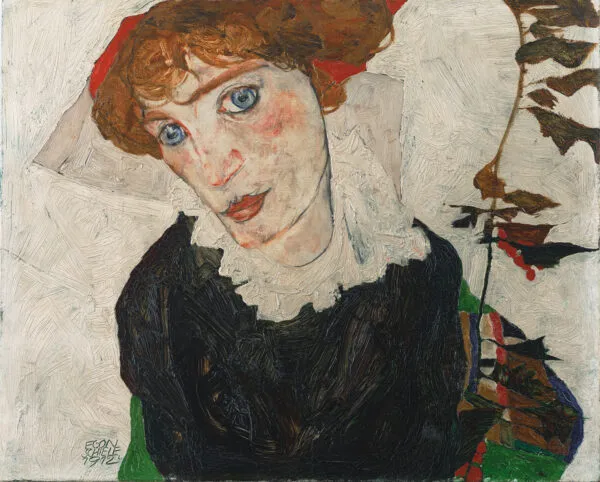
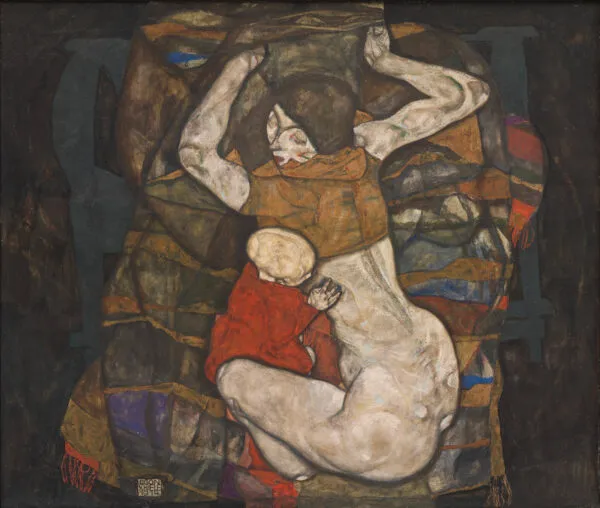
Among his late works: the museum dates it to 1915–1917, the last years before Schiele’s death in 1918. On our shelf it stands beside three other works about mothers. Two of them are small wooden panels in the Leopold Museum in Vienna: Mother and Child of 1912, in oil on wood at 36.5 x 29.2 cm, and Dead Mother I of 1910, in oil and pencil on wood at 32.1 x 25.7 cm. Set beside them, Mother with Two Children III shows how far the subject had grown in scale. The third is Young Mother, which completes the group. The full selection is in the Egon Schiele gallery, with more on his life in our article about Egon Schiele.
How is our hand-painted version made?
A painter works every canvas in oils, stroke by stroke: a hand-painted copy made for your order, not a machine print. Two passages are the hardest here. The first is the contrast between the mother and the children: the veil and the white cloth must stay pale and full of greys rather than turn into a flat white, while the children’s striped clothes keep every colour separate. The second is the dark ground, which is not an even black but a brownish surface of visible strokes; painted too smoothly, it would leave the group floating in a void. The original is painted on canvas, and so is our copy. When the work is finished we photograph it and send you the photograph for approval, and only then does it ship. This work has not yet been photographed in our workshop; we will add photographs to this page once we have them. Like every canvas we send, it can arrive stretched on a wooden stretcher bar; you choose that under the Stretcher option.
Which size for which wall?
Short answer: the original is large, so on most walls the question is how much of the wall the group should fill. The museum gives 150 x 159.8 cm without saying which side is the height; closest to it is our 150 x 160 cm, which matches the original on one side and is 2 mm longer on the other. For a narrow wall or a hallway, 60 x 65 cm or 70 x 75 cm is enough; above a chest of drawers or a desk, 80 x 85 cm or 90 x 95 cm; above a sofa in a living room, 120 x 130 cm or 130 x 140 cm; on a large wall, a stairwell or in a tall room, 160 x 175 cm, 180 x 195 cm or our largest size, 200 x 210 cm. A canvas painting at these sizes needs distance: close up, the patches of the children’s clothes read one by one, and the three faces only come together from a few metres away. Hang it with its centre at eye level, roughly 145–150 cm from the floor, or 15–25 cm above the backrest of a sofa.
Custom size, stretcher bar and frame
If none of the fourteen sizes suits your wall, we paint the work to your own measurement. If you choose “YES” under the Stretcher option, the canvas comes stretched on a wooden stretcher bar, ready to hang. Our 3D application is for choosing a frame only, not for showing the work on your wall; seeing it on your wall is a separate service. The frame is chosen separately and need not be part of the order.
Delivery and guarantee
We paint to order and deliver to sixteen countries in the European Union, among them Slovenia, Croatia, Austria, Italy, Hungary and Germany; the United Kingdom and Ireland are not currently among them. Before dispatch we send you a photograph of the finished work to approve. Production time depends on the size and on the studio’s workload. Every work travels protectively packed. Every order is covered by our Returns and Refund Policy.
Frequently asked questions
Who are the mother and children in Mother with Two Children III?
A mother seated between two small children, all three seen from the front. The Belvedere’s record names no sitters, so this page names none either. The mother is wrapped in a pale grey veil with a white cloth over her lap, and each child wears a rust-orange shawl over brightly patterned clothes.
Where is the original of Mother with Two Children III?
In the Belvedere in Vienna, under inventory number 4473. The museum bought it in 1951 from Jenny Steiner, who was then living in New York. The canvas is large and almost square, 150 x 159.8 cm.
When did Schiele paint Mother with Two Children III?
The Belvedere dates it to 1915–1917, while the signature at the bottom centre gives 1917 alone. These are the last years before Schiele’s death in 1918.
Why was Mother with Two Children III claimed back?
Jenny Steiner, a Jewish collector in Vienna, lost her collection after the annexation of Austria in 1938; the painting was restituted to her in November 1950, and in 1951 she sold it to the Belvedere. Her heirs later asked for it back. Austria’s Art Restitution Advisory Board declined in 2000 and again in 2010, finding that the sale rested on her free will at a fair price for the time, so the painting remains in the Belvedere.
Is there a Mother with Two Children II?
Yes. Schiele returned to the mother-and-child theme again and again from 1910, and a painting titled Mother with Two Children II, dated 1915, is in the Leopold Museum in Vienna. In it the mother is wrapped in green cloth against a brownish-yellow ground.
How are the colours spread in Mother with Two Children III?
Almost all of the colour belongs to the children: their clothes are built from stripes and patches of red, green, yellow, blue and white. The mother stays nearly colourless – grey veil, white cloth, pale skin – and the ground around the group is a loosely brushed, brownish black. Each copy on this page is a hand-painted painting that keeps that contrast, with the veil pale but full of greys.
Does it work as a gift?
Yes; if you are unsure which size to choose, there is a gift voucher.
- Subject: a veiled mother between two small children in patterned clothes and rust-orange shawls, against an almost black ground.
- Original: 1915–1917, oil on canvas, 150 x 159.8 cm, signed and dated lower centre, Belvedere, Vienna, inv. 4473.
- Ours: hand-painted in oils, 14 sizes or made to measure, stretched on a stretcher bar if you choose Stretcher: “YES”.
- Worth knowing: the Belvedere has shown the painting in its own exhibitions since 1954; its ownership history is set out in the two notes above.