


Description
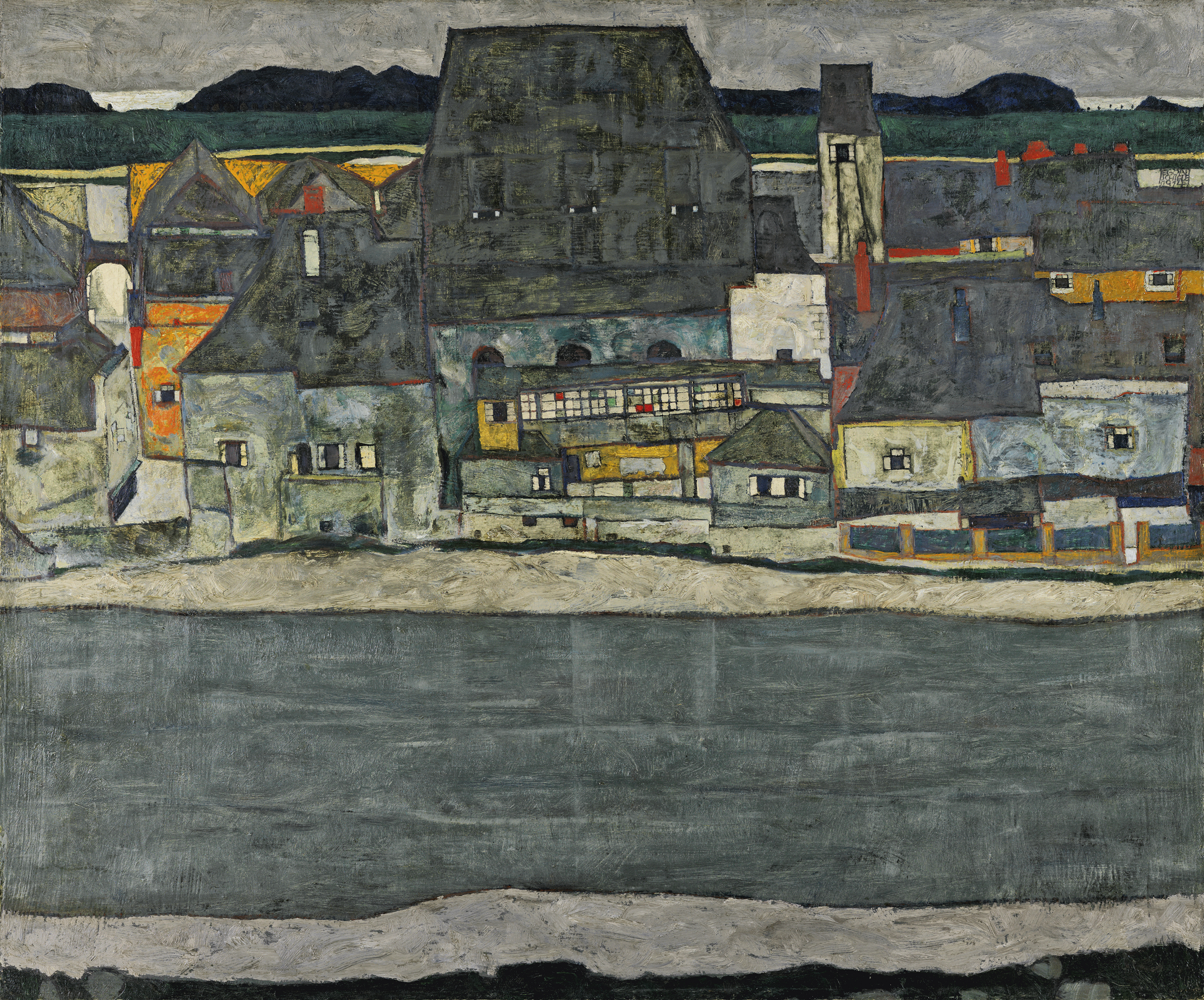
Houses on the River (The Old Town) is a work of 1914 by Egon Schiele: a close-packed row of houses above a broad grey river, with no sky and no people. The original is in the Museo Nacional Thyssen-Bornemisza in Madrid under inventory number 739; it measures 120.5 x 100 cm and is an oil on canvas. We make it as a hand-painted oil painting on canvas, in fifteen sizes or to your own measurement, and we send you a photograph of the finished work for approval before it ships.
| Title: | Houses on the River (The Old Town) |
| Other titles: | Hiše ob reki (Staro mesto) · Häuser am Fluss (Die alte Stadt) |
| Painter: | Egon Schiele (1890–1918) |
| Year: | 1914 |
| Original size (width × height): | 120.5 cm x 100 cm |
| Original technique: | Oil on canvas |
| Style: | Expressionism |
| Location: | Museo Nacional Thyssen-Bornemisza, Madrid (inv. 739, formerly 1978.81), Room 34 |
| Our reproduction: | hand-painted oil on canvas, 15 sizes from 50 x 40 cm to 205 x 164 cm, or a made-to-measure size |
Houses on the River (The Old Town) – Egon Schiele
What does the work show?
A town at the water, seen from the far bank. The upper two thirds of the canvas are filled with houses: white, grey and brownish walls, roofs in dark grey and brown, a few red and yellow planes among them, and small windows that are mostly no more than dark rectangles. In the middle of the row a taller, almost black building rises with three rows of windows, and to left and right the lower houses line up into an almost unbroken band. Above the roofs runs a narrow dark edge of the bank; there is hardly any sky. Below the houses lies a broad band of still grey-green water that takes the bottom third of the work and reflects nothing at all. There is no one in the scene.
Which town is this?
Krumau, today Český Krumlov in the Czech Republic. The museum record says so explicitly and adds that the work was for a long time wrongly identified as a view of Wachau in Lower Austria, until it was later shown to be Krumau. The same record says that this was the village where Schiele’s mother was born, that he visited it in the summer of 1910 with friends, among them Anton Peschka, and that in 1911 he moved there with his model Wally Neuzil.
Why does the town look so flat?
Because it is built that way. Per the museum record the composition lacks perspective and is designed as a flat frieze, which has sometimes been related to the stained glass windows and Gothic miniatures that fascinated Schiele and the German Expressionists. The record goes further: a comparison with the buildings standing today shows that the painter was not concerned with faithfully reproducing the row along the river — he altered the proportions of the roofs and inserted a tower that does not exist. That is the reading of the museum that holds the work, and we give it as theirs.
Why is nobody in the streets?
The museum record makes exactly that point: the image of a deserted, spooky town with no trace of human life gives the composition a melancholic air infused with a certain anxiety — the anxiety Schiele captured so successfully in his portraits. The record also cites Kimberly A. Smith, who called such landscapes “melancholic elegies exhibiting a readily perceptible fascination with death”. We leave the citation in her words and do not extend it.
What is the original painted on?
On canvas, in oils. Our reproduction is likewise in oils and is made on canvas, the same kind of support as the original.
Is the format upright or horizontal?
Horizontal. Our steps follow it in a landscape format, from 50 x 40 cm to 205 x 164 cm, with the width given first.
Can I have it at the size of the original?
Not exactly, and this is the place to be plain about it: none of our steps matches the original’s proportion within a centimetre. Its ratio of sides is 1 : 1.205, and every one of our steps is a little more elongated. The closest are 80 x 65 cm and 50 x 40 cm, both about a centimetre and a half out; the rest are three to eight centimetres out. By size the nearest step is 120 x 95 cm, half a centimetre narrower and five centimetres shorter than the original. If you want the original’s proportion or its size, choose a made-to-measure size.
Where does the work come from and where is it now?
The chain is published by the museum and we give it as theirs. The first owner was the Viennese collector Franz Hauer, whom Schiele — like Kokoschka — portrayed in 1914, the year of this painting. Mr and Mrs Mortimer M. Denker gave the work to the Solomon R. Guggenheim Museum in New York in 1965, and it entered the Thyssen-Bornemisza Collection in 1978. Today it is in Madrid, in Room 34 of the permanent collection, under inventory number 739; the record also carries the older mark 1978.81. The reading beside the chain is ours: the record does not say how the work passed from Hauer to the Denkers, and we do not assume it.
Where does this work sit among Schiele’s works?
Among the views of Krumau he painted over several years. From the same year is Krumau on the Vltava (The Small Town IV), also a view of that town from above; from 1917 comes Town among Greenery (The Old City III), and a year after this painting he made House Wall on the River. The full selection is in the Egon Schiele gallery, with more on his life in our article about Egon Schiele; the painter’s works in the Madrid collection are listed on the Thyssen-Bornemisza page for Egon Schiele. Schiele was a younger contemporary of Gustav Klimt, and the Vienna Secession was the milieu he came out of; Viennese Expressionism is the movement he helped define, and Austrian art of those years is still read through those two names. As an expressionist painting it shows the town as a wall, not as a stage.
How is our hand-painted version made?
Every canvas is painted by an artist in oils, stroke by stroke – not a machine impression but a hand-painted copy made for your order. Two things are hardest here. The first is the water: a large band that has to stay still and yet not uniform, or the bottom third of the work becomes an empty plane. The second is the windows: small dark rectangles in varying sizes that give the row its rhythm; make them equal and the town turns into a pattern. When the work is finished we photograph it and send you the photograph for approval, and only then does it ship. We hold no studio photographs of this work yet – it has not been photographed in our workshop, and nothing has been removed; when it is painted, the images will be added here. As a canvas reproduction it arrives stretched on a wooden bar, ready to hang.
Which size suits which wall?
Short answer: a wider wall, because the motif is built from horizontal bands. Above a desk or in a hallway 65 x 51 cm or 70 x 55 cm; above a sofa or a sideboard 100 x 80 cm or 120 x 95 cm; in a larger room 150 x 120 cm and up to 205 x 164 cm. Our smallest size is 50 x 40 cm. As a canvas painting full of small windows it opens up with size: at the larger steps you can see that no window is quite like another.
How do I order a made-to-measure size, stretcher bar and frame?
If none of the fifteen sizes suits your wall, we paint the work to your own measurement. The canvas comes stretched on a wooden bar; our 3D application is for choosing a frame only, not for showing the work on your wall. The frame is chosen separately and need not be part of the order.
How is it delivered and what do we guarantee?
We paint to order and deliver to sixteen countries in the European Union, among them Germany, France, Italy, the Netherlands and Poland; the United Kingdom and Ireland are not currently among them. Before dispatch we send you a photograph of the finished work for approval, and if you are not satisfied we correct the work or paint it again. Production time varies with the size and the studio’s workload.
Frequently asked questions
Which town did Schiele paint in Houses on the River (The Old Town)?
Krumau, today Český Krumlov in the Czech Republic, a small town on the Vltava in southern Bohemia. The record of the Museo Thyssen-Bornemisza notes that the work was long taken for a view of Wachau in Lower Austria before it was identified as Krumau. It was also the town where Schiele’s mother was born.
Why did Schiele paint Krumau so often?
He knew the town through his mother, visited it in the summer of 1910 with friends, among them Anton Peschka, and in 1911 moved there with his model Wally Neuzil. The stay ended that same year, because the townspeople disapproved of the couple’s way of life. Schiele still returned to Krumau as a motif for years, and since 1993 the Egon Schiele Art Centrum in Český Krumlov has shown his work in the town.
Did Schiele paint the town as it really looks?
Not exactly. According to the museum record, a comparison with the buildings standing today shows that the painter altered the proportions of the roofs and inserted a tower that does not exist. Like most of his town views, the composition has no real perspective and is built as a flat frieze, which has been compared with stained glass and Gothic miniatures.
Why are there no people in Houses on the River (The Old Town)?
The museum record reads the deserted town, with no trace of human life, as giving the composition a melancholic air infused with a certain anxiety, the same anxiety Schiele captured in his portraits. It also quotes Kimberly A. Smith, who called such landscapes “melancholic elegies” marked by a fascination with death. Even the broad band of river below the houses reflects nothing.
Where is Houses on the River (The Old Town) today?
In the Museo Nacional Thyssen-Bornemisza in Madrid, in Room 34, under inventory number 739. The canvas is painted in oils and measures 120.5 x 100 cm. Its first owner was the Viennese collector Franz Hauer; Mr and Mrs Denker gave it to the Guggenheim Museum in New York in 1965, and it entered the Thyssen-Bornemisza Collection in 1978.
Does it work as a gift?
It does; if you are unsure which size to choose there is a gift voucher.
- Subject: a close-packed row of houses above still water, with no sky and no people.
- Original: 1914, oil paint on canvas, 120.5 x 100 cm, Thyssen-Bornemisza, Madrid, inv. 739.
- Ours: hand-painted in oils on canvas, 15 sizes or a made-to-measure size.
- Worth knowing: per the museum record the painter inserted a tower that does not exist.