



Description
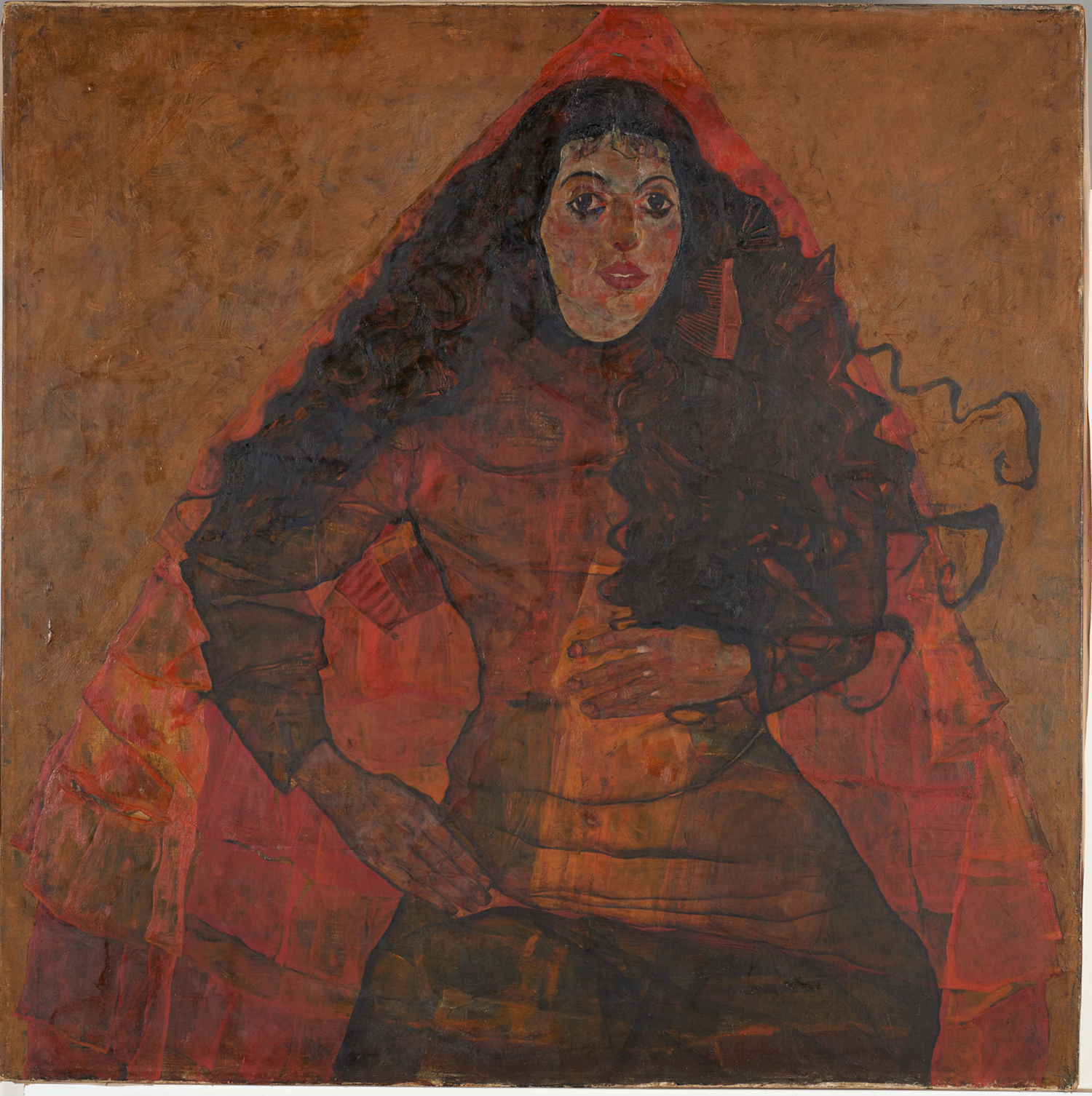
Trude Engel is a work by Egon Schiele dated 1912–1913: a young woman seated frontally on a square canvas, under a wide red veil that spreads over her head and shoulders. The original is held by the Lentos Kunstmuseum in Linz under inventory number 11; it measures 100 x 100 cm and is unsigned. We paint it by hand in oils, in fifteen sizes or to your own measurement, and before dispatch we send you a photograph of the finished work for approval.
| Title: | Trude Engel |
| Other titles: | Bildnis Trude Engel · Porträt Frl. Engel |
| Painter: | Egon Schiele (1890–1918) |
| Year: | 1912–1913, unsigned |
| Original size (width × height): | 100 cm x 100 cm (square) |
| Original technique: | Oil on canvas |
| Style: | Expressionism |
| Location: | Lentos Kunstmuseum, Linz (inv. 11) |
| Our reproduction: | hand-painted oil on canvas, 15 sizes from 50 x 50 cm to 200 x 200 cm, or a made-to-measure size |
Trude Engel – Egon Schiele
Who is in the painting?
Trude Engel – that is the name under which the Lentos Kunstmuseum in Linz holds the work. The record gives the full title as “Bildnis Trude Engel” and a second one, “Porträt Frl. Engel” (Frl. for Fräulein, Miss), on the authority of Rudolf Leopold, the collector after whom the Leopold Museum in Vienna is named. About the sitter the record says nothing more: not her dates, not her relation to the Austrian painter Egon Schiele (1890–1918), not how the portrait came about. Stories circulate about Schiele’s portraits of these years which the record does not confirm; you will not find them here.
What is on the canvas?
A young woman seated frontally, filling almost the whole square. Long, dark, wavy hair falls on both sides of her face and down to her waist; on the viewer’s right one strand breaks away and trails across the ground in a curling line. Over her head and shoulders lies a wide red-orange veil, opening towards the lower corners into a triangle almost the full width of the canvas, its sides falling in layered folds. The face is pale, with large dark eyes, a straight nose and a small red mouth. The dress is dark, in browns and olives, with orange and yellow patches showing through it. Her left hand lies across her waist; the right rests flat on her thigh. Behind her is a single ochre-brown plane: no chair, no room, nothing to say where she is sitting.
Why does this painting matter?
For three reasons. The first is its size and shape: a canvas one metre each way, filled almost entirely by the figure – the large, square or almost square format of the three works described below. The second is what it leaves out: no chair, no room and no signature. The record states plainly that the work is unsigned, and dates it to a span, 1912–1913, rather than a single year. The third is that it belongs to a public collection, the Lentos in Linz, that has researched its own holdings and published the results.
What does the painting mean?
The Lentos record gives no interpretation, and we do not put one into the museum’s mouth. Everything that would place the young woman is left out, and what remains is framed twice: by the dark hair on both sides of the face, then by the red veil opening into a triangle. The face sits near its apex, small against the whole and, like the hands, drawn in fine detail. It describes no setting; it puts a face and a length of cloth straight in front of you. Whether that is meaning or composition, the record does not say, and we leave the question open.
Where does the work come from, and what has the museum published?
The Lentos record places the work in the holdings it calls Neue Galerie der Stadt Linz – Lentos Kunstmuseum Linz, and gives 1953 as the year it entered the collection. The Neue Galerie was founded in 1946, and its core was formed by the City of Linz’s purchases from the Berlin art dealer and publisher Wolfgang Gurlitt (1888–1965) in 1952/53 and in 1956 – 111 paintings in all, together with watercolours, drawings and prints by German and Austrian artists. In October 2019 the Lentos published an interim report on its provenance research. It states that this part of the collection has been investigated systematically since 1998, that 64 works of art had been researched by then, chiefly from the Gurlitt collection, and that 13 paintings had been restituted on the basis of that research. In the report’s table of researched works this one appears under inventory number 11, as a Schiele with the entry “Ankauf 1953” – purchased in 1953. It is not among the restitutions the report lists. That is the report’s position as of October 2019; we know of no later report and draw no conclusion beyond it. The note below sets out how the work reached Linz.
Provenance
From the Engel family the portrait passed into the collection of the art dealer Wolfgang Gurlitt — founder of the Neue Galerie der Stadt Linz, the predecessor of today’s Lentos — where it was already catalogued in 1948. In the early 1950s the City of Linz purchased it from Gurlitt.
Where does this work sit among Schiele’s works?
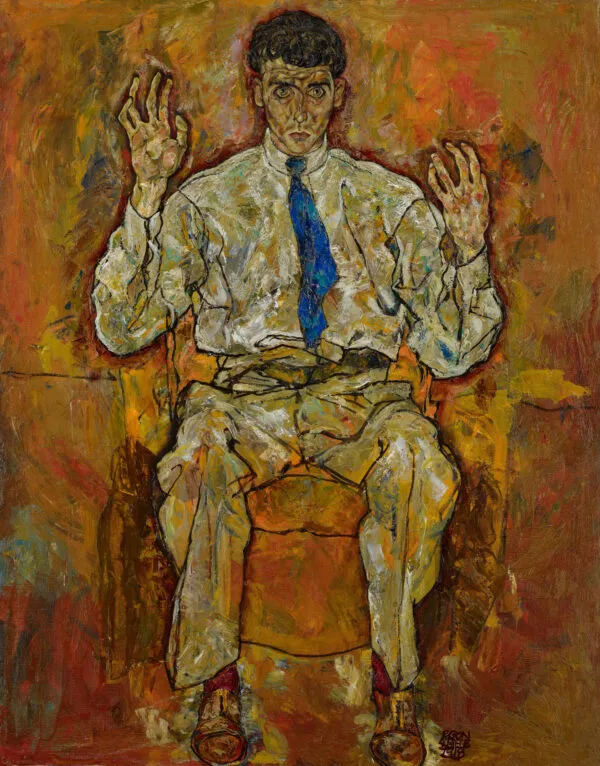
Among his large figure paintings on square or nearly square canvases. Two come from 1910 and are in the Belvedere in Vienna: Portrait of Eduard Kosmack, at 99.8 x 99.5 cm, and Portrait of Herbert Reiner (Reiner Boy), at 101 x 101.5 cm. From 1911 comes The Lyricist, in the Leopold Museum in Vienna, at 80.5 x 80 cm. All three are on canvas, like Trude Engel, but each carries Schiele’s signature or monogram with a date, while this work carries none. The full selection is in the Egon Schiele gallery, with more on his life in our article about Egon Schiele.
How is our hand-painted version made?
A painter works every canvas in oils, stroke by stroke: a hand-painted copy made for your order, not a machine print. Two passages are the hardest here. The first is the veil: a large red plane that must stay translucent without turning uniform, or it becomes a flat coloured triangle. The second is the face, small against the whole, where the slightest shift in the eyes or the mouth changes the expression. The original is painted in oils on canvas, and so is our copy. The original is unsigned, so our copy carries no signature either. When the work is finished we photograph it and send you the photograph for approval, and only then does it ship. This work has not yet been photographed in our workshop; we will add photographs to this page once we have them. Like every canvas we send, it can arrive stretched on a wooden stretcher bar; you choose that under the Stretcher option.
Which size for which wall?
Short answer: if you want it at the size of the original, choose 100 x 100 cm – it matches the original to the centimetre, one metre each way. All fifteen sizes are square, like the work, so you choose scale, not shape. For a hallway or beside a bed, 50 x 50 cm or 60 x 60 cm; above a chest of drawers or a desk, 70 x 70 cm or 80 x 80 cm; above a sofa in a living room, 100 x 100 cm or 120 x 120 cm; on a large wall, a stairwell or in a tall room, 150 x 150 cm and up to our largest size, 200 x 200 cm. A canvas painting with this much red in one plane rewards distance: from a few metres the veil reads as one colour, close up as several layers. Hang it with its centre at eye level, roughly 145–150 cm from the floor, or 15–25 cm above the backrest of a sofa.
Custom size, stretcher bar and frame
If none of the fifteen sizes suits your wall, we paint the work to your own measurement. If you choose “YES” under the Stretcher option, the canvas comes stretched on a wooden stretcher bar, ready to hang. Our 3D application is for choosing a frame only, not for showing the work on your wall; seeing it on your wall is a separate service. The frame is chosen separately and need not be part of the order.
Delivery and guarantee
We paint to order and deliver to sixteen countries in the European Union, among them Slovenia, Croatia, Austria, Italy, Hungary and Germany; the United Kingdom and Ireland are not currently among them. Before dispatch we send you a photograph of the finished work to approve. Production time depends on the size and on the studio’s workload. Every work travels protectively packed. Every order is covered by our Returns and Refund Policy.
Frequently asked questions
Who was Trude Engel?
She is the young woman in the portrait; the Lentos Kunstmuseum in Linz holds the work as “Bildnis Trude Engel”. Beyond her name, the museum’s record gives nothing about her – not her dates, and not her relation to Schiele. According to the provenance note the portrait came from the Engel family; stories about the sitter that the record does not confirm are left out here.
When was the portrait of Trude Engel painted?
The Lentos dates it to a span, 1912–1913, rather than to a single year. The canvas carries neither a signature nor a date that would settle the question. Some sources give 1912 or about 1913, both within the museum’s span.
Where is the original of Trude Engel?
In the Lentos Kunstmuseum in Linz, under inventory number 11. From the Engel family it passed to the Berlin art dealer Wolfgang Gurlitt, in whose collection it was catalogued by 1948, and the City of Linz bought it from him; the museum gives 1953 as the year it entered the collection. The Lentos provenance report of October 2019 lists it as purchased in 1953 and not among the works restituted.
What does the portrait show?
A young woman seated frontally, filling almost the whole square, under a wide red-orange veil that opens into a triangle towards the lower corners. Long dark hair frames her pale face, with its large dark eyes and small red mouth. Behind her there is only a bare ochre-brown ground – no chair, no room.
Is Porträt Frl. Engel the same work?
Yes. It is the second title the Lentos record gives for this portrait, on the authority of the collector Rudolf Leopold. The main title is “Bildnis Trude Engel”; Frl. stands for Fräulein, Miss.
How is Trude Engel painted?
In oils on a square canvas, one metre each way. The red veil is a single large plane that stays translucent, while the face, small against the whole, is drawn in fine detail. The work is unsigned, and each copy on this page is a hand-painted painting that carries no signature either.
Does it work as a gift?
Yes; if you are unsure which size to choose, there is a gift voucher.
- Subject: a young woman seen from the front under a wide red veil, against a bare ochre ground.
- Original: 1912–1913, oil on canvas, 100 x 100 cm, unsigned, Lentos Kunstmuseum, Linz, inv. 11.
- Ours: hand-painted in oils, 15 square sizes or made to measure, stretched on a stretcher bar if you choose Stretcher: “YES”.
- Worth knowing: our 100 x 100 cm size is exactly the size of the original, and like the original our copy carries no signature.