







































Description
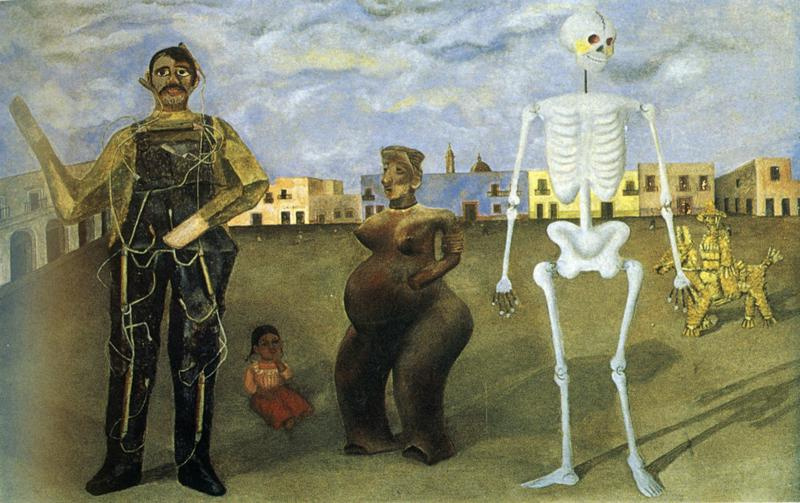
Four Inhabitants of Mexico City is a painting from 1938 in which a small girl sits on the ground in the middle of an empty town square, surrounded by a large male dummy wound with thin cords, a brown clay female figure, a white skeleton and a tiny straw rider on a horse. The original, oil on canvas, is 31.4 cm high and 47.6 cm wide and is in a private collection in Palo Alto. The hand-painted copy you order from us is made in oil colours on canvas in a single landscape size, 60 x 38 cm, larger than the original; before it is dispatched we send you a photograph of the finished painting.
| Title: | Four Inhabitants of Mexico City |
| Other titles: | Cuatro habitantes de la Ciudad de México · Vier Bewohner von Mexiko-Stadt |
| Painter: | Frida Kahlo (1907–1954) |
| Year painted: | 1938 |
| Original size: | 31.4 cm x 47.6 cm (height x width) |
| Original technique: | Oil on canvas |
| Painting style: | Mexican modernism |
| Located at: | Private collection, Palo Alto (USA) |
| Our reproduction: | Hand-painted oil on canvas, 1 sizes or made to measure |
Four Inhabitants of Mexico City – Frida Kahlo
What does Four Inhabitants of Mexico City show?
The scene is a wide, almost deserted square with yellowish olive ground. Behind it runs a row of low houses in pink, yellow, blue and white, with a church tower and a dome in the middle.
On the left stands the biggest figure: a moustached man in dark dungarees and a mustard-yellow shirt, one plank-flat arm raised in an arc, the other on his hip, thin pale cords wound all over him. He looks more like a giant dummy than a living man.
At his feet a slight, dark-haired girl in a red skirt and a pale blouse sits on the ground, one hand lifted to her face. She is the smallest human figure and the only one seated.
To her right stands a brown clay female figure with a round belly, broad hips and short arms; our data describe it as a pre-Columbian clay figure.
Further right a white skeleton stands on long, thin legs, its eye sockets touched with red and yellow and a thin dark thread rising from its skull. In the right background a small yellow straw rider sits on his horse under a blue, cloudy sky.
When and in what circumstances was it painted?
Kahlo painted this work in 1938. The English Wikipedia describes 1937 and 1938 as exceptionally productive years, when she painted more than in all eight earlier years of her marriage to Diego Rivera, and among the typical works of that time it names this very painting, listed there as Four Inhabitants of Mexico, together with What the Water Gave Me.
In April 1938 the French poet André Breton visited Rivera and at once claimed her as a Surrealist; in November she opened her first solo exhibition in New York, at Julien Levy’s gallery.
Why does this scene appeal to lovers of Mexican art?
According to Wikipedia, from the late 1920s Kahlo drew more and more on Mexican folk art, drawn to its fantasy, its naivety and its fascination with violence and death. On this canvas such motifs meet on a single square: the skeleton stands only a few steps from the girl and the clay figure.
The same article lists skeletons and skulls among the recurring elements of her painting and notes that many of her works set opposites side by side, such as life and death. Our sources give no detailed reading of this particular work.
A careful viewer also stumbles over the count: the title speaks of four inhabitants, yet besides the girl four other figures stand on the square. Which four the artist meant, the sources do not explain. Her life is told in the English Wikipedia article on Frida Kahlo, which is about the painter; there is no separate article on this painting.
Where is the original today?
The original belongs to a private collection in Palo Alto in the United States. Our sources name no museum showing it and do not say how it got there.
It is a small work, 31.4 cm high and 47.6 cm wide, only a little larger than a sheet of A3 paper. Kahlo painted it in oil on canvas; year, technique, size and the place of the collection are taken from the list of her works on the English Wikipedia.
Our oil painting reproduction is likewise made in oil on canvas, just like the original.
Four Inhabitants of Mexico City or another Kahlo?
From the same fertile year, 1938, comes Self-Portrait with Monkey (1938), with the artist herself in the foreground and a tiny monkey beside her. If you like works from the years when Leon Trotsky lived at the Blue House, look too at Self-Portrait Dedicated to Leon Trotsky from 1937.
A child sitting on the ground under a wide sky also appears in the later Portrait of Lucha María, a Girl from Tehuacán, painted in 1942.
All the famous Frida Kahlo paintings we paint to order are collected on the Frida Kahlo page.
How does our painter paint the square, the skeleton and the figures?
Wikipedia credits her style with flattened perspective, clearly outlined figures and bright colours.
Our painter starts with sky and ground: thin, softly blended layers of blue and cloud, then broad, smoothed strokes for the olive-yellow square. The houses are plain areas of colour, with windows, balconies and the tower drawn in with a fine brush.
The skeleton asks for the most patience: each bone is edged with a thin grey shadow so the white stays clean yet takes on form. The clay figure gets a warm brown with a slight sheen, and the dummy’s pale cords go on last.
The girl, only a few centimetres tall, comes last, with the finest brush, so her red skirt and small face stay crisp. The result is a Frida Kahlo reproduction whose layers of oil paint you can make out up close, while the surface remains smooth and even.
Which size suits your wall?
In short: this painting comes in one size only, 60 x 38 cm, which looks best above a desk, above a chest of drawers or in a hallway.
We offer it solely in this landscape size (width x height). The original measures about 48 x 31 cm when rounded; in catalogues that give the height first you will find it as 31 x 48 cm. Our painting is 12.4 cm wider and 6.6 cm taller, so the one size we offer is larger than the original.
The proportions are similar, ours slightly more elongated. As a painting for the living room it works above a side table, beside a bookcase or in a group of small works; alone above a large sofa it would be too small.
Can I order another size or a frame?
If your wall needs a different width and height, send us a custom size request. We check whether it can be done for this subject and tell you the price and the time it takes; we do not promise larger sizes in advance.
The painting can reach you rolled, stretched on a wooden stretcher bar or framed. Stretching and framing are done by our workshop in Slovenia, which prepares every canvas painting in our range.
Our 3D app lets you try frames around the four inhabitants; choosing a frame is all it does. Seeing the painting on a photo of your own wall is a separate service.
How long does it take and how is it delivered?
Once you confirm the order, the painter needs 15 to 45 working days for the square with its four inhabitants. Before dispatch we send you a photograph of the finished painting, and if you would like a change, the painter makes it before we pack.
Parcels within Slovenia and the rest of the EU travel without customs duty or formalities, and our returns policy covers every order.
As a gift it suits someone drawn to Mexican folk art and unusual scenes. As a skeleton is not to every taste, a wall art voucher lets the recipient choose instead.
Frequently asked questions
Where is the original kept?
In a private collection in Palo Alto, USA; our sources mention no museum where it is on display.
Who are the figures on the square?
A male dummy covered in cords, a clay female figure, a skeleton and a straw rider, with a girl sitting on the ground among them.
Is it a print?
No. Every layer of colour goes on by brush; no printer is involved.
How big is the original?
It is 31.4 cm high and 47.6 cm wide, so smaller than our 60 x 38 cm size.
Can I get it in a different size?
Send us your measurements and we reply with feasibility and price.
How long will I wait for my painting?
The square and its figures take 15 to 45 working days to paint; after that the parcel travels customs-free inside the EU.
Is it suitable for a home office or as a gift?
Yes. The 60 x 38 cm size sits well above a desk, and as a gift it pleases anyone who loves Mexico.
What does the skeleton on the square mean?
Wikipedia counts skeletons among the signs that often appear in her painting; it offers no reading of this work.
- Subject: a girl on an empty town square, surrounded by a male dummy, a clay figure, a skeleton and a straw rider.
- Original: 1938, oil on canvas, 31.4 x 47.6 cm (height x width), private collection, Palo Alto.
- Ours: hand-painted in oil on canvas to your order, in one landscape size: 60 x 38 cm.
- Worth knowing: Our size is larger than the original, by 12.4 cm in width and 6.6 cm in height.