




“This is truly a most admirable work, and executed so beautifully, whether in colouring, drawing, or composition, that every craftsman at the present day stands in a marvel thereat.”
Sandro Botticelli – hand-painted paintings in oil on canvas
At SvetSlik.si you can order 7 paintings by Sandro Botticelli as hand-painted oil reproductions on canvas, painted for you by our own painters. Every painting comes in several sizes – 53 formats across the gallery, from 40 x 30 cm to 200 x 148 cm – or in a size of your own, and prices start at 900 €. We only pick up the brush once your order has arrived, which is why delivery takes 15 to 45 working days; before dispatch we send you a photograph of the finished painting.
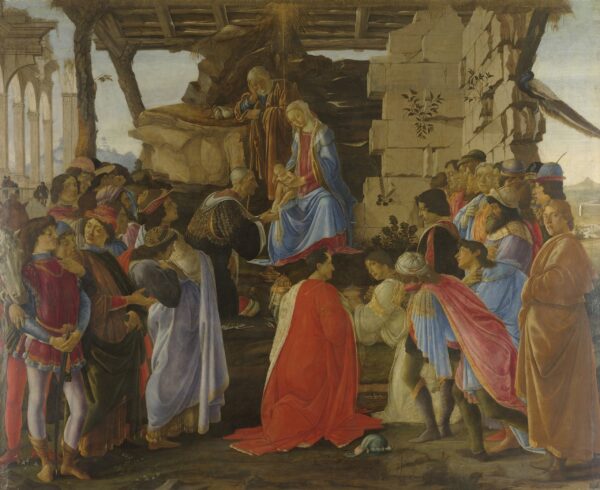
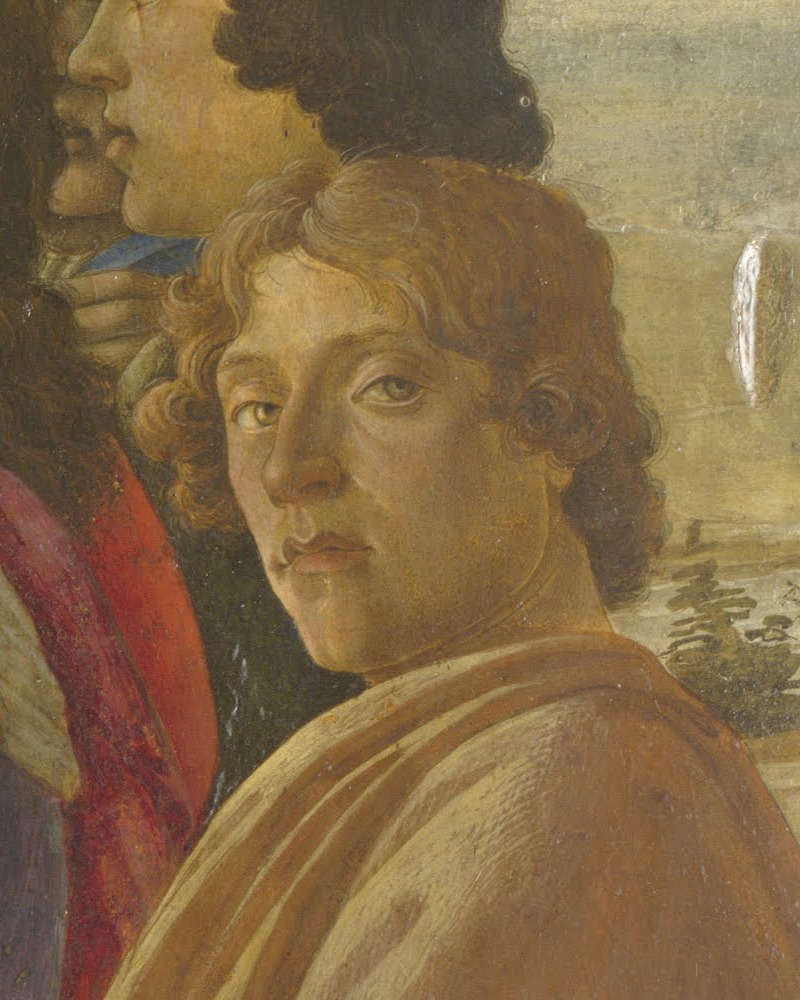
The words at the top of this page come from Giorgio Vasari, in the second edition of his Lives of the Artists, published in 1568, in the chapter on Botticelli. With them he praised the Adoration of the Magi, which Botticelli painted around 1475 for the altar of Gaspare del Lama in the Florentine church of Santa Maria Novella; today it hangs in the Uffizi. The face beside the quotation is taken from the same painting: the man in the yellow-brown cloak at the far right edge, looking straight out at us, is generally taken to be the painter’s self-portrait. The altar stood in a much-visited church, so the painting quickly spread Botticelli’s name, and it is still celebrated for the variety of angles and expressions with which he brought dozens of faces to life.
Sandro Botticelli’s periods – and what you will find in our gallery
The young Florentine master (c. 1475)
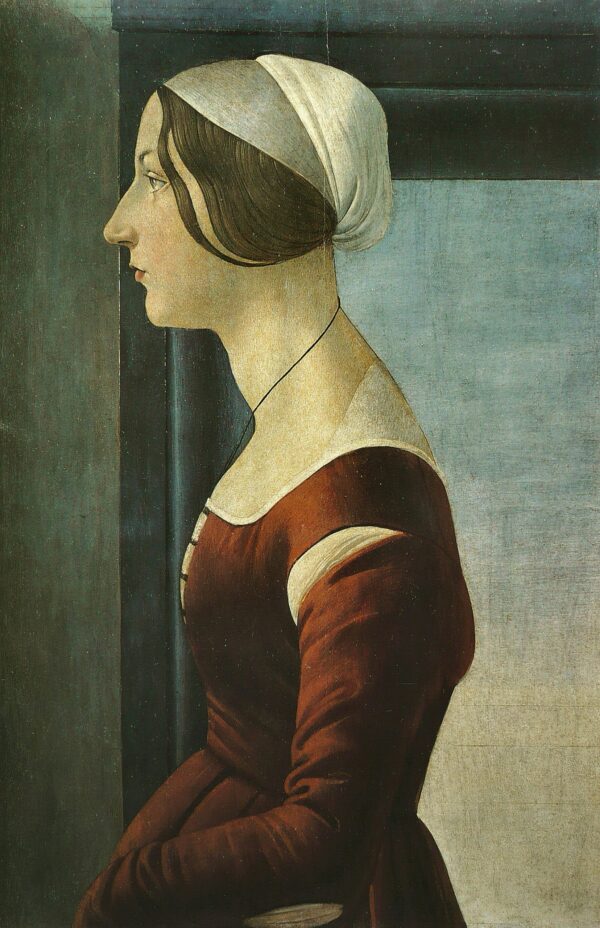
Through the 1470s Botticelli ran his own workshop in Florence, and his reputation rose fast. The high point of this early style is the Adoration of the Magi. The Holy Family sits on a rocky platform beneath a ruined shed, among broken classical walls; the Magi kneel before them, and some thirty people in rich red, blue, gold and black clothes crowd in from both sides, with horses at the far left. Most scholars recognise members of the Medici family among the kings and their followers: Cosimo the Elder kneels before the Child, and his sons Piero and Giovanni and his grandsons Lorenzo and Giuliano are among the company. Probably from the same years is the Portrait of a Young Woman in the Galleria Palatina of the Palazzo Pitti, though its date is uncertain and is placed anywhere between 1475 and 1490. The young woman stands in strict profile facing left at a window opening; she wears a white linen cap over smooth brown hair, a dark red dress with a pale sleeve and a thin dark cord round her long neck, with a grey-green wall and a dark window frame behind her. Nineteenth-century critics called her Simonetta, after Simonetta Vespucci, the celebrated beauty who died young, but the features do not match; who she was remains unknown.
The great years for the Medici circle (c. 1480–1485)
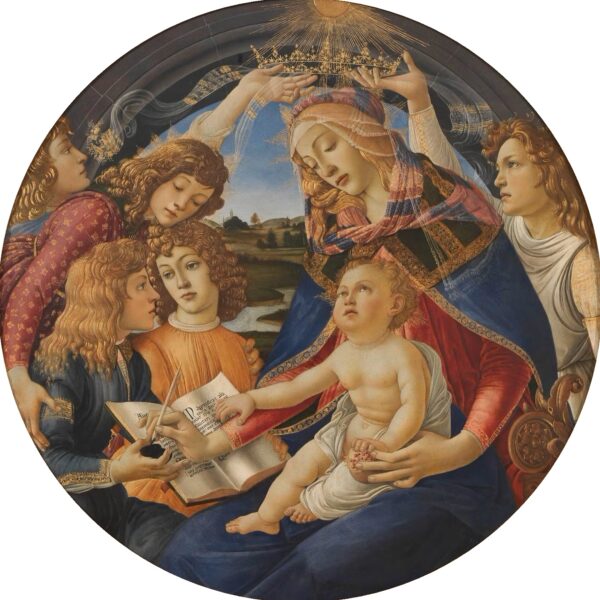
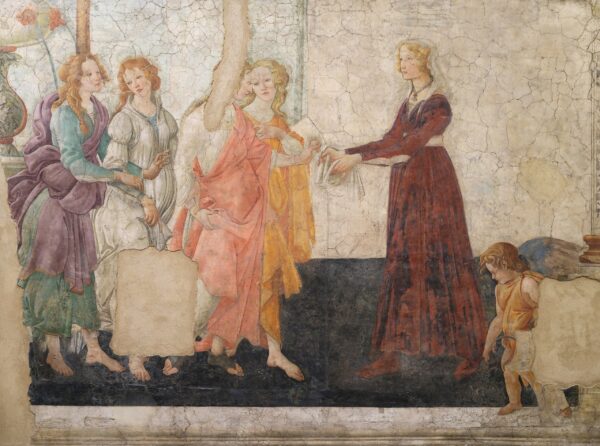
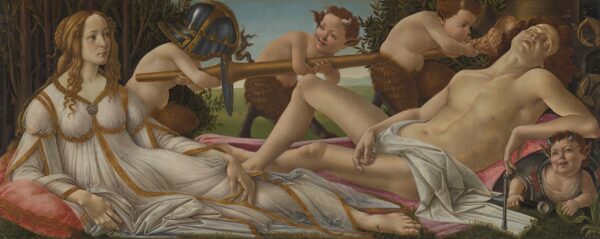
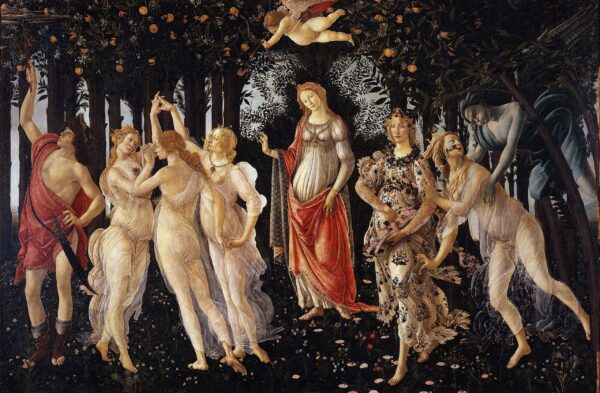
The 1480s were Botticelli’s most successful decade: the large mythologies were painted then, along with many of his most famous Madonnas. Primavera dates from around 1480, though scholars debate the exact year. In a dark orange grove, nine figures stand across a flowering meadow from left to right: Mercury in red reaches up into the trees with his staff, the three Graces in transparent white veils dance in a ring, Venus stands in the centre in white and red with a blindfolded, winged Cupid aiming an arrow above her, and on the right Flora, in a dress covered with flowers, scatters blossoms beside Chloris, with flowers spilling from her mouth, and the blue-green, winged Zephyrus bending in from the trees. Some 500 plant species and about 190 different flowers have been identified in the painting, and the golden oranges allude to the balls on the Medici coat of arms. In the mid-16th century Vasari saw it at the Villa di Castello, owned by Lorenzo di Pierfrancesco de’ Medici, together with The Birth of Venus; what it means is still debated. Around 1481–1483 came the Madonna of the Magnificat, a round painting 118 cm across, the kind known as a tondo. The Virgin, in blue and red, dips her pen and writes the Magnificat, the hymn from the Gospel of Luke, in a book held by angels; the Child on her lap holds a pomegranate and touches the page, two of the five curly-haired angels hold a delicate gold crown over her head, rays of gold light fall from above, and a river landscape opens in the distance. Several old copies of it exist, one of them in the Louvre. Between 1483 and 1485 Botticelli painted a fresco on a wall of the Villa Lemmi near Florence, owned by Giovanni Tornabuoni, uncle of Lorenzo de’ Medici: Venus and the Three Graces Presenting Gifts to a Young Woman shows four women in long pastel robes, pink, white, green and orange – Venus and the three Graces – coming forward from the left, and on the right a young woman in a dark red dress holding out a white cloth to receive their gift, with a small winged Cupid at the lower right. The young woman is often identified as Giovanna degli Albizzi, wife of Lorenzo Tornabuoni. The fresco and its companion, A Young Man Being Introduced to the Seven Liberal Arts, were found under whitewash in 1873, taken off the wall and transferred to canvas; both are now in the Louvre. Around 1485 Botticelli painted Venus and Mars, in tempera and oil on poplar, 173 cm long and only 69 cm high, a shape suggesting it was set into wall panelling or furniture. In a laurel grove Venus lies awake on the left, in a white dress trimmed with gold, against a red cushion, while on the right Mars sleeps, nearly nude with only a white cloth, his head thrown back; four infant satyrs play with his lance, helmet and armour, one blows a conch shell in his ear, and wasps fly round a tree stump at the upper right. They may be a pun on Botticelli’s neighbours the Vespucci, whose name means “little wasps”. The National Gallery in London has owned it since 1874.
The late, darker period (c. 1495)
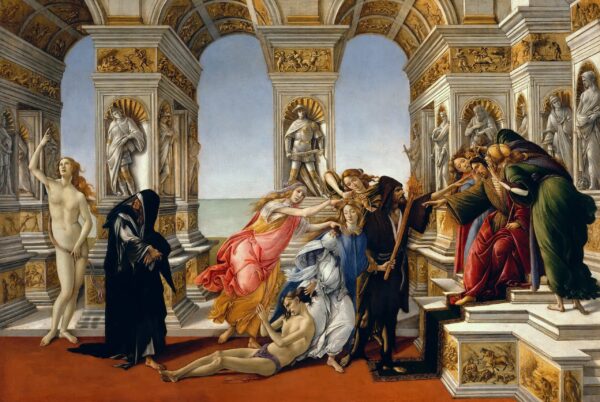
In the 1490s Botticelli’s style became more personal, and from 1490 until his execution in 1498 the stern Dominican friar Girolamo Savonarola preached in Florence; how far he influenced the painter remains uncertain. Botticelli turned back to antiquity at this time, with smaller paintings full of figures and dramatic moments. He finished the Calumny of Apelles around 1494–1495, and it measures only 62 x 91 cm. Following Lucian’s description of a lost painting by the ancient Greek painter Apelles, which Leon Battista Alberti had recommended to artists, a trial unfolds in a marble hall of arches with gilded reliefs and statues, the sea and sky beyond: on the right a king with donkey’s ears sits on his throne while Ignorance and Suspicion whisper into them; in the centre Calumny, holding a flaming torch, drags a nearly naked innocent young man by the hair, led by Rancour in a black hood, while Fraud arranges her hair; on the left an old woman in black, Repentance, turns towards Truth, who stands nude and points up to heaven. It is probably the last of Botticelli’s secular paintings to survive, and he may have painted it for himself.
The most famous Sandro Botticelli paintings at SvetSlik.si
Botticelli’s most famous work is The Birth of Venus in the Uffizi; the only painting of his to rival its fame is Primavera, which hangs in the same museum. Both rank among the best-known paintings in the world and are icons of the Italian Renaissance, because mythological scenes on such a large scale had been virtually unknown in Western art since antiquity. The Adoration of the Magi was singled out by Vasari with the praise you read at the top, and the Madonna of the Magnificat is one of the Madonnas that made Botticelli famous in the 1480s.
Which Sandro Botticelli painting suits which room?
With us you choose the size to fit your wall, not the museum. The wide Primavera, with its flowering meadow and dancing Graces, comes into its own above a living-room sofa, where it can be seen from across the room. The long, low Venus and Mars was probably made for a bedchamber to celebrate a marriage, and it still looks its best above a bed, a sideboard or a long sofa. The fresco Venus and the Three Graces Presenting Gifts to a Young Woman, with its soft pastel colours, brings calm to a dining room or bedroom, while the Adoration of the Magi, with its colourful crowd, wants a wall you can stop in front of and discover the faces, in a living room or a hallway. The Calumny of Apelles suits a study or a library, the round Madonna of the Magnificat on a square canvas a quiet corner or a bedroom, and the upright Portrait of a Young Woman a narrower wall beside a window or in a hallway. A rule that works: let the painting take up about two thirds of the width of the furniture beneath it, with its centre around 150 cm from the floor.
Sizes, prices, custom size, stretcher and frame
The sizes of each painting keep the proportions of the original, and each size is priced on the product page. Across the gallery there are 53 formats, from 40 x 30 cm to 200 x 148 cm. Here, plainly, is why prices on this shelf start higher than on others: Botticelli’s scenes are full of figures, flowers, gold and fine detail, and a crowd scene takes our painter far longer than a portrait. So the Portrait of a Young Woman starts at 900 €, Primavera, Venus and Mars, the Villa Lemmi fresco and the Madonna of the Magnificat at 1,800 €, and the crowded Adoration of the Magi and Calumny of Apelles at 2,500 €. On size, too, we will be open: the original Primavera is 314 cm wide and the Villa Lemmi fresco 283 cm, so all our sizes of these two works are smaller than the originals; the largest Primavera measures 190 x 120 cm, the largest fresco 200 x 148 cm. For Venus and Mars our largest size, 180 x 75 cm, is slightly bigger than the original; for the Adoration of the Magi (134 x 111 cm) 150 x 120 cm is a little larger and 190 x 150 cm well larger. The Calumny of Apelles measures only 91 x 62 cm, so every size from 120 x 83 cm up is much larger than the museum panel, and its reliefs read better in a big painting. The Portrait of a Young Woman measures 40.5 x 61 cm; 42 x 65 cm is about the same, and from 57 x 82 cm up ours are larger. The Madonna of the Magnificat is round in the original, 118 cm across: we paint the round composition on a square canvas, with the corners light as the photograph shows them or, on request, in a colour you choose; the largest size, 130 x 125 cm, is a little bigger than the original. The Villa Lemmi fresco we paint as it looks today, cracks and missing plaster included. If your wall needs a different measurement, send us the width and height: we paint it to your own size. We ship the painting rolled, stretched on a wooden stretcher bar or framed; the frame is chosen in our 3D application, which is there for choosing the frame only. For a present, there is the wall art voucher.
How do we hand-paint a Botticelli?
Botticelli’s originals are not oil paintings on canvas. Most are painted in tempera on wooden panels, Venus and Mars in tempera and oil on poplar, and the Villa Lemmi scene is a fresco taken off a wall. Ours are hand-painted copies in oil on canvas, made from a high-resolution photograph of the original in the size you choose, which is why we can send them rolled, stretched or framed. Botticelli drew with clear, softly flowing contours and delicate pastel colours, so the painter first transfers the drawing with care – the young woman’s profile, the hands of the dancing Graces, the folds of the transparent veils – then lays in the areas of colour, and finally adds the fine detail: the flowers in Primavera’s meadow, the gold rays and crown of the Madonna of the Magnificat, the reliefs in the hall of the Calumny. When the painting is finished we send you a photograph of it; if anything is not right, we correct it before dispatch.
Sandro Botticelli in brief
Sandro Botticelli, born Alessandro di Mariano di Vanni Filipepi, came into the world around 1445 in Florence, on the street called Borgo Ognissanti, the son of a tanner. He took the nickname Botticelli, “little barrel”, from his brother Giovanni. According to Vasari he first trained as a goldsmith, and around 1461 he was apprenticed to the painter Filippo Lippi. He spent his whole life in the same Florentine neighbourhood; his only long stays away were in Pisa in 1474 and in Rome in 1481–1482, where he painted three large scenes on the walls of the Sistine Chapel for Pope Sixtus IV. His patrons included the Medici, Lorenzo de’ Medici and his circle among them. After about 1495 he painted less and less; he died on 17 May 1510 and was buried at Ognissanti, his parish church. He never married. After his death he was all but forgotten until the Pre-Raphaelites rediscovered him in the late 19th century. Read more in the Sandro Botticelli biography.
Frequently asked questions
Which Sandro Botticelli paintings can I order?
The gallery holds Primavera, Venus and Mars, Adoration of the Magi, Venus and the Three Graces Presenting Gifts to a Young Woman, Calumny of Apelles, Madonna of the Magnificat and Portrait of a Young Woman. The shelf is growing, and more Botticelli paintings are being added.
Who was Sandro Botticelli?
A Florentine painter of the Early Renaissance (c. 1445–1510), a pupil of Filippo Lippi and a painter of the Medici circle; his best-known works are The Birth of Venus and Primavera, both in the Uffizi.
Are the originals oil paintings on canvas?
No. Most are tempera on wooden panels, Venus and Mars is tempera and oil on poplar, and the Villa Lemmi scene is a fresco. Ours are hand-painted in oil on canvas.
Why is the Madonna of the Magnificat painted on a square canvas?
The original is a round tondo 118 cm across. We paint the round composition on a square canvas, with light corners as in the photograph or, on request, in a colour you choose.
Where can you see the originals?
Primavera, the Adoration of the Magi, the Madonna of the Magnificat and the Calumny of Apelles are in the Uffizi in Florence, the Portrait of a Young Woman in the Galleria Palatina of the Palazzo Pitti, Venus and Mars in the National Gallery in London and the Villa Lemmi fresco in the Louvre in Paris.
How much does a Sandro Botticelli painting cost?
The originals are in museums. A hand-painted reproduction in oil on canvas from SvetSlik.si starts at 900 €, depending on the painting and the size. You receive a real painting, not a print.
Which size should I choose?
Measure the furniture below the wall and pick a painting about two thirds of that width. Every size and its price is listed on each painting’s page; if none fits, we paint yours to your own measurements.
How long does delivery take, and can I order a custom size?
As every painting is painted to order, delivery takes 15 to 45 working days. A custom size is possible for any painting, and before dispatch we send you a photograph of the finished painting.