




“In art, conciseness is both a necessity and a luxury; a concise man provokes thought, a wordy man provokes boredom; always move towards conciseness.”
Édouard Manet – hand-painted paintings in oil on canvas
At SvetSlik.si you can order 7 paintings by Édouard Manet as hand-painted oil reproductions on canvas, the work of our own painters. Every painting comes in several sizes – 49 formats across the gallery, from 40 x 30 cm to 200 x 159 cm – or in a size of your own, and prices start at 108 €. We only start painting once your order is in, which is why delivery takes 15 to 45 working days; before the painting leaves us, we send you a photograph of it.
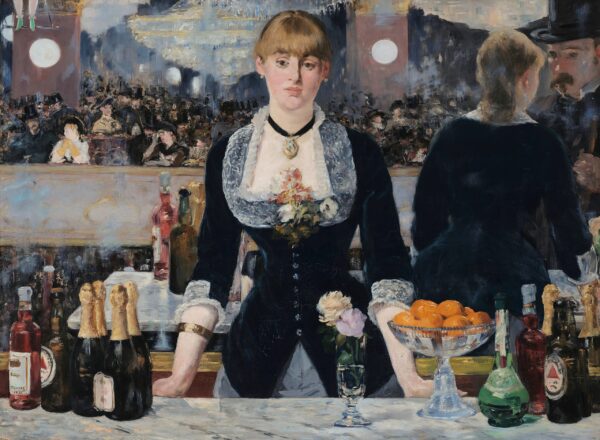
The words at the top of this text were recorded by the painter Georges Jeanniot, who visited Manet in January 1882 while he was painting his last major work, A Bar at the Folies-Bergère, and published them in La Grande Revue in 1907. For Manet, conciseness was also a way of working: instead of building a painting in successive layers on a dark ground, as Thomas Couture had taught him, he painted directly, alla prima, with opaque paint on a light ground, simplifying details and leaving out the transitional tones. The Impressionists took up the method, and you will see it in the works on this page too.
Édouard Manet’s periods – and what you will find in our gallery
The scandal years (1863–1865)
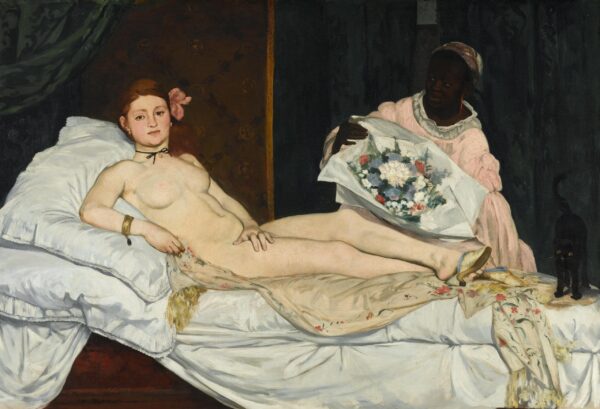
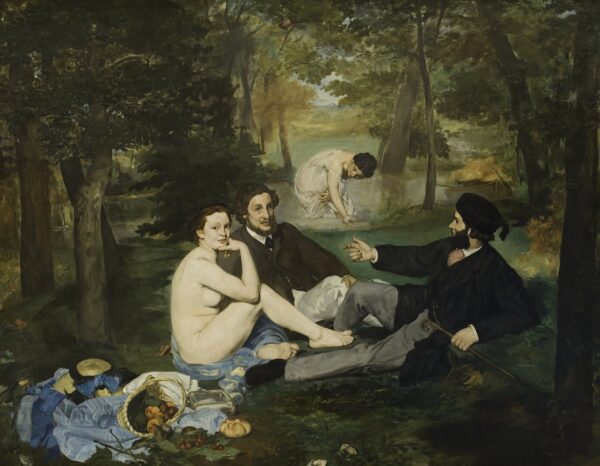
In 1863 the Paris Salon rejected Le Déjeuner sur l’herbe, known in English as Luncheon on the Grass, and Manet showed it instead at the Salon des Refusés. In a woodland clearing two dressed men sit on the grass with a nude woman who looks straight out at the viewer; her clothes, a basket of fruit and a round loaf lie at the lower left, and behind them a second woman in a light shift bends over a stream. The arrangement of the main figures comes from Marcantonio Raimondi’s engraving of the Judgement of Paris after Raphael. A nude woman among clothed men and the quick, sketch-like brushwork outraged the public, and at 264.5 cm wide and 208 cm high the canvas had a size normally kept for history painting. The woman is thought to have been modelled by Victorine Meurent, who also posed for Olympia. That painting reached the Salon only in 1865 and caused an even bigger scandal: the pose follows Titian’s Venus of Urbino, but Manet painted no goddess, rather a Parisian woman of his own day, with an orchid in her hair, a black ribbon at her neck and a bracelet, who calmly meets the viewer’s gaze. A Black maid, modelled by a woman named Laure, brings her a bouquet, and at the foot of the bed a black cat stands where Titian had a little dog. Both paintings are in the Musée d’Orsay in Paris, and both are seen as the start of modern art.
Scenes of modern life (1868–1879)
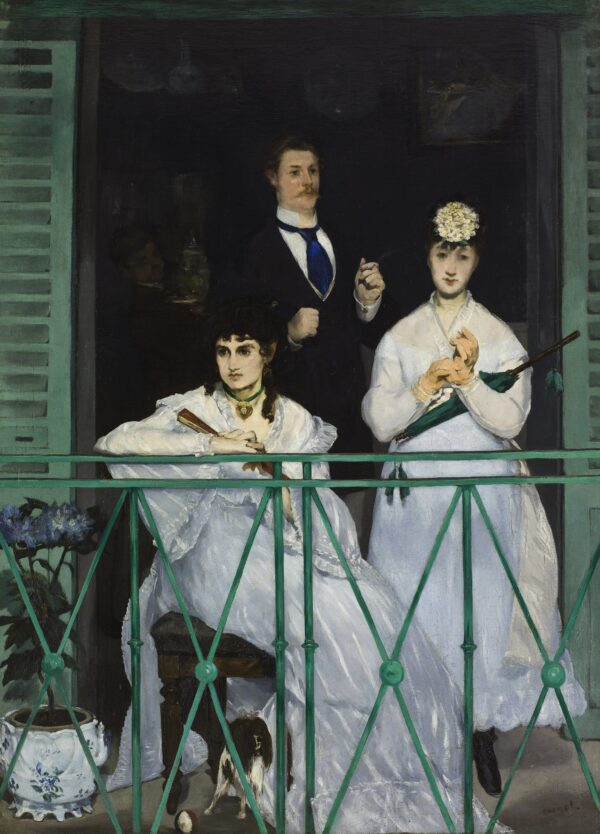
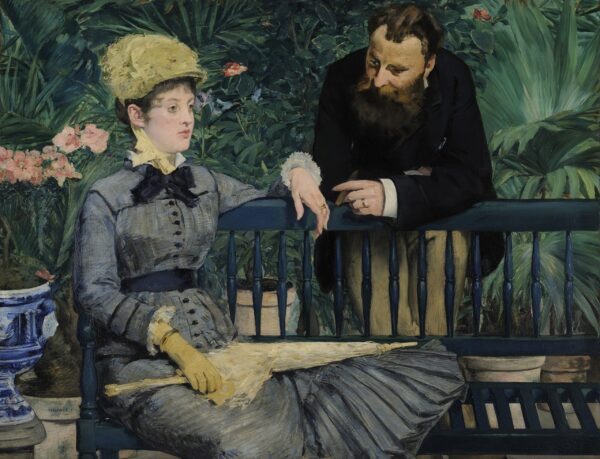
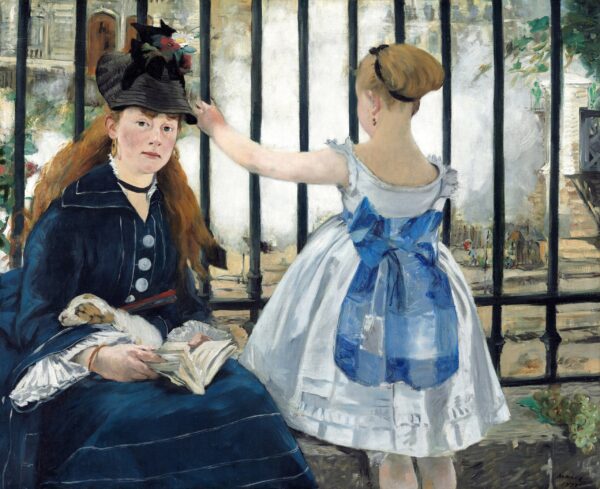
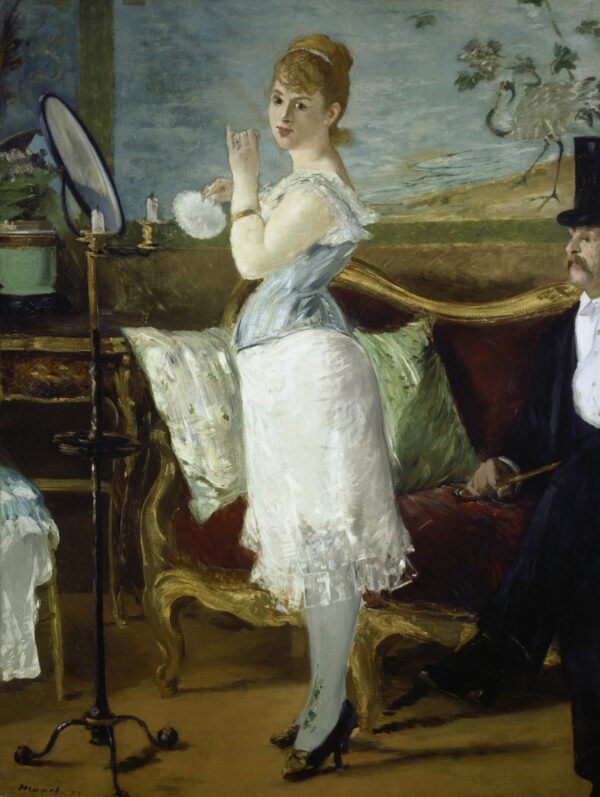
The Balcony, painted in 1868 and inspired by Goya’s Majas on a Balcony, was shown at the Salon of 1869. Behind a green iron railing sits the painter Berthe Morisot in white with a fan; in the centre stands the painter Antoine Guillemet in a blue tie, and on the right the violinist Fanny Claus holds a parasol; the boy in the dark interior is probably Manet’s son Léon. None of them looks at another, which puzzled the critics. In The Railway of 1873, widely known as Gare Saint-Lazare and shown at the Salon of 1874, Victorine Meurent sat for Manet for the last time: she sits by an iron railing near the Gare Saint-Lazare with a sleeping puppy and an open book in her lap, while a little girl in a white dress with a big blue bow looks through the bars at a train we see only as a white cloud of steam. In 1877 the Salon refused Nana, so Manet put it in the window of a shop on the Boulevard des Capucines, where it drew crowds. A young woman in a white chemise and a pale blue corset stands before a mirror, a powder puff in her hand, and turns towards the viewer; at the right edge, cut off by the frame, sits a gentleman in evening dress and top hat. The name Nana then stood for a courtesan, and Émile Zola’s novel of the same title came out only three years later. The Salon of 1879 showed In the Conservatory: in a winter garden full of greenery Madame Guillemet sits in a grey dress and a yellow straw hat, her husband Jules leans towards her from behind the bench, and their wedding rings tell us they are married. In 1896 the National Gallery in Berlin bought it, the first museum anywhere to buy a Manet.
The last major work (1882)
Manet finished A Bar at the Folies-Bergère in 1882 and showed it at the Salon that year; it is considered his last major work. Behind a marble counter with champagne and beer bottles, a glass holding two flowers and a bowl of oranges stands the barmaid Suzon, who really did work at the Folies-Bergère music hall in Paris in the early 1880s. The large mirror behind her shows the crowded hall, the chandeliers, a trapeze artist’s green shoes at the top left, and also her own back and a man in a top hat, oddly shifted to the right. The painting belonged to the composer Emmanuel Chabrier, a close friend of Manet’s, and hung over his piano; today it is in the Courtauld Gallery in London. After it Manet limited himself to small formats.
The most famous Édouard Manet paintings at SvetSlik.si
Le Déjeuner sur l’herbe and Olympia are counted among the watershed paintings that mark the start of modern art: both caused a scandal in Paris, and progressive artists soon hailed them as the breakthrough to a new style. A Bar at the Folies-Bergère, with its puzzling mirror, has been the subject of numerous scholarly and popular articles, and art historians compare it with Las Meninas by Velázquez, a painter Manet admired.
Which Édouard Manet painting suits which room?
Manet’s originals are large, so with us you choose the size to fit your wall rather than the museum. The wide Le Déjeuner sur l’herbe and Olympia belong above a sofa or sideboard in a living room, where their seated and reclining figures have room. A Bar at the Folies-Bergère, with its counter full of bottles and oranges, suits a dining room, a kitchen or a home bar, and In the Conservatory, with the greenery of its winter garden, a bright room full of plants. The upright The Balcony and Nana work on a narrower wall, in a hallway or a bedroom, and The Railway, only a little wider than it is tall, looks right above a desk. A rule that works: let the painting take up about two thirds of the width of the furniture beneath it, with its centre around 150 cm from the floor.
Sizes, prices, custom size, stretcher and frame
The sizes of each painting keep the proportions of the original, and each size is priced on the product page. Across the gallery there are 49 formats, from 40 x 30 cm to 200 x 159 cm, and prices start at 108 €. Because Manet’s originals are large, here it is plainly: the original of Le Déjeuner sur l’herbe is 264.5 cm wide, so all our sizes are smaller than it, the largest being 200 x 159 cm. For Olympia our largest size, 200 x 130 cm, is about as wide as the original (191 cm), and Nana is offered up to 105 x 145 cm, a little smaller than the original (115 x 154 cm), because the photograph we paint from allows nothing bigger. For The Balcony, A Bar at the Folies-Bergère, In the Conservatory and The Railway our largest sizes go beyond the original. If your wall needs a different measurement, send us the width and height: we paint to your own size. We ship the painting rolled, stretched on a wooden stretcher bar or framed; the frame is chosen in our 3D application, which is there for choosing the frame only. If you are looking for a present, there is the wall art voucher.
How do we hand-paint a Manet?
Every original on this page is an oil painting on canvas, and that is how we paint too: ours are hand-painted copies in oil on canvas, made from a high-resolution photograph of the original in the size you choose. Manet painted directly, with visible strokes, so the painter first lays in the large light and dark areas – Olympia’s white sheets, the deep green trees of Le Déjeuner sur l’herbe, the black interior behind The Balcony – and then, with a quicker brush, adds the outlines Manet liked to stress in black and details such as the bouquet, the bottles and the reflections in the mirror. If something in the final photograph is not right, we correct it before dispatch.
Édouard Manet in brief
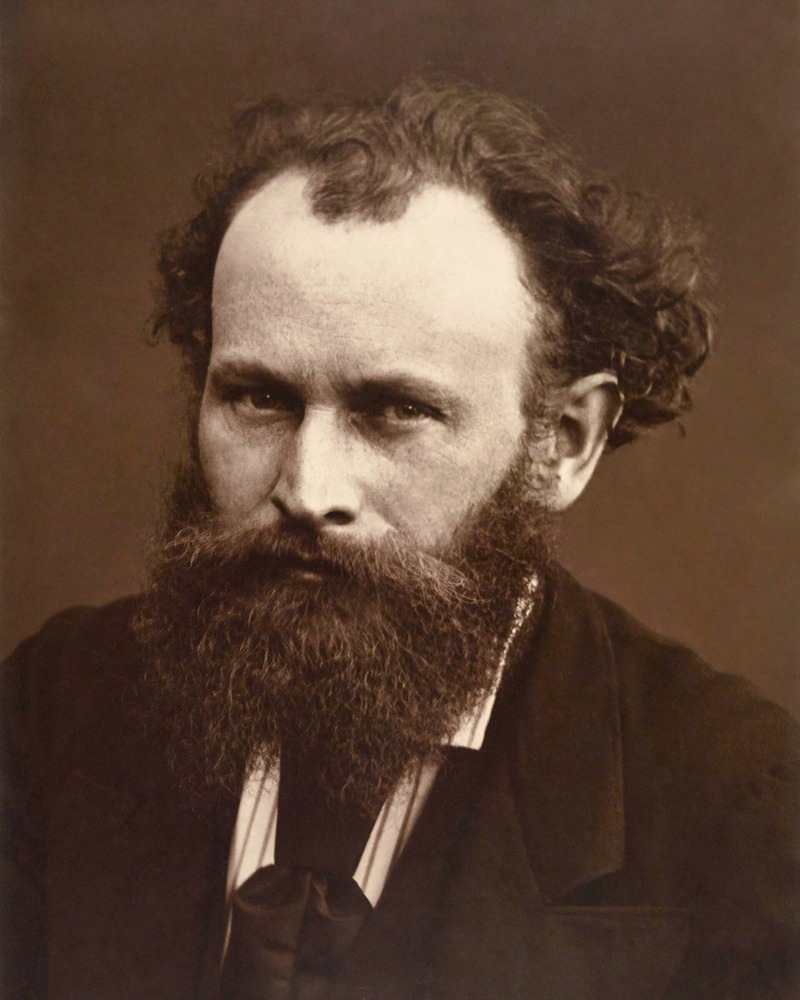
Édouard Manet was born in Paris on 23 January 1832 into a wealthy, well-connected family; his father, a judge, expected him to pursue a career in law. After a voyage on a training ship to Rio de Janeiro in 1848 he twice failed the examination to join the navy, and from 1850 to 1856 he trained under the painter Thomas Couture, copying Velázquez and Titian in the Louvre. He was one of the first 19th-century artists to paint modern life and a pivotal figure in the move from Realism to Impressionism. Through the painter Berthe Morisot he became friends with Degas, Monet, Renoir, Sisley, Cézanne and Pissarro, yet he did not exhibit with the Impressionists, preferring the Salon. He received the Légion d’honneur in 1881 and died in Paris on 30 April 1883 after a long illness. A catalogue of 1975 lists 430 oil paintings, 89 pastels and more than 400 works on paper. Read more in the Édouard Manet biography.
Frequently asked questions
Which Édouard Manet paintings can I order?
The gallery holds Olympia, Le Déjeuner sur l’herbe, The Balcony, A Bar at the Folies-Bergère, In the Conservatory, The Railway and Nana. The shelf is growing, and more Manet paintings are being added.
Who was Édouard Manet?
A French painter (1832–1883), one of the first to paint modern life and a pivotal figure between Realism and Impressionism; his Le Déjeuner sur l’herbe and Olympia are seen as the start of modern art.
Are the originals oil paintings on canvas?
Yes, all of them, and several are large: Le Déjeuner sur l’herbe is over 2.6 metres wide. Ours are hand-painted in oil on canvas too.
Why is Nana offered only up to 105 x 145 cm?
The photograph of the original that we paint from allows no larger size, so our largest is a little smaller than the original, which measures 115 x 154 cm.
Where can you see the originals?
Olympia, Le Déjeuner sur l’herbe and The Balcony are in the Musée d’Orsay in Paris, A Bar at the Folies-Bergère in the Courtauld Gallery in London, In the Conservatory in the Alte Nationalgalerie in Berlin, The Railway in the National Gallery of Art in Washington and Nana in the Hamburger Kunsthalle.
How much does an Édouard Manet painting cost?
The originals are in museums. A hand-painted reproduction in oil on canvas from SvetSlik.si starts at 108 €, depending on the painting and the size. You receive a real painting, not a print.
Which size should I choose?
Measure the furniture below the wall and pick a painting about two thirds of that width. Every size and its price is listed on each painting’s page; if none fits, we paint yours to your own measurements.
How long does delivery take, and can I order a custom size?
As every painting is painted to order, delivery takes 15 to 45 working days. A custom size is possible for any painting, and before dispatch we send you a photograph of the finished painting.