







































Description
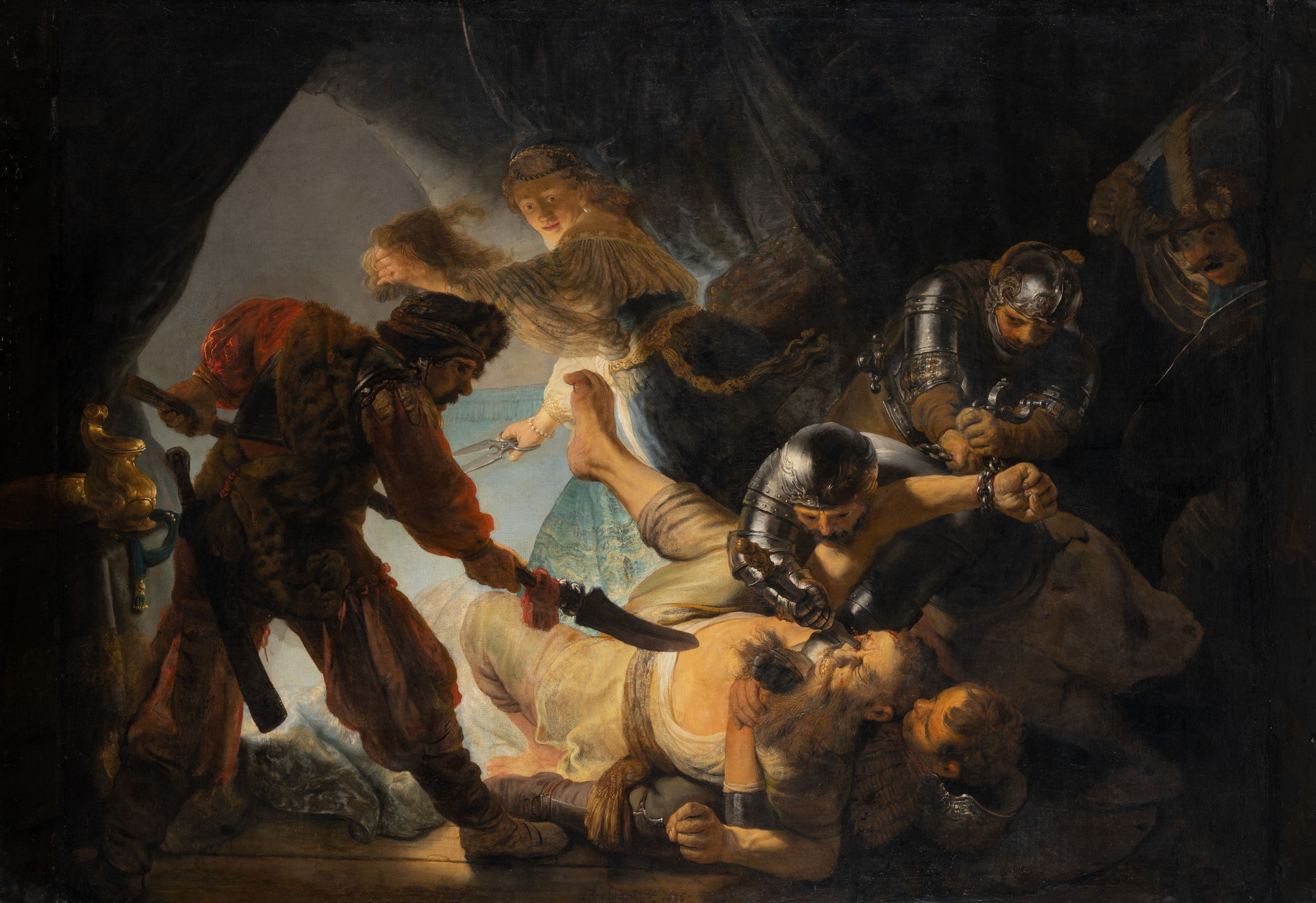
The Blinding of Samson is Rembrandt’s large, dramatic painting of 1636: in a dark tent Philistine soldiers throw the biblical hero Samson to the ground, chain him and put out one of his eyes with a dagger, while Delilah flees towards the light with the scissors and his cut-off hair. The original, oil on canvas, is 219.3 cm high and 305 cm wide and belongs to the Städel Museum in Frankfurt. We paint it by hand in oil on canvas in 8 landscape sizes, from 56 x 40 to 200 x 148 cm, or to your own measurement, and show it to you in a photograph before dispatch.
| Title: | The Blinding of Samson |
| Other titles: | Die Blendung Simsons · Samson Blinded by the Philistines |
| Painter: | Rembrandt van Rijn (1606–1669) |
| Year painted: | 1636, Amsterdam |
| Original size: | 219.3 cm x 305 cm (height x width) |
| Original technique: | Oil on canvas |
| Painting style: | Baroque, Dutch Golden Age |
| Located at: | Städel Museum, Frankfurt am Main (inv. 1383) |
| Our reproduction: | Hand-painted oil on canvas, 8 sizes or made to measure |
The Blinding of Samson – Rembrandt
What does The Blinding of Samson show?
The scene takes place at the entrance of a tent. Samson lies on his back, an armoured soldier presses on his chest, a second chains his wrists, a third drives a curved dagger into his eye, and blood spurts. In the left foreground a soldier in red with a halberd stares at the horror.
Delilah, in a pale dress, flees towards the opening of the tent with the scissors in one hand and a lock of Samson’s hair in the other, looking back. The Städel describes her expression as triumph, fascination and disgust all at once.
What is the story behind the painting?
The story comes from the Book of Judges. Samson had superhuman strength as long as his hair grew. His lover Delilah coaxed the secret from him, cut his hair and called the Philistines.
Rembrandt painted the climax, but according to Wikipedia the whole action can be read from the figures: the soldier who enters fearfully, the one who holds Samson down, the one who ties him and the one who blinds him.
Why is the painting so famous?
Because it is one of the most violent paintings of the Baroque. A harsh beam like a spotlight turns the scene into a stage, the Städel writes. According to Wikipedia no painter before Rembrandt had shown exactly this moment of the story.
Wikipedia also records that the painting was linked to Rembrandt’s commissions for the House of Orange: it went to the secretary Constantijn Huygens while the Passion paintings were running late. There is more in the Wikipedia article.
Where is the original, and how did it reach Frankfurt?
In the Städel Museum in Frankfurt am Main, inventory number 1383. The museum bought it in 1905 from the Counts of Schönborn in Vienna for 336,000 marks.
Because the museum could not raise that sum alone, 85 private donors gave 167,700 marks within days, and the city and the museum association gave the rest. The Städel calls it one of the most spectacular acquisitions in its history.
The Blinding of Samson or another Rembrandt?
This suits lovers of the Baroque and of great stories: a study, a library, a gallery or a large wall, but not a child’s room or a bedroom, because the scene is cruel. Similar violent drama comes with Belshazzar’s Feast, and a struggle that ends in peace with Jacob Wrestling with the Angel.
For drama without blood there is The Storm on the Sea of Galilee, and for a big group of armed men The Night Watch. The Rembrandt page has more biblical stories and famous Rembrandt paintings.
How does our painter paint your Blinding of Samson?
This Rembrandt reproduction is demanding because the original has many figures in motion. In oil on canvas the painter first lays in the darkness of the tent and the shaft of light from outside, then arranges the bodies so that the scene stays readable.
Last come the metallic glints of the armour, Delilah’s pale dress and the red of the soldier in front. An oil painting reproduction like this has a depth that a paper print lacks.
Which size for which wall?
In short: 56 x 40 or 70 x 52 cm for a shelf or a narrow wall, 80 x 59 or 101 x 74 cm above a desk or chest of drawers, 114 x 82 and 140 x 105 cm above a sofa, and 160 x 115 and 200 x 148 cm for large walls.
There are 8 landscape sizes (width x height): 56 x 40, 70 x 52, 80 x 59, 101 x 74, 114 x 82, 140 x 105, 160 x 115 and 200 x 148 cm. The original is 305 cm wide, so even our largest size is smaller. As a painting for the living room above a sofa, 140 x 105 cm suits well.
Because the scene is dense, hang it where you can see it from at least two metres away, with its centre about 150 cm from the floor.
Can I choose another size or a frame?
Yes. The original is roughly 7 : 5 in proportion; in that ratio Delilah at the exit and Samson on the ground stay on the canvas. Tell us the size you want and we will reply with a price and a date.
We send this canvas painting rolled, stretched on a stretcher bar or framed, and our workshop in Slovenia does the stretching and framing. Choose the frame in the 3D application, which is only for choosing the frame; viewing it on your own wall is a different service. Heavy dark wood stresses the darkness of the tent, gold the gleam of the armour.
When will the painting be with me?
We paint Samson to order; within 15 to 45 working days it is ready to ship. It travels customs-free to any EU country. Before dispatch you receive a photograph; whatever you would like different, we correct, and our returns policy applies to every order.
For a collector of great biblical stories who would rather choose the size, there is the wall art voucher.
Frequently asked questions
Where is the original Blinding of Samson?
In the Städel Museum in Frankfurt am Main, inventory number 1383.
Which story is the scene from?
From the Book of Judges in the Old Testament: Delilah cuts Samson’s hair, and the Philistines seize and blind him.
Who is running away with the scissors?
Delilah, holding Samson’s cut-off hair in her hand.
Does the painting suit every room?
The scene is cruel, so it is better for a study, a library or a gallery than for a bedroom or a child’s room.
Is it a print?
No. It is a hand-painted copy, painted with a brush in oil on canvas.
How big is the original?
It is 219.3 cm high and 305 cm wide. Our sizes run from 56 x 40 to 200 x 148 cm.
What did the museum pay for it?
The Städel bought it in 1905 for 336,000 marks, with the help of 85 private donors, the city and the museum association.
Which size suits a large wall?
For a wall at least three metres wide, choose 160 x 115 or 200 x 148 cm.
- Subject: Philistine soldiers overpower and blind Samson as Delilah flees the tent with his hair.
- Original: 1636, oil on canvas, 219.3 x 305 cm, Städel Museum, Frankfurt.
- Ours: painted by hand in oil on canvas, in 8 landscape sizes from 56 x 40 to 200 x 148 cm or made to measure.
- Worth knowing: the Städel bought it in 1905 with the help of 85 private donors.