







































Description
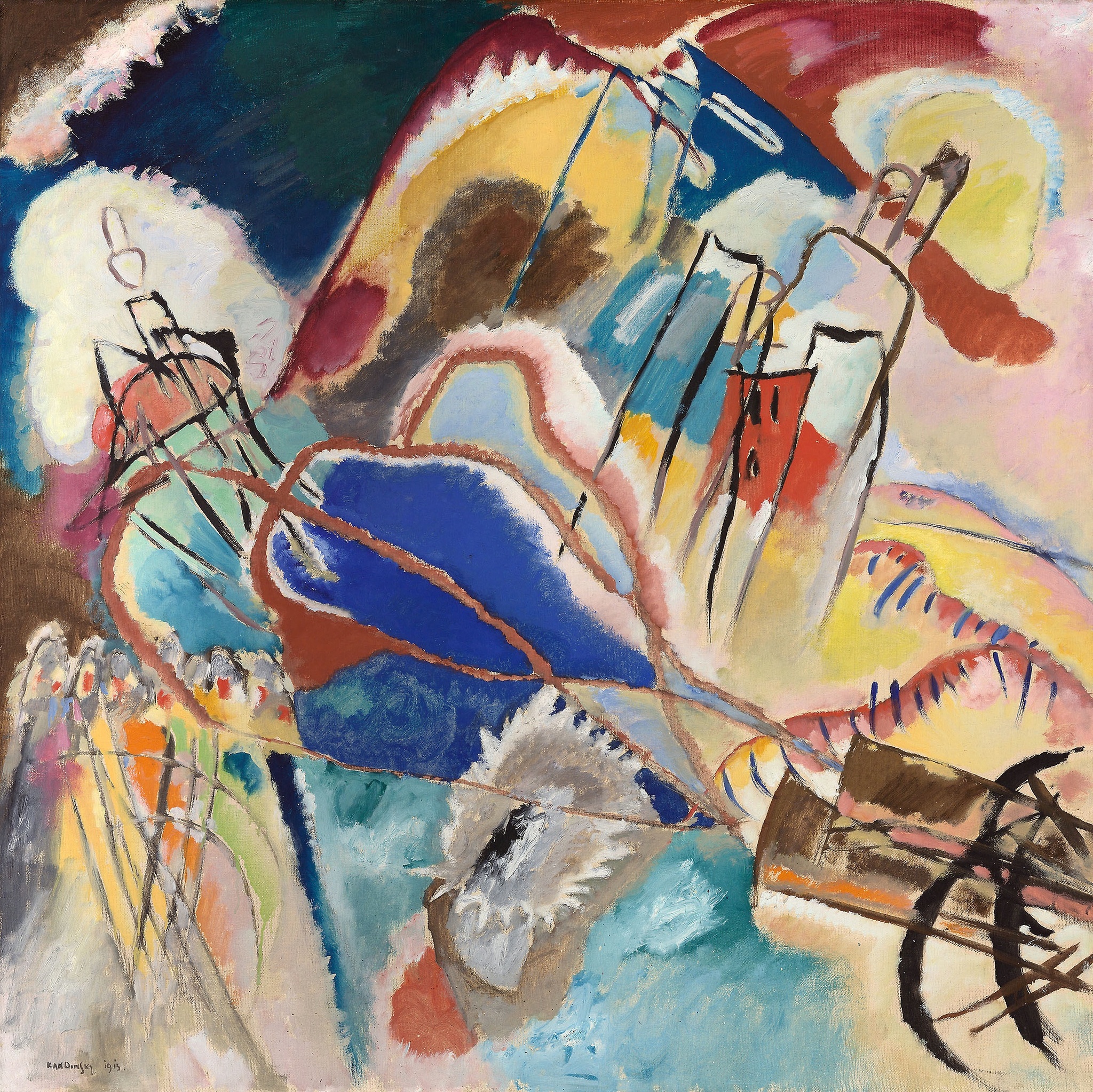
Improvisation No. 30 (Cannons) is a painting by Wassily Kandinsky from 1913: a turbulent landscape of hills, pale towers and a deep blue mass, with a crowd of small figures at the lower left and a dark cannon-like shape at the lower right. The original belongs to the Art Institute of Chicago. We make it as a hand-painted reproduction in oil on canvas, in eight sizes or made to measure, and before dispatch you receive a photograph of the finished work to approve.
| Title: | Improvisation No. 30 (Cannons) |
| Other titles: | Improvisation Nr. 30 (Kanonen) |
| Painter: | Wassily Kandinsky (1866–1944) |
| Year: | 1913 |
| Original size: | 111.3 cm x 111 cm |
| Original technique: | Oil on canvas |
| Available sizes: | eight sizes from 60 x 60 cm to 180 x 180 cm |
| Location: | Art Institute of Chicago (inv. no. 1931.511) |
| Our reproduction: | hand-painted oil on canvas, made to measure on request |
Improvisation No. 30 (Cannons) – Wassily Kandinsky
What can be seen in the painting?
At the upper left a dark blue and deep green sky is edged at the top by a pale pink and white cloud, and a brown strip runs down the left edge. Below it billows a large cream-white cloud-like mass, over which a tall tower is drawn in thin black lines, topped with a small loop. Across the top centre arches a broad crimson and maroon band enclosing yellow and pale blue, with a brown patch inside and thin blue lines falling from it. At the upper right a pale yellow glow shines above a reddish-brown horizontal band. Right of centre rise several tall towers outlined in thin brown and black lines, one filled with red and marked with small dark windows. In the centre lies a large deep blue form, bordered by a wavy pale pink band, and two reddish-brown wavy lines cross it towards the lower right. On the right, yellow and pink hills carry short red and blue strokes on their crests. At the lower right a brown boxy shape with black curved strokes and long dark bars recalls a cannon with a wheel. At the lower left a crowd of small figures with pale heads stands above strokes of yellow, orange and green, and in the lower centre a grey-white spiky form rises from turquoise.
Colour in upheaval
The composition is full of movement: forms tilt, swell and cross one another, pulling the eye several ways at once. The deep blue mass in the centre carries the most weight, and the wavy lines crossing it lead the gaze down to the dark cannon-like shape at the lower right. The pale towers on the right and the thin tower on the left answer each other across the whole surface, while the crowd at the lower left makes a quieter area. Above, the dark sky at the upper left weighs against the pale yellow glow at the upper right. Warm pinks, yellows and reds dominate the right half, cool blues and greens the left, and this contrast gives the work its tension. On the wall it reads as a vivid, restless burst of colour.
About the painting
Kandinsky painted it in 1913. The original is 111 cm high and 111.3 cm wide and belongs to the Art Institute of Chicago (inv. no. 1931.511). On this page we give the width first, so the original reads 111.3 x 111 cm here. Our painter works from a public-domain photograph of the original, so the subject can be carried faithfully onto the canvas, from the arrangement of the forms to the individual shades of colour.
How is our hand-painted version made?
The painter works from a high-resolution reference and builds the painting up in layers, with brush and oil paint. First the arrangement of the main forms is sketched in thin paint, then the colours go on layer by layer, from the large areas down to the smallest details. The edges of the forms and the transitions between colours are compared with the reference until the proportions match. An oil painting reproduction keeps its colours for many years, because oil does not fade the way a print does. Since every reproduction is made individually, no two copies match down to the last detail; the subject, the proportions and the colours do. Depending on the size, painting takes several days, and the paint then needs enough time to dry before the canvas is packed.
Hand-painted, not printed
You can see the difference between a print and a hand-painted canvas as soon as you look at the work from the side: the brushstrokes form a slight relief that shows in raking light and can be felt with the fingertips. Whether it is a landscape, a figurative subject or an abstract painting, every shade is mixed on the palette and applied by hand. Before dispatch we photograph the finished work and send you the photograph to approve, so you know exactly what you will receive. Only when you are happy does it go on its way. Small irregularities in the brushwork are not flaws but the trace of the hand that painted it, and they are exactly what makes each copy one of a kind.
Which interior suits it?
The warm, saturated colours make the painting glow, so it looks good in a living room or dining room, next to natural wood and quiet furniture. It works best on a light, neutral wall; next to other very colourful works on the same wall the colours would drown each other out. Hang it with its centre at about eye level, roughly 150 cm from the floor; above a sofa or sideboard, leave a gap of 20 to 30 cm. In a bedroom a medium size above the bed works well, and in a hallway or on a narrow wall a smaller size hung at eye level.
Which size for which wall?
As a painting for the living room it works best at 90 x 90 and 100 x 100 cm, where the details come into their own. The 60 x 60 and 70 x 70 cm sizes suit the wall above a desk or a hallway, and 110 x 110, 130 x 130, 150 x 150 and 180 x 180 cm a large wall above a sofa or in an entrance hall. All eight sizes are listed in the size selector; the price depends on the size you choose. A simple rule helps: above a sofa or a sideboard the painting looks best at about two thirds of the furniture’s width, and on an empty wall choose a size that leaves at least 30 to 40 cm of free wall on each side.
Custom sizes, stretcher and frame
If none of the sizes fits your wall, we paint this Kandinsky reproduction to your measurements; that is our painting made to measure, and we tell you how the composition adapts to the new proportions. Every canvas is stretched on a wooden stretcher. A frame is optional and not included in the base price. If you would like a frame, the best choice for this work is a narrow natural or dark wooden frame, because it calms and holds the colours together, while a wide, ornate gold frame would compete with the painter’s colours.
Delivery and guarantee
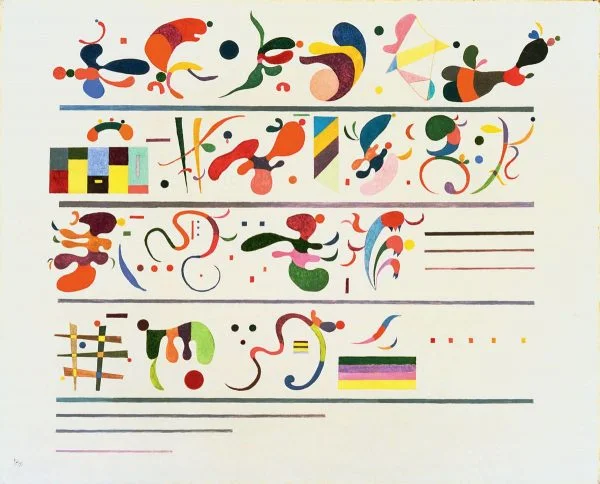
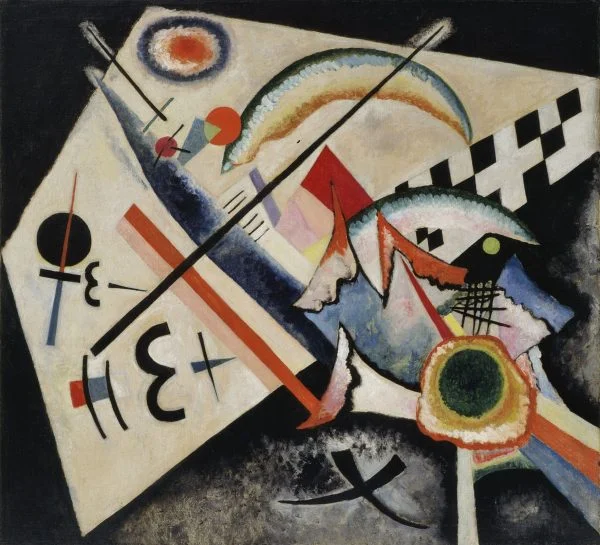
Because every painting on canvas is painted only after you order, in our studio in Slovenia, allow 15 to 45 days depending on the size you choose. We ship protected, insured and tracked, within the EU without customs. If anything is wrong on arrival, get in touch and we will put it right. All our works by Kandinsky are collected in the Wassily Kandinsky gallery, and the painter is introduced in our article about Wassily Kandinsky. Related works we paint include Red Spot II, White Cross and Succession.
Frequently asked questions
Where is the original?
It belongs to the Art Institute of Chicago (inv. no. 1931.511). The work is recorded in Wikidata, and the photograph we paint from is on Wikimedia Commons.
How big is the original?
It measures 111.3 x 111 cm. We give the width first; the height is 111 cm. Our largest size is 180 x 180 cm.
When was the painting made?
In 1913.
What does the painting show?
Hills, pale towers and a large deep blue mass under a turbulent sky, with a crowd of small figures at the lower left and a dark cannon-like shape at the lower right.
Is this a print?
No. It is a canvas painting, painted by hand in oil; the brushstrokes show in raking light and can be felt with the fingertips.
Which size should I choose?
For a living room 90 x 90 and 100 x 100 cm work best, above a desk or in a hallway 60 x 60 and 70 x 70 cm. Before deciding, tape a sheet of paper of the chosen size to the wall and leave it there for a day.
Can I have a size that is not on the list?
Yes. We also paint sizes outside the list and tell you how the forms will be arranged.
How is it delivered?
Insured and tracked, within the EU without customs. Before dispatch you receive a photograph of the finished painting to approve.
How do I care for the painting?
Remove dust with a soft, dry brush or cloth, without water or cleaning agents. Hang the painting away from direct sun, radiators and damp, and it will keep its colours for many years.
Is the original for sale, and what is it worth?
It is not for sale and has no market price. It belongs to a museum collection and stays there; what we offer is a hand-painted copy, not the original, and we never confuse the two.
Is the painting suitable as a gift?
Yes, especially for someone who loves Kandinsky’s forms and colours. If you are unsure about the subject or the size, there is a gift voucher, and the choice stays with the person who receives it.
- Subject: hills, pale towers, a deep blue mass, a crowd of small figures and a dark cannon-like shape
- Original: Art Institute of Chicago, 1913, 111.3 x 111 cm
- Our version: hand-painted oil on canvas, eight sizes from 60 x 60 to 180 x 180 cm, on a wooden stretcher, framed on request
- Worth knowing: every painting is photographed before dispatch and sent to you for approval