





Description
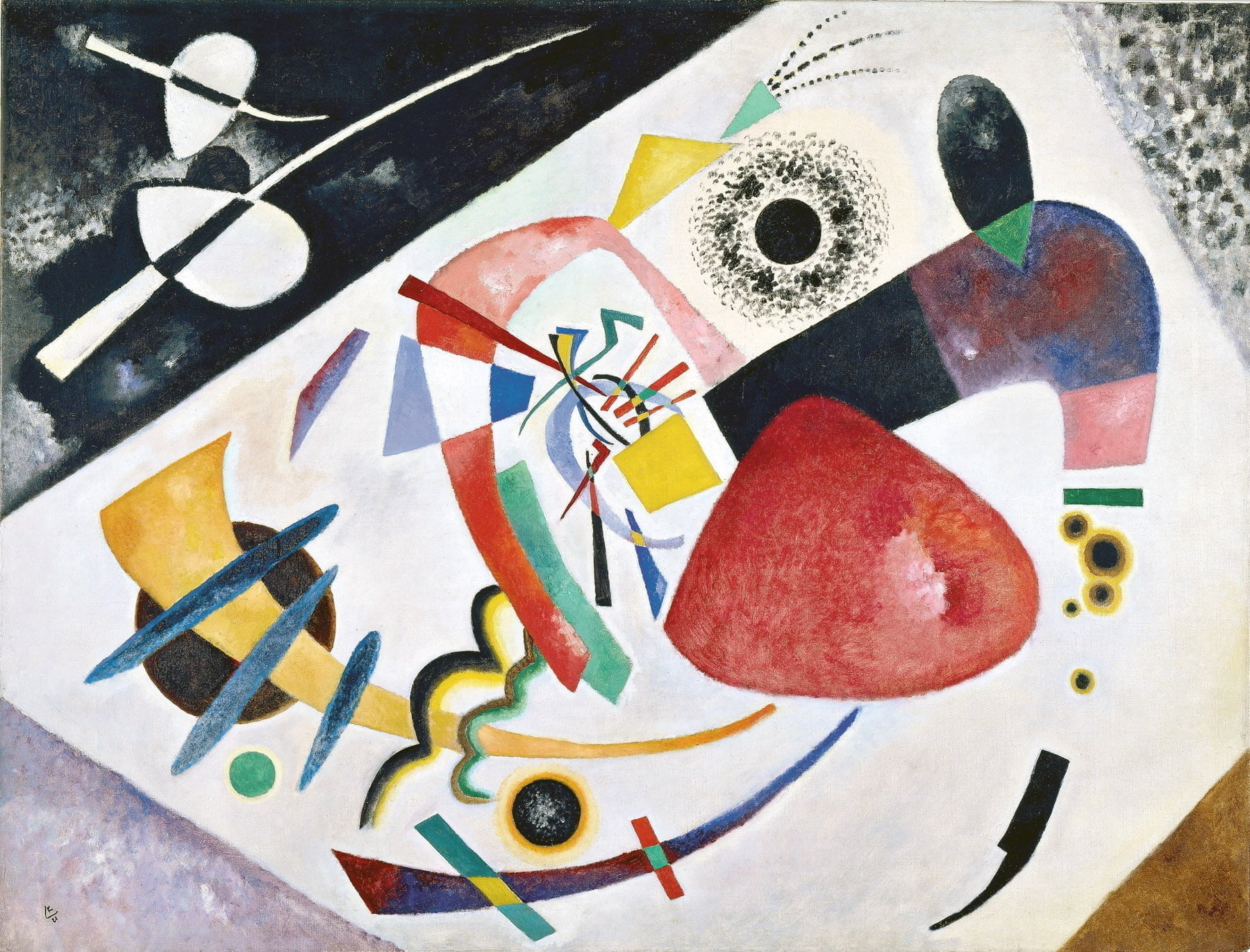
Red Spot II is a painting by Wassily Kandinsky from 1921: on a dark ground lies a large, tilted white plane, and on it, right of centre, a large rounded red form, surrounded by circles, arcs, triangles and thin coloured lines. The original is held by the Lenbachhaus in Munich. We make it as a hand-painted reproduction in oil on canvas, in eight sizes, including the original size, or made to measure, and before dispatch you receive a photograph of the finished work to approve.
| Title: | Red Spot II |
| Other titles: | Roter Fleck II |
| Painter: | Wassily Kandinsky (1866–1944) |
| Year: | 1921 |
| Original size: | 181 cm x 131 cm |
| Original technique: | Oil on canvas |
| Style: | Abstract art |
| Location: | Städtische Galerie im Lenbachhaus, Munich (inv. no. G 17562) |
| Our reproduction: | hand-painted oil on canvas, 8 sizes from 60 x 40 cm to 181 x 131 cm, made to measure on request |
Red Spot II – Wassily Kandinsky
What can be seen in the painting?
Across the painting, from the lower left to the upper right, stretches a large white plane, like a sheet laid at a slant on a dark ground. The upper left corner is black and dark blue, with two white semicircular forms crossed by a long white line. The upper right corner is grey and speckled, the lower left lilac and the lower right brown. Right of centre lies a large rounded red form with a pink sheen: the red spot of the title. Above it a black band continues into an arch of blue, violet and pink, topped by a black oval with a green triangle. At the top centre is a black circle ringed by a wreath of black dots, with a yellow triangle to its left. In the centre are a pink arc, red and green strips, a yellow square and a tangle of thin red, green and blue lines. On the left a yellow, horn-like form touches a dark circle crossed by three long blue shapes. Along the bottom run wavy black, yellow and green lines, a long dark blue and red arc and a black circle in a yellow ring; on the right are five small yellow circles with black centres, a green strip and a black hook. At the lower left is the signature: a K in a triangle and the year 21.
The start of a new phase
According to the museum’s record, Kandinsky left Germany when the First World War broke out and returned to Russia by way of Switzerland. In the years of war and revolution he almost stopped painting and served instead on numerous cultural-policy bodies. Red Spot II, painted while he was still in Russia, marks, according to the museum, the start of a new phase in his work, with a fundamental change in his means of expression.
Geometry, but not Constructivism
The museum considers the precise bodies and planes, the geometric division and the smooth paint of this painting unthinkable without his contact with Russian Constructivism, with Kazimir Malevich, Vladimir Tatlin and Lyubov Popova. The violent expressive force of the works from before the First World War has given way to a cool, seemingly rational composition of pure single forms. Yet, according to the museum, Kandinsky always kept his distance from Constructivism. He uses triangles, circles, arcs and lines with soft boundaries and in irregular groups, and his placing of forms side by side lacks the logically constructed build typical of the Constructivists.
Why the circle?
According to the museum, the circle became one of the central elements of Kandinsky’s painting in the years that followed. For him it was the perfect form, the one fullest of tension, and he said he loved the circle the way he had once loved the horse. With geometric forms he looked for ever purer forms that call up no distracting associations. The museum notes that even in abstraction he stayed with figures, whether representational or abstract, and that this sets him apart from painters of pure colour fields. As an abstract painting it shows no objects, but its forms remain distinct figures with soft edges.
How is our hand-painted version made?
The painter works from a high-resolution reference and builds the painting up in layers, with brush and oil paint. With this subject two things matter: smooth, even paint on the white plane and the red spot, and precise edges to the triangles and arcs, which must nevertheless not be hard, because in Kandinsky they are soft. The speckled corners and the wreath of dots around the black circle are made with the tip of the brush, dot by dot. An oil painting reproduction keeps its colours for many years, because oil does not fade the way a print does. Since every reproduction is made individually, no two copies match down to the last detail; the subject, the proportions and the colours do.
Which interior suits Red Spot II?
The painting is bright and full of colour: red, yellow, blue, green and pink on a white plane, framed by dark corners. It suits a modern or minimalist room with white or light grey walls, where it becomes the one strong accent, and it also works in a study or an office. Beside it, one or two plain pieces of furniture are enough; several other colourful works on the same wall would compete with the red spot.
Which size for which wall?
The original measures 181 x 131 cm, and that is also our largest size: in it you get the painting at the size of the original. As a painting for the living room it works best at 120 x 90 or 140 x 100 cm, where the red spot and the fine lines come into their own. The 60 x 40 and 55 x 50 cm sizes suit a desk or a hallway, 70 x 50 and 80 x 60 cm a bedroom, and 160 x 120 and 181 x 131 cm a large wall above a sofa or in an entrance hall. Because the white plane is light, the work also looks good on a darker wall.
Custom sizes, stretcher and frame
If none of the eight sizes fits your wall, we paint this Kandinsky reproduction to your measurements; that is our painting made to measure, and we tell you how the composition adapts to the new proportions. Every canvas is stretched on a wooden stretcher. A frame is optional and not included in the base price. If you would like a frame, a narrow dark or natural wooden frame suits this work best, closing off the dark corners, while a wide, ornate gold frame would compete with the colourful forms in the centre. Hang the work where daylight falls from the side rather than straight on, so that the white plane does not glare.
Delivery and guarantee
Because every painting on canvas is painted only after the order, in our studio in Slovenia, allow 15 to 45 days depending on the size you choose. We ship protected, insured and tracked, within the EU without customs. If anything is wrong on arrival, get in touch and we will put it right. All our works by Kandinsky are collected in the Wassily Kandinsky gallery, and the painter is introduced in our article about Wassily Kandinsky. Related works we paint include White Cross, In the Black Square and Im Grau.
Frequently asked questions
Where is the original?
In the Städtische Galerie im Lenbachhaus in Munich, under inventory number G 17562. The museum’s record is available in German and in English.
How big is the original?
It measures 181 x 131 cm. We give the width first; the museum puts the height first, 131 x 181 cm. Our largest size, 181 x 131 cm, is exactly the size of the original.
When was the painting made?
In 1921, while Kandinsky was still in Russia. At the lower left are a K in a triangle and the year 21.
What does the painting show?
Nothing figurative: a white plane on a dark ground, with a large red spot, circles, arcs, triangles and thin coloured lines.
Is this a print?
No. It is a canvas painting, painted by hand in oil; the brushstrokes show in raking light and can be felt with the fingertips.
Which size should I choose?
For a living room 120 x 90 and 140 x 100 cm work best, for a desk or hallway 60 x 40 or 55 x 50 cm. Before deciding, tape a sheet of paper of the chosen size to the wall and leave it there for a day.
Can I have a size that is not on the list?
Yes. We also paint sizes outside the list and tell you how the forms will be arranged.
How is it delivered?
Insured and tracked, within the EU without customs. Before dispatch you receive a photograph of the finished painting to approve.
Where is the red spot in the painting?
Right of centre: a large rounded red form with a pink sheen, the largest area of colour in the work.
Is the original for sale, and what is it worth?
It is not for sale and has no market price. It belongs to a public museum collection and stays there; what we offer is a hand-painted copy, not the original, and we never confuse the two.
Is the painting suitable as a gift?
Yes, especially for someone who loves vivid colour and clear forms. If you are unsure about the subject or the size, there is a gift voucher, and the choice stays with the person who receives it.
- Subject: a white plane on a dark ground with a large red spot, circles, arcs, triangles and thin coloured lines
- Original: Lenbachhaus, Munich, inv. no. G 17562, 1921, 181 x 131 cm
- Our version: hand-painted oil on canvas, eight sizes from 60 x 40 to 181 x 131 cm, on a wooden stretcher, framed on request
- Worth knowing: signature at the lower left: a K in a triangle and the year 21