







































Description
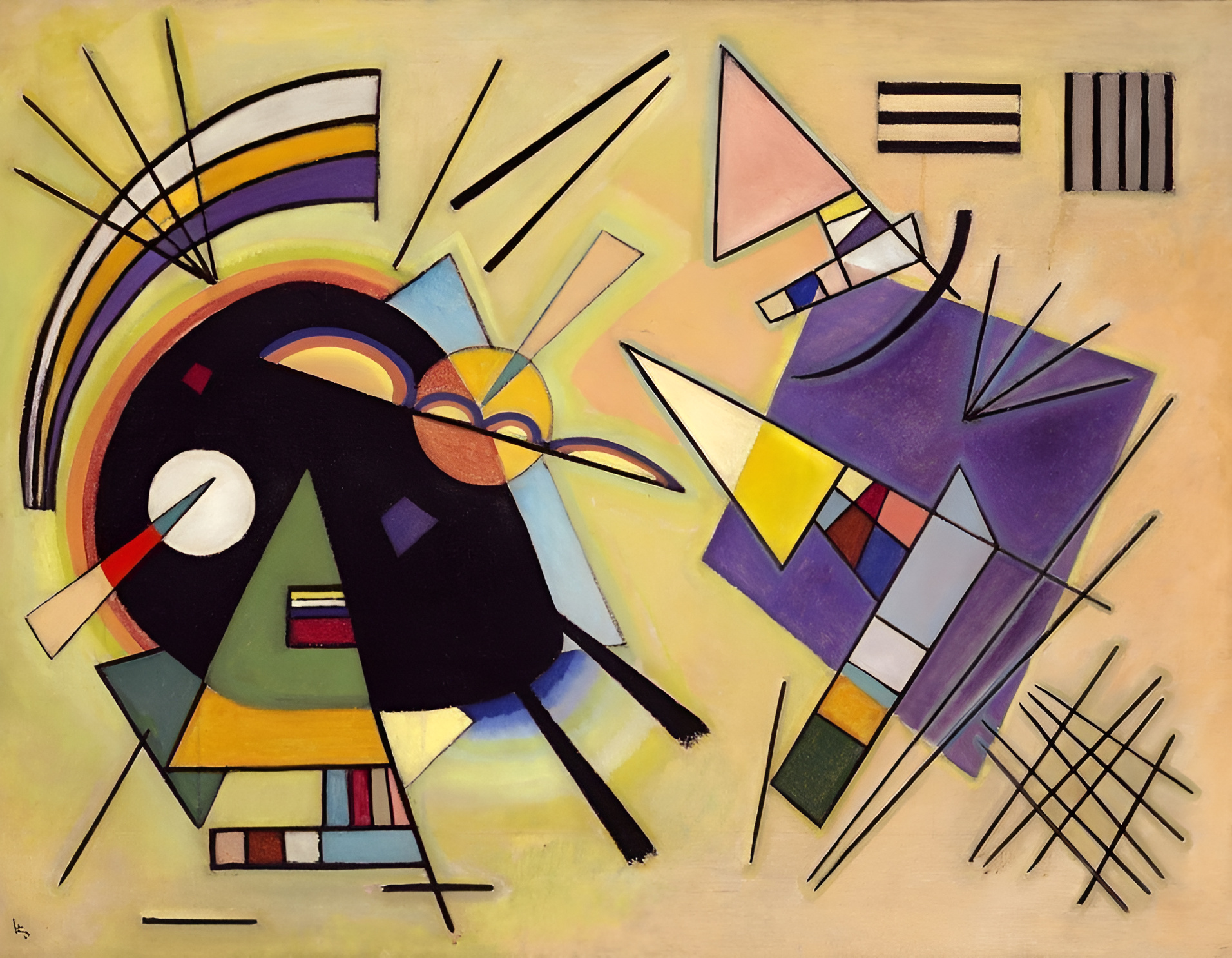
Black and Violet is a painting by Wassily Kandinsky: a landscape-format canvas on a warm, yellowish ground, with a large black rounded form on the left and a tilted violet square on the right, and arcs, triangles, grids and thin lines around them. We make it as a hand-painted reproduction in oil on canvas, in eight sizes or to your measurements, and before dispatch you receive a photograph of the finished work for approval.
| Title: | Black and Violet |
| Painter: | Wassily Kandinsky |
| Original technique: | oil on canvas – as the work is generally described, though no institution confirms it |
| Our reproduction: | hand-painted oil on canvas, 8 sizes from 60 x 50 cm to 180 x 140 cm, made to measure on request |
Black and Violet – Wassily Kandinsky
What do we deliberately not state here?
This canvas is not held by any public collection that has catalogued it, so there is no published object record, no measured dimensions and no inventory number. That is why you will not find a year of execution, a collection name or an accession number on this page. We say what can be checked against an institution, and nothing else.
What is on the canvas?
The ground is warm and yellowish, paler on the left and turning pink towards the right. On the left stands a large black rounded form; on its left side sits a white disc pierced by a red wedge, and in front of it a green triangle holding a small stack of red and white bars. Below the triangle lies a yellow-orange trapezium, below that a row of small coloured rectangles, and at the lower left a grey-blue triangle. Above the black form a striped arc – white, yellow, violet and black – sweeps down along the left side. Near the centre a long black diagonal crosses an orange disc and a yellow circle, with a violet wavy band winding beside them. On the right stands a large tilted violet square; a pale pink triangle sits at its tip, a pale yellow pointed wedge pushes into it from the left, and across it a ladder of small coloured rectangles runs down at a slant, ending in a dark green block. At the upper right are three horizontal black bars and a small grille of upright strokes, at the lower right a net of crossing black lines. Thin black needles are scattered across the whole canvas. At the lower left is a monogram.
How is the painting built?
From two large bodies. The black form on the left and the violet square on the right are roughly the same size and stand at the same height; between them a pale strip of ground remains, crossed by a long black diagonal. The left side is softer: the rounded black plane, the striped arc, the disc and the circle. The right is sharper: the square, the triangles, the wedges, the ladder of rectangles and the net of straight lines. Thin black needles link the two sides, starting on one and reaching towards the other. As an abstract painting it has no subject to recognise, but it has a clear balance between dark and light, round and angular.
Why is it called Black and Violet?
The title names the two largest planes on the canvas: the black rounded form on the left and the violet square on the right. Both are dark and heavy, and everything else – the yellowish ground, the red, green and blue fragments – arranges itself around them. The title says no more than that, and we give it no further meaning.
What is geometric about it?
Almost everything. The canvas holds circles and discs, triangles in several colours, a square, a trapezium, straight bars and a net of crossing lines; even the striped arc is drawn with a compass. Yet the forms do not sit on a grid: they tilt, overlap and push into one another, so the canvas reads as movement rather than as a plan. The straight edges are sharp and the planes evenly painted; only in the transitions beside the black form does the colour soften into lighter tones.
How does it work in a room?
As a light painting with two dark centres of weight. The warm, yellowish ground sits well with wood and with white or beige walls, while the black and the violet give the work weight, so it does not get lost even on a large wall. It works best with some empty space around it, so that the two bodies are not lost.
How is our hand-painted version made?
The painter works from a high-resolution reference and builds the painting up in layers, with brush and oil colours. With this subject straight edges and clean planes decide everything: the black has to be deep, the violet even and the thin needles sharp to their tips. An oil painting reproduction keeps its colour for many years, because oil does not fade the way the colour of a print does. Because every hand-painted copy is made on its own, no two are alike in every detail; what they share is the subject, the proportions and the colours.
Which size for which wall?
As a painting for the living room it works best at 100 x 78 or 120 x 90 cm, where the small rectangles and needles stay legible from a few metres away. The 60 x 50 and 70 x 55 cm sizes suit a desk or a hallway, 80 x 60 and 90 x 70 cm a bedroom, and 150 x 120 cm a larger wall. The largest size, 180 x 140 cm, is meant for open spaces. At the smallest sizes the thin lines and the fine net at the lower right are the first things lost.
Custom sizes, stretcher and frame
If none of the eight sizes fits your wall, we paint the work to your measurements; that is our painting made to measure, and we tell you how the composition adapts to the new proportion. Every canvas is stretched on a wooden stretcher. A frame is optional and not included in the base price.
Delivery and guarantee
Every canvas here is painted only after it is ordered, in our studio in Slovenia, so allow 15 to 45 days depending on the size. We send it protected, insured and tracked, across the EU without customs. If something is wrong on arrival, write to us and we will put it right. All of Kandinsky’s works here are gathered in our Wassily Kandinsky gallery, and the painter is introduced in our article about Wassily Kandinsky. Related works we paint include Blue Segment, In the Black Square, White Cross and Red Spot II.
Frequently asked questions
Where is the original?
No public collection holds it or has catalogued it, so we name no place. What we cannot check against an institution, we do not claim.
How large is the original?
There are no measured dimensions published by an institution. So we do not compare it with our versions. Those measure from 60 x 50 to 180 x 140 cm.
When was it painted?
We give no year here, because no institution that holds or has catalogued the painting confirms one.
What is shown in the painting?
Nothing figurative: a large black rounded form, a tilted violet square, and circles, triangles, grids and lines on a warm, yellowish ground.
Is this a print?
No. This is a canvas painting: it is painted by hand in oil, and the brushstrokes are visible in raking light and can be felt.
Which size should I choose?
For a living room 100 x 78 and 120 x 90 cm work best, for a desk or a hallway 60 x 50 or 70 x 55 cm. Before deciding, tape paper of that size to the wall for a day.
Can I have a size that is not on the list?
Yes. We also paint sizes that are not on the list, in the proportion your wall needs, and tell you how the forms will fall.
How is it delivered?
Insured and tracked, across the EU without customs. Before dispatch you receive a photograph of the finished Kandinsky reproduction for approval.
What do the forms mean?
We do not know, and we do not guess. We can describe what is on the canvas – the black body, the violet square, the striped arc, the grids and the needles – but we give them no meaning, because no source we could check gives one.
Is the original for sale, and what is it worth?
We do not know and do not estimate it, because the original is not in a public collection. What we offer is a copy painted by hand, not the original, and we never confuse the two.
Does it make a good gift?
It does, especially for someone who likes geometry and strong contrasts. If you are unsure about the subject or the size there is a gift voucher, and the decision stays with them.
- Subject: a large black rounded form on the left, a tilted violet square on the right, circles, triangles, grids and lines around them
- Original: not catalogued by any public collection, so no place, no year and no inventory number
- Our version: hand-painted oil on canvas, eight sizes from 60 x 50 to 180 x 140 cm, on a wooden stretcher, framed on request
- Worth knowing: the title names the two largest planes on the canvas, the black and the violet