


Description
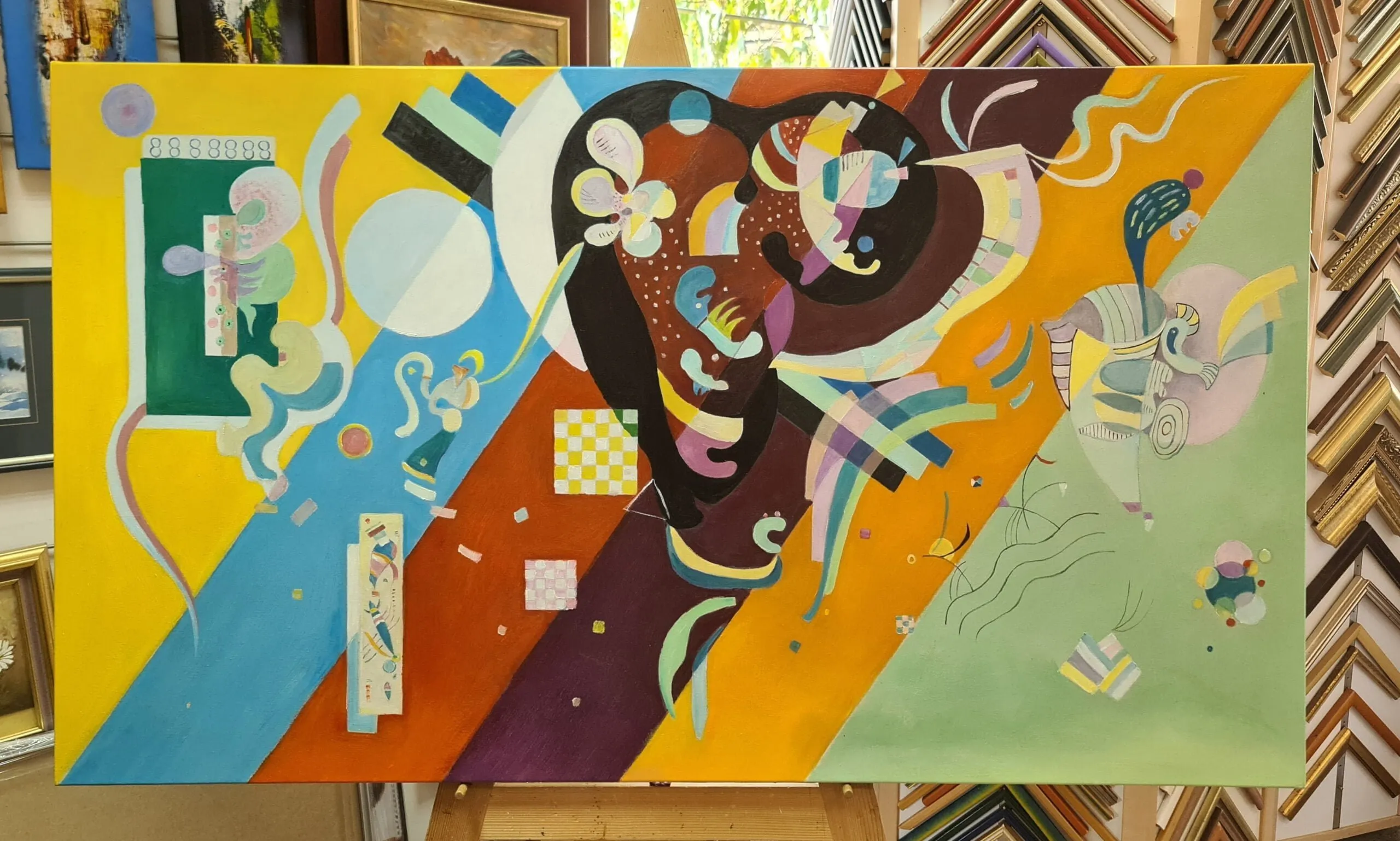

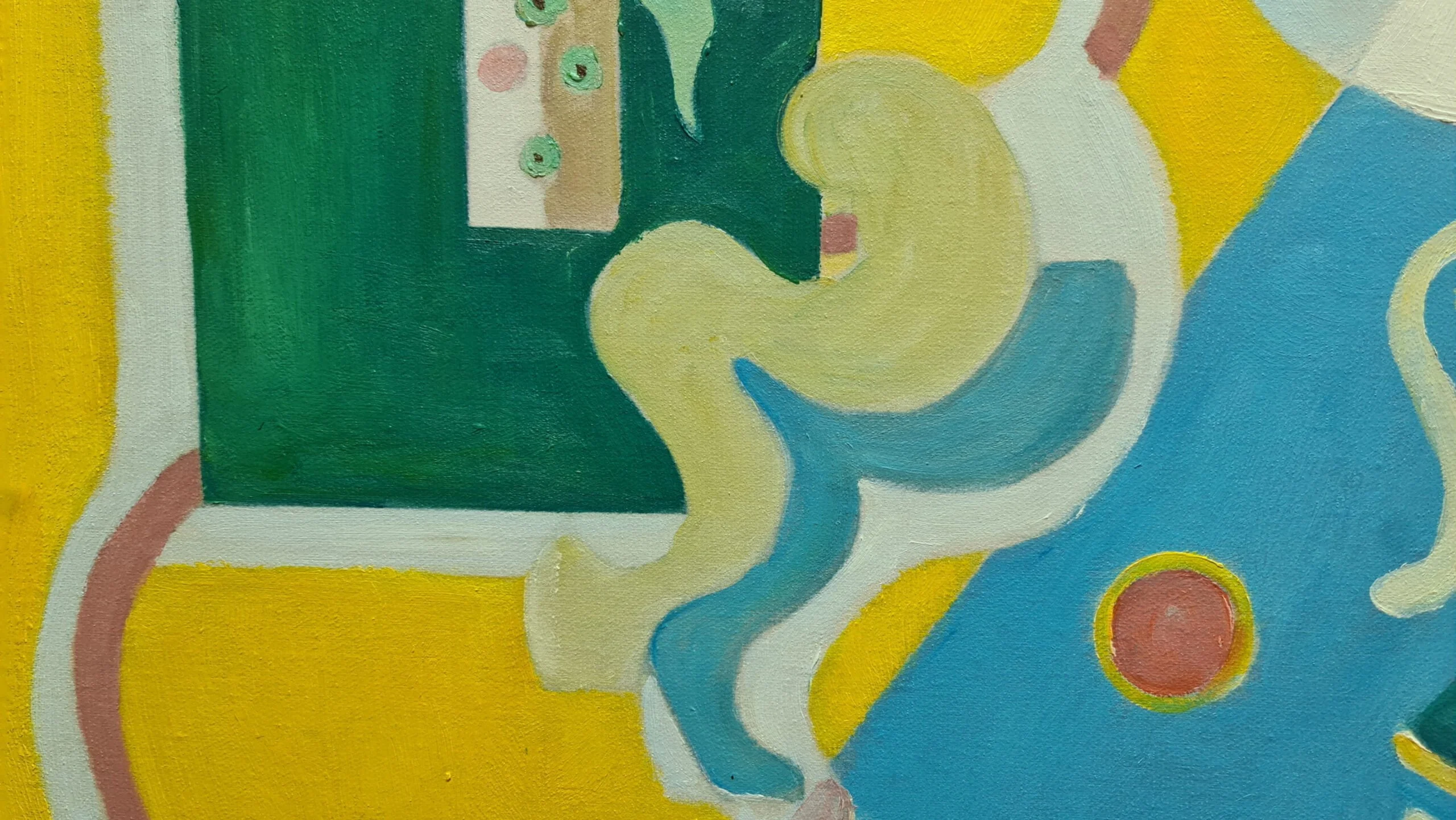
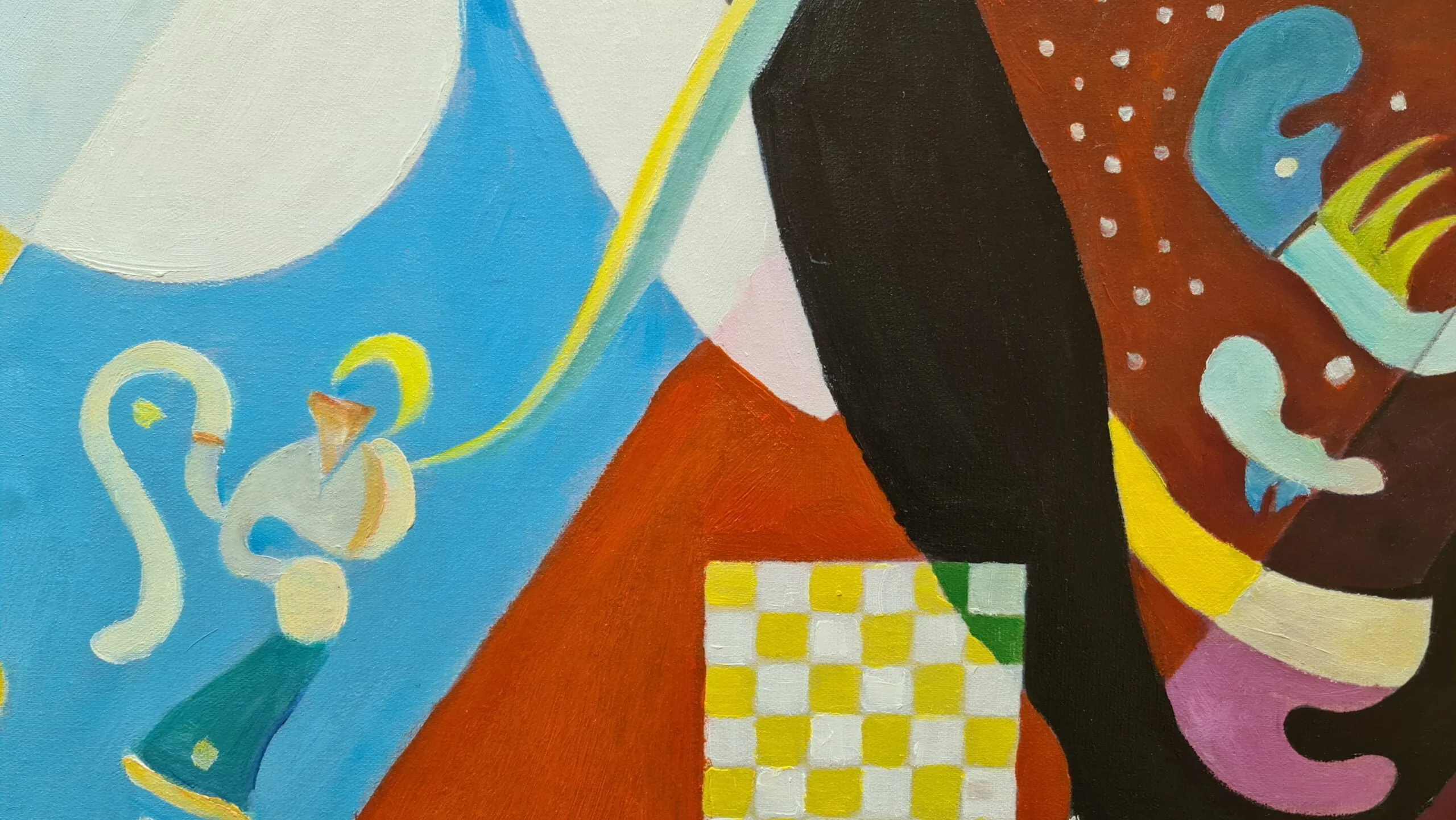
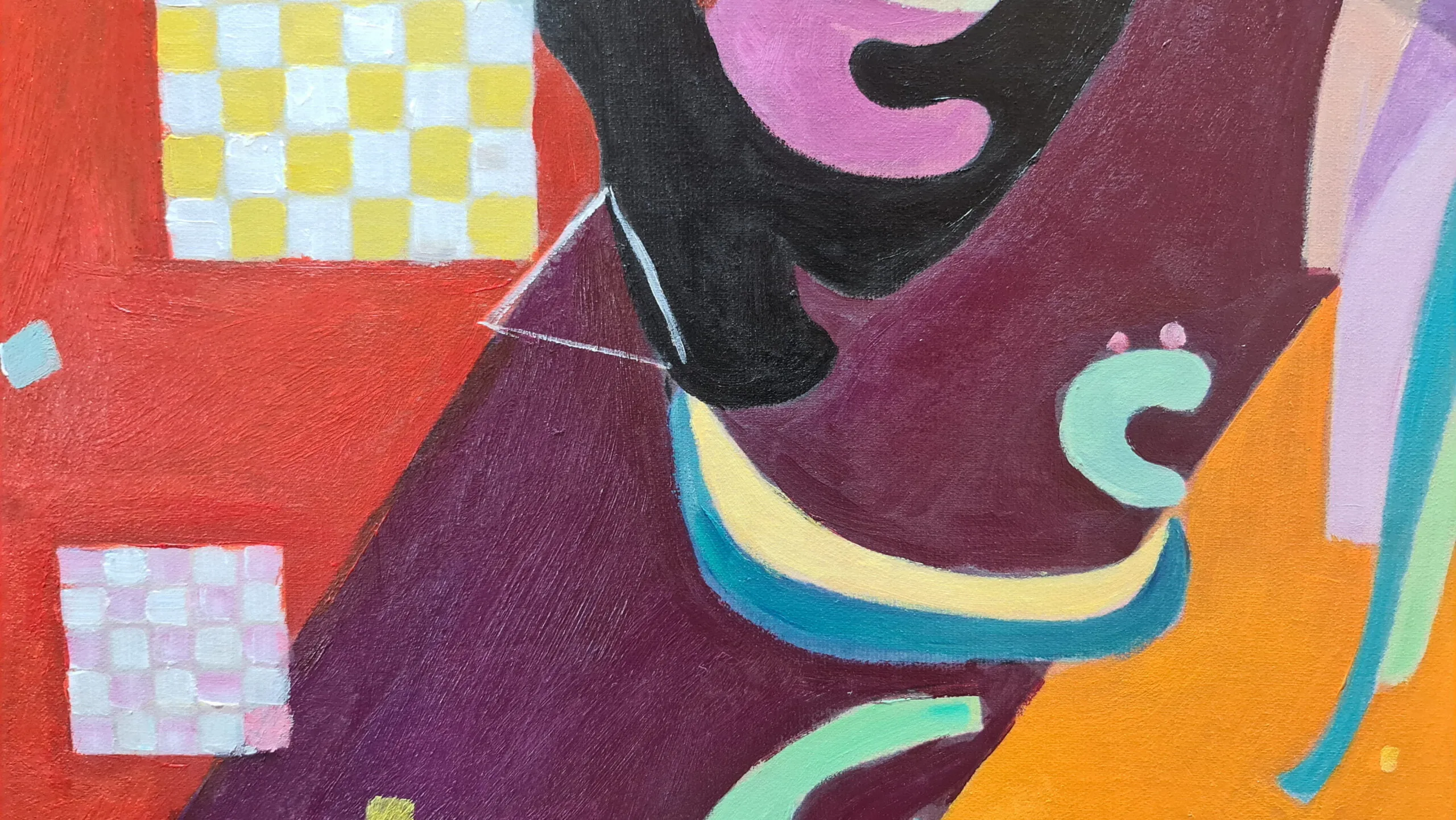

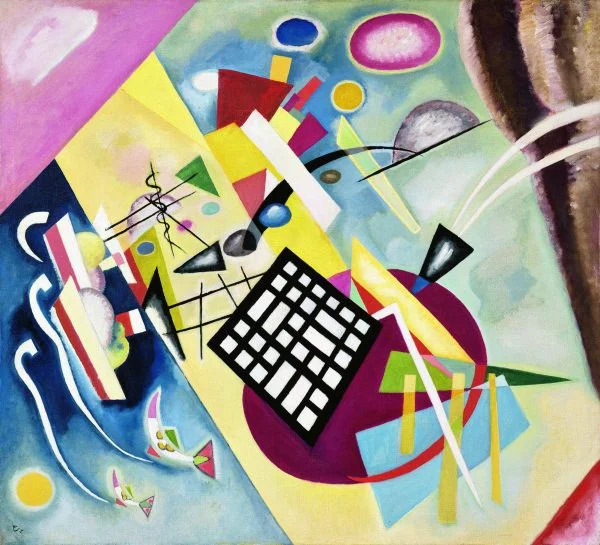
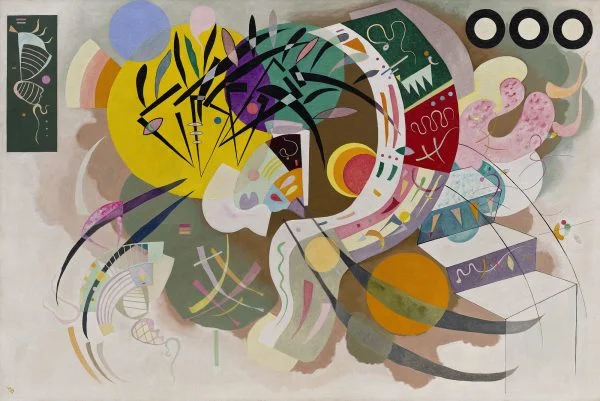
Composition IX is a painting by Wassily Kandinsky from 1936: a wide landscape-format canvas crossed on the diagonal by bands of yellow, blue, red, violet, orange and green, with small signs, two chequerboards and a large winding black form floating over them. The original belongs to the collection of the Centre Pompidou in Paris and until 14 February 2027 is on loan to the Kandinsky exhibition at Palazzo Bonaparte in Rome. We make it as a hand-painted reproduction in oil on canvas, in seven sizes or to your measurements, and before dispatch you receive a photograph of the finished work for approval.
| Title: | Composition IX |
| Other titles: | Komposition IX · L’Un et l’Autre |
| Painter: | Wassily Kandinsky (1866–1944) |
| Year: | 1936 |
| Original size: | 195 cm x 113.5 cm |
| Original technique: | Oil on canvas |
| Painting style: | Abstract art |
| Location: | Centre Pompidou, Paris (inv. JP 890 BIS P) |
| Our reproduction: | hand-painted oil on canvas, 7 sizes from 60 x 40 cm to 195 x 114 cm, made to measure on request |
Composition IX – Wassily Kandinsky
How is the painting built?
From slanting bands. Broad parallel bands cross the canvas from the lower left to the upper right: yellow on the left, then light blue, red, dark violet and orange, and on the right a large pale green field. Over this coloured ground the forms float as if they belonged to no band at all. The museum notes that the great diagonals dividing the ground are exceptional in Kandinsky’s work, even in 1936, and that a multitude of floating motifs – embryonic forms, a chequerboard and geometric figures – contrasts with the bold assertion of the coloured diagonals. As an abstract painting it has no subject to recognise, but it has a clear tension between the broad, calm ground and the small, restless signs on it.
What is on the canvas?
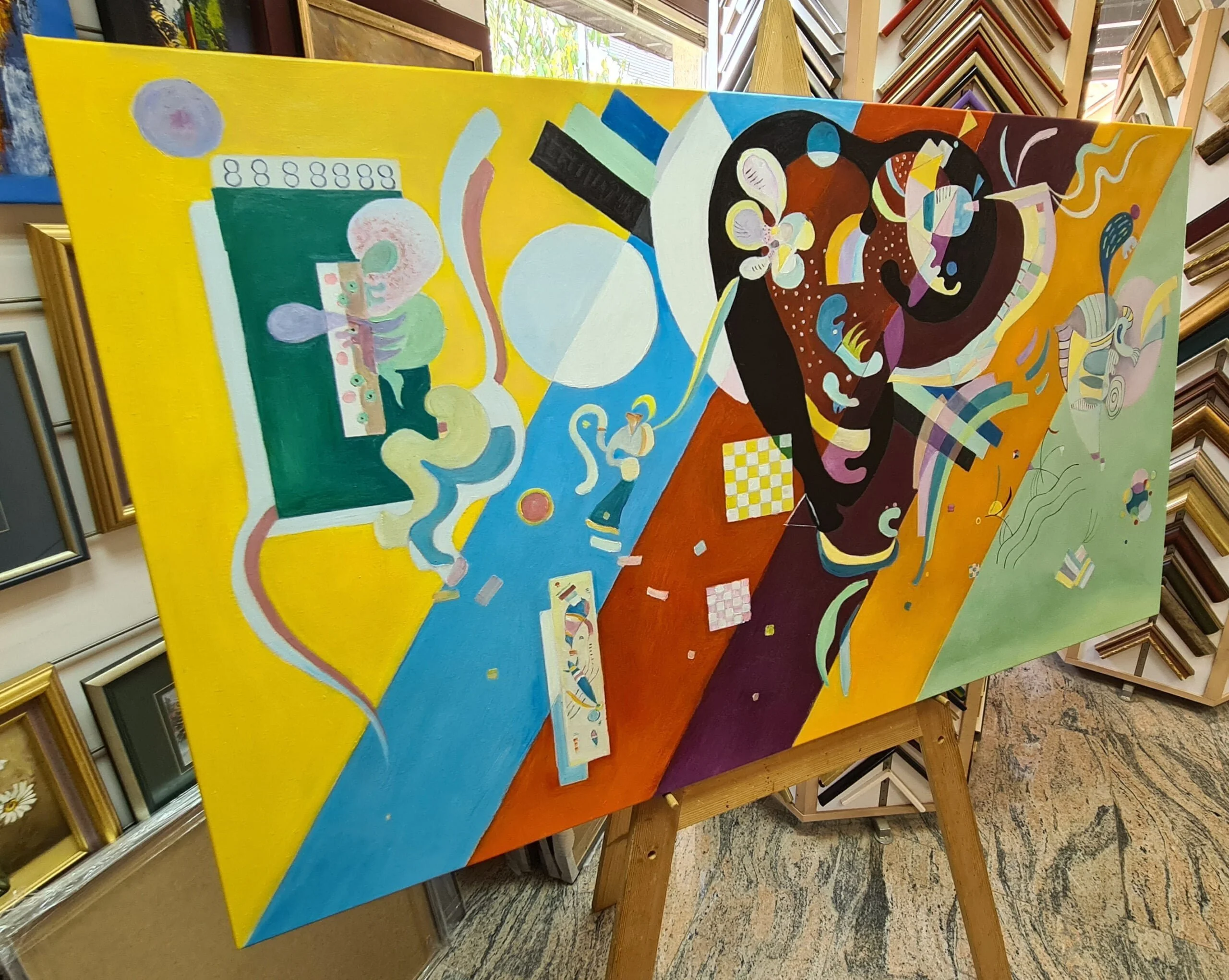
The centre is taken by a large black form that winds like a loop; in its dark red inner field fine dots are scattered, small embryonic forms float among them, and at its upper left edge sits a flower-like form. Behind it a large pale half-disc rises at the top, and to its left a white disc stands on the border between the yellow and the blue band. At the upper left rises an upright green rectangle topped by a row of small signs like figures of eight, with pale brown twisting forms beside it. On the red band lies a yellow and white chequerboard, below it a smaller pink and white one. At the lower left, on the border between the blue and the red band, stands a narrow upright tablet with small signs. On the right, on the border between orange and green, is a pale shell-like form with a striped cone and a turquoise plume rising from it, and concentric rings beside it. At the upper right thin wavy ribbons wind in turquoise and pink. On the green at the lower right are thin black wavy lines like hair, a cluster of pale small circles and a small striped rhombus. In the upper left corner is a pink circle, at the lower left a monogram.
Why is it called Composition IX?
The museum records that the painting was first titled L’Un et l’Autre, One and the Other. Kandinsky later placed it among his Compositions and gave it the number nine. The museum points to a curiosity here: he did not give that name to Courbe dominante of the same year, which is larger and, in the painter’s own view, more accomplished; we paint it as Dominant Curve.
What is a composition for Kandinsky?
The museum calls Composition IX the smallest of Kandinsky’s Compositions and sums up how he himself defined these paintings in his book Concerning the Spiritual in Art: as expressions that form within him slowly and that, after the first sketches, he reworks at length and almost pedantically. In them reason, consciousness and intention play the leading part, but in the end, as he wrote, feeling always wins over calculation. For him a composition is therefore the most deliberate kind of painting, not a quick idea.
Where was it made, and how did it reach the museum?
The museum records that from 1934 Kandinsky lived in Neuilly-sur-Seine near Paris and turned there to large compositions; Composition IX is dated 1936. At the lower left are the monogram VK and the number 36, on the back VK, the number 626 and the year 1936. In 1939 the French State bought it, and in the museum’s words it is the only painting by Kandinsky to enter a French museum during his lifetime. Kandinsky had deposited it at the Musée du Jeu de Paume and asked 100,000 francs for it; he received 5,000. The same museum also holds a study for Composition IX, a drawing in graphite and ink from the same year.
How is our hand-painted version made?
The painter works from a high-resolution reference and builds the painting up in layers, with brush and oil colours. With this subject the straight edges of the bands and the precision of the small signs decide everything: every band has to run parallel to the others, and every dot and every figure of eight on the green rectangle has to stay distinct. An oil painting reproduction keeps its colour for many years, because oil does not fade the way the colour of a print does. Because every hand-painted copy is made on its own, no two are alike in every detail; what they share is the subject, the proportions and the colours. The photographs at the top of the page show our copy in the studio: the first photograph the whole canvas from the front, on an easel among frame samples, the second photograph from the left, the third photograph from the right. The fourth photograph shows the upper left close up: the green rectangle and the pale yellow curling form. The fifth photograph shows the white disc and the yellow and white chequerboard beside the black form, the sixth photograph both chequerboards beside the lower end of the black loop, and the seventh photograph the shell-like form with its turquoise feather.
Which size for which wall?
The original measures 195 x 113.5 cm; at our largest size, 195 x 114 cm, the width is the same and the height 5 mm greater. As a painting for the living room it works best at 140 x 80 or 160 x 90 cm, where the small signs still stay legible. The 60 x 40 and 80 x 50 cm sizes suit a desk or a hallway, 100 x 60 cm a bedroom, and 180 x 100 cm a larger wall. Because the painting is very wide, it looks best above a sofa or a long sideboard, where it has room across.
Custom sizes, stretcher and frame
If none of the seven sizes fits your wall, we paint the work to your measurements; that is our painting made to measure, and we tell you how the bands adapt to the new proportion. Every canvas is stretched on a wooden stretcher. A frame is optional and not included in the base price.
Delivery and guarantee
Every canvas here is painted only after it is ordered, in our studio in Slovenia, so allow 15 to 45 days depending on the size. We send it protected, insured and tracked, across the EU without customs. If something is wrong on arrival, write to us and we will put it right. All of Kandinsky’s works here are gathered in our Wassily Kandinsky gallery, and the painter is introduced in our article about Wassily Kandinsky. Related works we paint include Thirty, Sky Blue and Composition X.
Frequently asked questions
Where is the original?
It belongs to the collection of the Musée national d’art moderne at the Centre Pompidou in Paris, inventory number JP 890 BIS P. Until 14 February 2027 it is on loan to the Kandinsky exhibition at Palazzo Bonaparte in Rome. The museum’s record is on the Centre Pompidou page.
How large is the original?
It measures 195 x 113.5 cm. We give the width first; the museum gives the height first, as 113.5 x 195 cm. At our largest size, 195 x 114 cm, the width is the same and the height 5 mm greater.
When was it painted?
In 1936. It is dated twice: at the lower left with the monogram and the number 36, on the back with the year 1936.
What is shown in the painting?
Nothing figurative: slanting coloured bands with small signs, embryonic forms, two chequerboards and a large winding black form floating over them.
Is this a print?
No. This is a canvas painting: it is painted by hand in oil, and the brushstrokes are visible in raking light and can be felt.
Which size should I choose?
For a living room 140 x 80 and 160 x 90 cm work best, for a desk or a hallway 60 x 40 or 80 x 50 cm. Before deciding, tape paper of that size to the wall for a day.
Can I have a size that is not on the list?
Yes. We also paint sizes that are not on the list, in the proportion your wall needs, and tell you how the bands and signs will fall.
How is it delivered?
Insured and tracked, across the EU without customs. Before dispatch you receive a photograph of the finished Kandinsky reproduction for approval.
What do the chequerboards mean?
The museum lists the chequerboard among the floating motifs, together with the embryonic forms and the geometric figures, but gives it no meaning; so we give it none either.
Is the original for sale, and what is it worth?
It is not for sale, so it has no market price. It belongs to a public museum collection and stays there; what we offer is a copy painted by hand, not the original, and we never confuse the two.
Does it make a good gift?
It does, especially for someone who likes strong colour and small details. If you are unsure about the subject or the size there is a gift voucher, and the decision stays with them.
- Subject: slanting bands of yellow, blue, red, violet, orange and green, with small signs, two chequerboards and a large black form over them
- Original: Centre Pompidou, Paris, inv. JP 890 BIS P, 1936, 195 x 113.5 cm; in Rome until 14 February 2027
- Our version: hand-painted oil on canvas, seven sizes from 60 x 40 to 195 x 114 cm, on a wooden stretcher, framed on request
- Worth knowing: according to the museum, the only painting by Kandinsky to enter a French museum in his lifetime