






Description
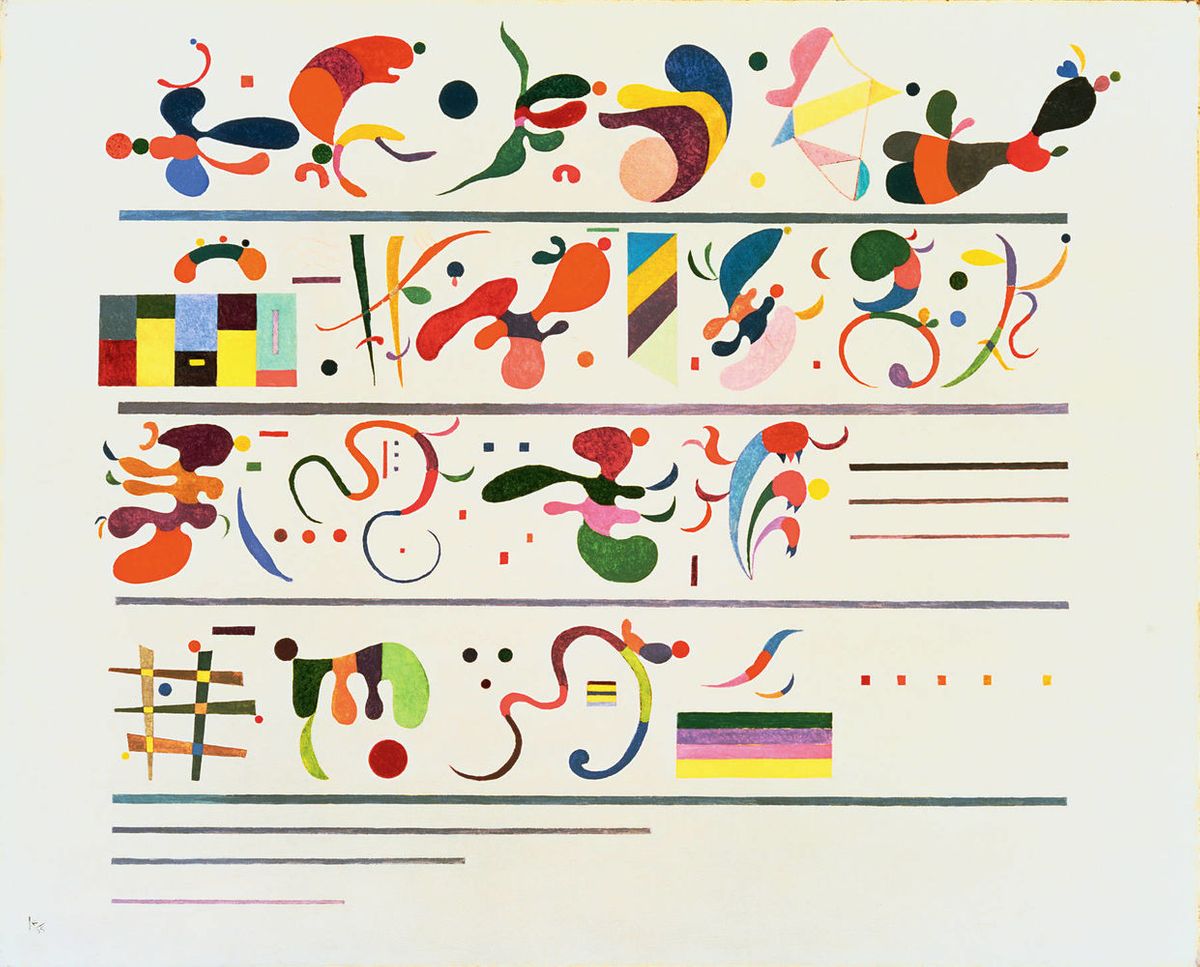
Succession is a painting by Wassily Kandinsky from 1935: on a pale, almost white plane, small coloured forms that recall creatures, plants and signs follow one another in four horizontal rows, separated by thin lines. The original is held by The Phillips Collection in Washington. We make it as a hand-painted reproduction in oil on canvas, in eight sizes or made to measure, and before dispatch you receive a photograph of the finished work to approve.
| Title: | Succession |
| Other titles: | Sukzession |
| Painter: | Wassily Kandinsky (1866–1944) |
| Year: | 1935 |
| Original size: | 100.01 cm x 80.96 cm |
| Original technique: | Oil on canvas |
| Style: | Abstract art |
| Location: | The Phillips Collection, Washington (inv. no. 0958) |
| Our reproduction: | hand-painted oil on canvas, 8 sizes from 50 x 40 cm to 150 x 120 cm, made to measure on request |
Succession – Wassily Kandinsky
What can be seen in the painting?
The ground is pale, almost white, and long, thin grey-blue and grey-violet horizontal lines run across it, dividing the painting into four rows. In the top row larger forms follow one another: a blue and red form like a butterfly, an orange form with a red edge, a green tendril, a yellow, blue and pink creature, a pale yellow and pink figure like a kite and a dark green form with a red beak. In the second row, on the left, is a small grid of coloured rectangles in yellow, red, blue, grey and black; to its right are red and orange forms, a slanting strip of blue, yellow and violet, and green and blue spirals. The third row holds a violet-red form, thin blue and red loops, a green form with a pink heart and a blue and red feather, with three parallel lines on the right. In the fourth row are crossed brown and green slats on the left, coloured loops and a red circle in the middle, and on the right a band of green, violet, pink and yellow and a row of tiny squares. Below run three more horizontal lines of different lengths, and the signature is in the bottom left corner. Between the larger forms, small black and red dots and tiny red squares are scattered, and above the grid in the second row sits a small orange arch with dark dots on top.
Four rows like a musical stave
The museum points out that, seen close up, the rows hold imaginary beings, shapes and signs moving in step across four bands, laid out much like music written on a stave. The forms really do follow one another like notes or letters on a line, from left to right, and the title Succession supports that reading. As an abstract painting it tells no story; it invites the eye to follow form after form, as if reading.
Embryos, amoebas and invertebrates?
According to the museum, the first impression points to something Kandinsky cared about all his life: natural science and its drawings of embryos, amoebas and invertebrates. The soft, rounded forms with their offshoots and dots in the upper rows do look like tiny living things under a microscope. Yet, as the museum says, on closer inspection they turn out to be creatures and signs of the painter’s own invention.
A late work full of energy
The museum places Kandinsky among the painters who changed early twentieth-century art, because he looked for an abstract language for ideas rather than things. It counts Succession among the works of his final years, when he painted with renewed energy. It also brings in two artists who read these late works each in his own way. Marcel Duchamp wrote in 1943 that in them thought becomes visible; the museum takes his remark as a pointer to how Kandinsky turned the canvas into a clean white field above which signs float. Jean Arp, a friend of the painter, found something else in them: life that keeps on growing. The museum sets the two readings against each other; in this painting both are easy to see.
How is our hand-painted version made?
The painter works from a high-resolution reference and builds the painting up in layers, with brush and oil paint. With this subject clean, precise work matters most: the ground has to stay evenly pale, and each of the dozens of small forms needs a clear edge and its own colour, with nothing running. The thin horizontal lines are painted with a steady hand in a single stroke. An oil painting reproduction keeps its colours for many years, because oil does not fade the way a print does. Since every reproduction is made individually, no two copies match down to the last detail; the subject, the proportions and the colours do.
Which interior suits Succession?
The painting is light and cheerful, with many small accents of colour on a white ground. It suits a modern or minimalist room, a child’s room, a music room or a work corner, where it is seen close up and the single forms can be discovered one by one. It works well on white, light grey or softly tinted walls; next to a very busy wallpaper the small forms would be lost. Hang it with its centre at about eye level, roughly 150 cm from the floor; above a sofa or sideboard, leave a gap of 20 to 30 cm, so the rows of forms can be read comfortably.
Which size for which wall?
The original measures 100.01 x 80.96 cm; at our 100 x 81 cm size the width is 0.1 mm less and the height 0.4 mm more. As a painting for the living room it works best at 90 x 70 or 100 x 81 cm, where the small forms are still easy to read. The 50 x 40 and 60 x 50 cm sizes suit a desk or a hallway, 70 x 60 cm a bedroom, and 110 x 90, 130 x 110 and 150 x 120 cm a large wall, where the rows of forms come alive like a whole sheet of music.
Custom sizes, stretcher and frame
If none of the eight sizes fits your wall, we paint this Kandinsky reproduction to your measurements; that is our painting made to measure, and we tell you how the composition adapts to the new proportions. Every canvas is stretched on a wooden stretcher. A frame is optional and not included in the base price. If you would like a frame, a narrow white or light-wood frame suits this work best, because it does not disturb the pale ground, while a dark or wide gold frame would draw more attention than the small forms.
Delivery and guarantee
Because every painting on canvas is painted only after the order, in our studio in Slovenia, allow 15 to 45 days depending on the size you choose. We ship protected, insured and tracked, within the EU without customs. If anything is wrong on arrival, get in touch and we will put it right. All our works by Kandinsky are collected in the Wassily Kandinsky gallery, and the painter is introduced in our article about Wassily Kandinsky. Related works we paint include Red Spot II, White Cross and Im Grau.
Frequently asked questions
Where is the original?
In The Phillips Collection in Washington, under inventory number 0958; the museum acquired it in 1944. The museum’s record is on the museum’s website, and the work also appears in the museum’s online collection.
How big is the original?
It measures 100.01 x 80.96 cm. We give the width first; the museum puts the height first, 80.96 x 100.01 cm. At our 100 x 81 cm size the width is 0.1 mm less and the height 0.4 mm more.
When was the painting made?
In 1935, in Kandinsky’s late period.
What does the painting show?
Nothing figurative: four rows of small coloured forms on a pale ground, separated by thin horizontal lines that, according to the museum, recall musical notation.
Is this a print?
No. It is a canvas painting, painted by hand in oil; the brushstrokes show in raking light and can be felt with the fingertips.
Which size should I choose?
For a living room 90 x 70 and 100 x 81 cm work best, for a desk or hallway 50 x 40 or 60 x 50 cm. Before deciding, tape a sheet of paper of the chosen size to the wall and leave it there for a day.
Can I have a size that is not on the list?
Yes. We also paint sizes outside the list and tell you how the forms will be arranged.
How is it delivered?
Insured and tracked, within the EU without customs. Before dispatch you receive a photograph of the finished painting to approve.
Why is it called Succession?
Succession means a sequence: in the four rows the forms follow one after another, like notes in a score.
Is the original for sale, and what is it worth?
It is not for sale and has no market price. It belongs to a museum collection and stays there; what we offer is a hand-painted copy, not the original, and we never confuse the two.
Is the painting suitable as a gift?
Yes, especially for someone who loves music, playful forms and light colours. If you are unsure about the subject or the size, there is a gift voucher, and the choice stays with the person who receives it.
- Subject: four rows of small coloured forms on a pale ground, separated by thin horizontal lines
- Original: The Phillips Collection, Washington, inv. no. 0958, 1935, 100.01 x 80.96 cm
- Our version: hand-painted oil on canvas, eight sizes from 50 x 40 to 150 x 120 cm, on a wooden stretcher, framed on request
- Worth knowing: according to the museum, the rows of forms recall musical notation