Description
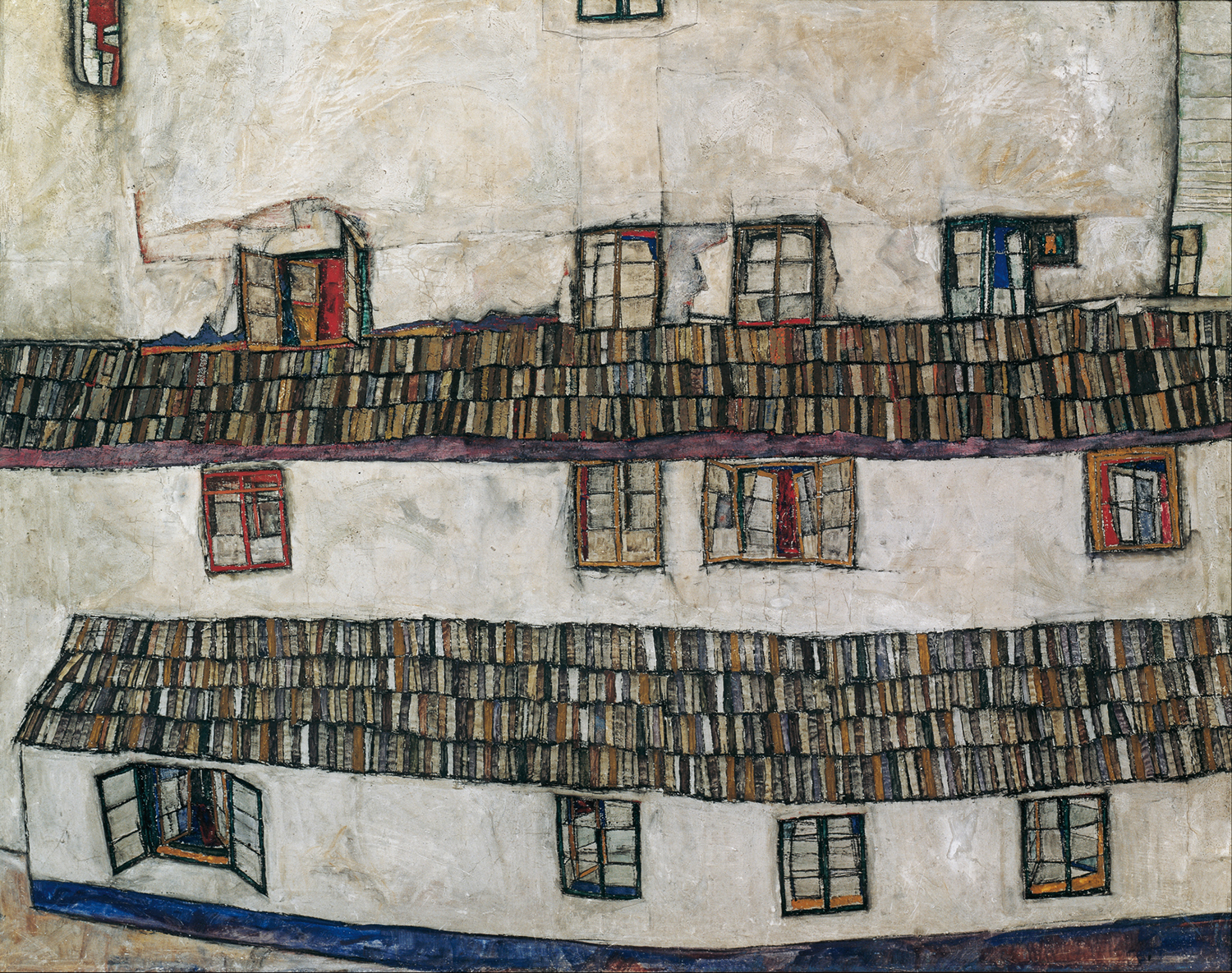
House Wall (Windows) is a 1914 work by Egon Schiele: the pale, cracked plaster wall of a house fills the whole canvas, crossed by two broad bands of roof and set with windows in three rows, each painted in its own colours. The original is held by the Belvedere in Vienna under inventory number 4278; it measures 142 x 111 cm and is unsigned. We paint it by hand in oils, in fifteen sizes or to your own measurement, and before dispatch we send you a photograph of the finished work for approval.
| Title: | House Wall (Windows) |
| Other titles: | Hauswand |
| Painter: | Egon Schiele (1890–1918) |
| Year: | 1914, unsigned |
| Original size (width × height): | 142 cm x 111 cm (the museum does not label the axes; landscape format) |
| Original technique: | Oil on canvas |
| Style: | Expressionism |
| Location: | Belvedere, Vienna (inv. 4278) |
| Our reproduction: | hand-painted oil on canvas, 15 sizes from 50 x 40 cm to 205 x 164 cm, or a made-to-measure size |
House Wall (Windows) – Egon Schiele
What does the painting show?
A house front, seen straight on and from close by. The Belvedere’s record says it was probably a building in Český Krumlov (Krumau in German), the town where Schiele’s mother was born; the building had inspired the artist on one of his stays there. The word “probably” is the museum’s, and the record gives no address. What the Austrian painter Egon Schiele (1890–1918) made of that house is not a view of a town but a wall: no sky, no street scene, no people. The record describes the façade as roughly plastered, riddled with cracks and showing all the traces of time, and punctuated by windows in an irregular arrangement, some open and some closed, each in different colours.
What is on the canvas?
An off-white wall, divided across its full width by two broad bands of roof. Both are built from hundreds of short upright strokes in browns, ochres, greys and a little violet, like tiles or shingles seen edge-on, and a thin violet line runs under the upper band. Above it sits the top row of windows, under a high, pale stretch of plaster; the one on the left stands wide open, with red inside and its casements swung out. Between the two roofs is a second row of four windows, framed in red or ochre, one of them open on a red curtain. Below the lower roof comes a third row of four, the one on the far left with both casements thrown open. At the top edge a small window on the left and another in the centre are partly cut off by the frame. The plaster itself is not flat: greys, creams and faint yellows are worked into it, and the cracks are drawn in dark line. Along the bottom runs a deep blue strip and, beneath it, a narrow band of path.
Why does this painting matter?
For what it does with an entirely ordinary subject. The first reason is the surface. The museum’s record notes that Schiele used paint resembling the plaster on a real façade, heightening the tactile effect, so the wall looks as though you could run a hand over it. The second is the composition: the wall fills the whole canvas, the arrangement tells us nothing about the surroundings, and space is indicated only by the narrow path along the lower edge. The third is the place behind it. The record links the house, probably, to Český Krumlov, the birthplace of Schiele’s mother.
What does the painting mean?
The Belvedere’s record gives no interpretation, and we do not invent one for it. There is no horizon, no sky and no street to place the house. The windows are the only openings in it, and no two are painted alike: open or shut, framed in red, ochre or dark green, some showing a coloured interior and some only grey glass. Whether Schiele meant more by that, the record does not say, and we leave the question open.
Where does the work come from?
The Belvedere’s provenance section for the work is short: three entries, all of them naming Hans Böhler. The first, dated before 1917, is recorded as a purchase from, or an exchange with, Böhler in Vienna; the second places Böhler in Vienna and New York. No other owner is named, and the record carries no restitution or claim note. The note below says how the work passed from Böhler to the Belvedere.
Provenance and where it is
The painting was owned by the painter and collector Hans Böhler (already before 1917); the Belvedere purchased it from Böhler in New York in 1948. It is now at the Upper Belvedere.
Where does this work sit among Schiele’s works?
Among his paintings of houses and towns. Three of them are in our range: the painting Houses in Winter (View from the Studio), then House Wall on the River and Houses on the River (The Old Town). House Wall (Windows) is a single façade with nothing around it, while the other three, as their titles say, bring in a winter view from the studio, a river or an old town. The full selection is in the Egon Schiele gallery, with more on his life in our article about Egon Schiele.
How is our hand-painted version made?
An artist works every canvas in oils, stroke by stroke: a hand-painted copy made for your order, not a machine print. Two passages are the hardest here. The first is the plaster. It has to stay grainy and uneven, or the wall turns into a smooth white field and the work loses the very thing the museum singles out. The second is the roofs and the windows: each roof is made of hundreds of separate strokes that must not merge into one brown band, and every window has to keep its own colours rather than being evened out. The original is oil on canvas, and so is our copy. When the work is finished we photograph it and send you the photograph for approval, and only then does it ship. This work has not yet been photographed in our workshop; we will add photographs to this page once we have them. Like every canvas we send, it can arrive stretched on a wooden stretcher bar; you choose that under the Stretcher option.
Which size for which wall?
Short answer: for most living rooms choose between 100 x 80 cm and 130 x 100 cm; closest to the original is 150 x 120 cm. Reading the record’s 142 x 111 cm as height by width, as the image shows, that size is 8 cm wider and 9 cm taller than the original. A subject built of horizontal bands wants length beneath it, so it sits well above a sofa, a sideboard or a bed, and less well alone on a narrow strip of wall. Above a chest of drawers or a desk, 70 x 55 cm or 80 x 65 cm; above a sofa in a living room, 110 x 85 cm or 130 x 100 cm; above a long dining table or on a large wall, 150 x 120 cm or 170 x 134 cm; in a stairwell or a tall room, up to our largest size, 205 x 164 cm. At the smaller sizes the plaster and the cracks read less clearly; if the surface matters most to you, choose 100 x 80 cm or larger. A canvas painting of this kind rewards distance: close up you read the strokes one by one, and from a few metres the wall comes together. A hand-painted painting hangs best with its centre at eye level, roughly 145–150 cm from the floor; above a sofa, 15–25 cm above the backrest.
Custom size, stretcher bar and frame
If none of the fifteen sizes suits your wall, we paint the work to your own measurement. If you choose “YES” under the Stretcher option, the canvas comes stretched on a wooden stretcher bar, ready to hang. Our 3D application is for choosing a frame only, not for showing the work on your wall; seeing it on your wall is a separate service. The frame is chosen separately and need not be part of the order. With so much off-white in the composition, a plain frame in a quiet tone keeps the attention on the wall.
Delivery and guarantee
We paint to order and deliver to sixteen countries in the European Union, among them Slovenia, Croatia, Austria, Italy, Hungary and Germany; the United Kingdom and Ireland are not currently among them. Before dispatch we send you a photograph of the finished work to approve. Production time depends on the size and on the studio’s workload. Every order is covered by our Returns and Refund Policy.
Frequently asked questions
What does Schiele’s House Wall (Windows) show?
A single house front seen straight on and from close by, with no sky, no street and no people. Its pale, roughly plastered wall is riddled with cracks, crossed by two broad bands of roof and set with windows in three rows, some open and some shut, each painted in its own colours. The German title is Hauswand (Fenster).
Which house did Schiele paint in House Wall (Windows)?
According to the Belvedere, probably a building in Český Krumlov, Krumau in German, the Bohemian town where Schiele’s mother was born. The house had caught his eye on one of his stays there. The museum gives no address, and the word “probably” is its own.
When did Schiele paint House Wall (Windows)?
In 1914, the same year as his Houses on the River (The Old Town), another motif from Krumau. The work is unsigned; it is painted in oils on canvas and measures 142 x 111 cm, in landscape format.
Why does the wall in House Wall (Windows) look so rough?
Because Schiele made the paint itself imitate plaster. The Belvedere’s record notes that he used paint resembling the plaster of a real façade, heightening the tactile effect, so the surface looks as though you could run a hand over it. The cracks are drawn in dark line, and the façade shows, in the museum’s words, all the traces of time.
Where is House Wall (Windows) today?
In the Belvedere in Vienna, where it hangs in the Upper Belvedere under inventory number 4278. Hans Böhler (1884–1961), an Austrian artist and collector who knew Klimt and Schiele and bought their works, owned it already before 1917. The Belvedere purchased it from Böhler in New York in 1948.
Does it work as a gift?
Yes; if you are unsure which size to choose, there is a gift voucher.
- Subject: a cracked, plastered house wall crossed by two bands of roof, with windows in three rows, each in its own colours; no sky and no people.
- Original: 1914, oil paint on canvas, 142 x 111 cm, unsigned, Belvedere, Vienna, inv. 4278.
- Ours: hand-painted in oils, 15 sizes or made to measure, stretched on a stretcher bar if you choose Stretcher: “YES”.
- Worth knowing: the museum’s record notes that Schiele used paint resembling real plaster, so the surface is meant to look touchable.