


Description
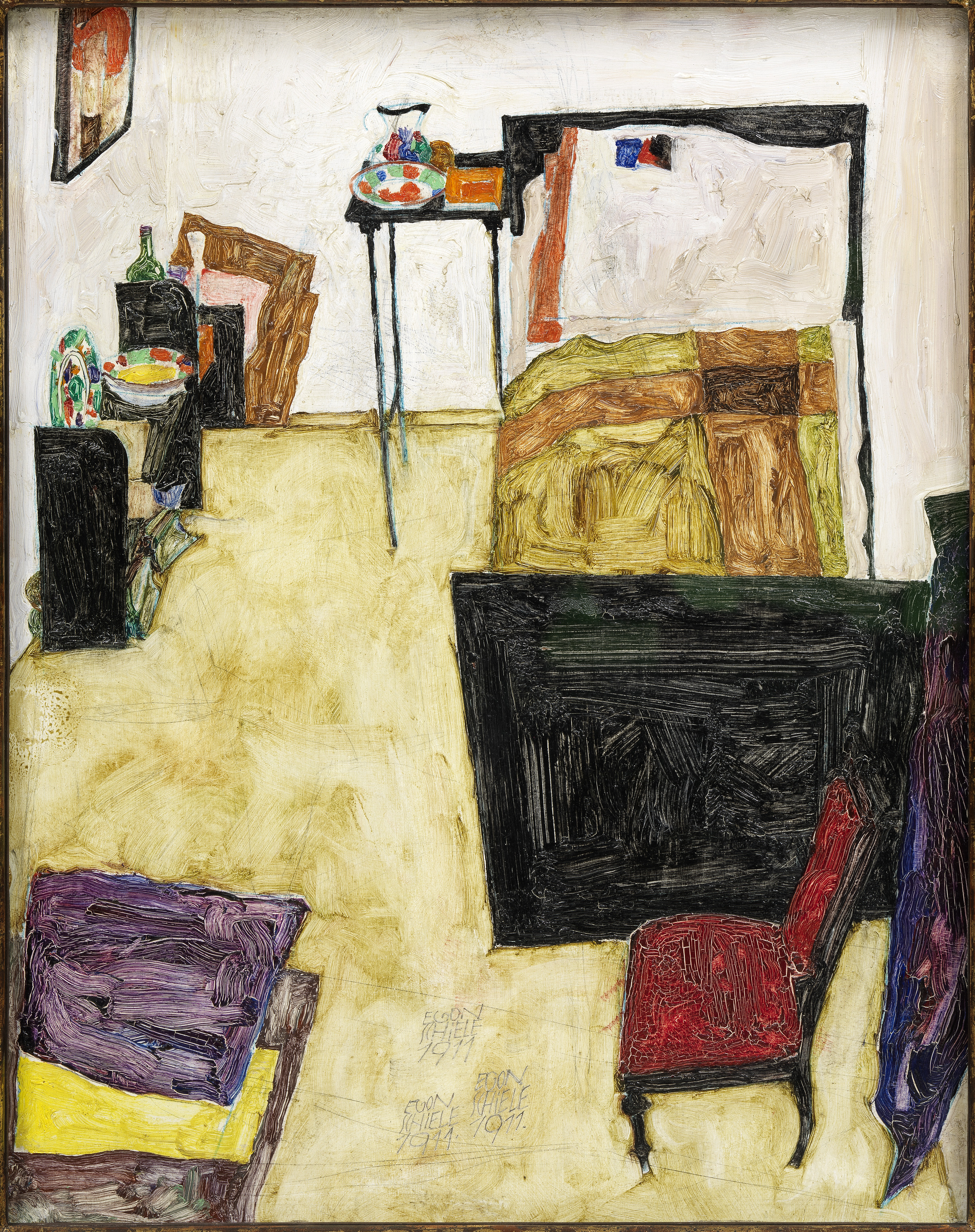
The Artist’s Room in Neulengbach is a work of 1911 by Egon Schiele: a room with nobody in it, with a yellow floor, a black bed, a red chair and a small still life on a thin-legged table in the middle. The original is in the Wien Museum in Vienna under inventory number 117203; it measures 31.5 x 40 cm and is painted in oil on wood. We make it as a hand-painted oil painting on canvas, in thirteen sizes or to your own measurement, and we send you a photograph of the finished work for approval before it ships.
| Title: | The Artist’s Room in Neulengbach |
| Other titles: | „Mein Wohnzimmer“ (Das Zimmer des Künstlers in Neulengbach) · Umetnikova soba v Neulengbachu |
| Painter: | Egon Schiele (1890–1918) |
| Year: | 1911 |
| Original size (width × height): | 31.5 cm x 40 cm |
| Original technique: | Oil on wood |
| Style: | Expressionism |
| Location: | Wien Museum, Vienna (inv. 117203) |
| Our reproduction: | hand-painted oil on canvas, 13 sizes from 50 x 65 cm to 160 x 205 cm, or a made-to-measure size |
The Artist’s Room in Neulengbach – Egon Schiele
What does the work show?
A room with nobody in it. The lower half of the panel is taken up by an ochre-yellow floor that tilts towards the viewer, as though the room were set at a slight angle. Along the right edge stands a bed with a dark blue-green cover and a white pillow, and behind it a red-brown board leans upright. Below the bed a large black cupboard lies across the right half like a dark block. At the very bottom right is a red chair with a high back, turned away from us. On the left stands a black chest with a small bottle and a shallow dish in which yellow and red catch the light. In the middle of the room a thin-legged table carries a still life: a white jug and a small bowl of fruit. In the lower left corner lie folded violet and yellow cloths. High on the pale wall at the left hangs a small framed work. The walls are light and almost bare, so the objects carry all the weight; no window is painted, so where the light comes from is left open.
Which room is this?
Schiele’s own, in Neulengbach. The museum record carries the work under two titles: „Mein Wohnzimmer“ — my living room — and Das Zimmer des Künstlers in Neulengbach, the artist’s room in Neulengbach. Among the motifs the record lists a bedroom and a bed, and among its themes living quarters and Vienna around 1900. So the title says living room while the furniture says bedroom; the museum does not reconcile the two, and neither do we.
What does the museum record say about it?
Less than you might expect, and saying so is the honest thing. The record has no descriptive text: it gives the artist, the year 1911, the technique, the measurements, inventory number 117203 and the work’s place in the permanent display. It does carry three facts you will not find elsewhere: the work weighs three kilograms, its frame measures 44.9 x 37.2 x 4 cm, and the catalogues list it as P 220 in Jane Kallir and as no. 84 in Tobias G. Natter (2017). We do not fill any of that out with readings the record does not make.
What is the original painted on?
On wood. The museum record gives oil paint and wood, that is an oil painting on a wooden panel, not on canvas. Our reproduction is painted in oils on canvas. We do not present those as the same thing: a wooden panel and a stretched canvas are different supports, and we name the difference. Setting Sun of 1913, which we also offer, is an oil on canvas; this panel is not.
Is the format upright or horizontal?
Upright. The record gives a height of 40 cm and a width of 31.5 cm, so the panel is a little more than a quarter taller than it is wide. Our steps follow it in a portrait format, from 50 x 65 cm to 160 x 205 cm, with the width given first.
Can I have it at the size of the original?
At the size of the original, no: the panel is 31.5 x 40 cm, and our smallest step, 50 x 65 cm, is larger on both sides. In proportion, though, our steps come very close. The original’s ratio of sides is 1 : 1.27, and four steps sit within a centimetre of it: 130 x 165 cm is one millimetre off, 110 x 140 cm three, 150 x 190 cm five and 90 x 115 cm seven. Six steps are between one and two centimetres off, two between two and three, and 100 x 130 cm is three centimetres off. For the original’s size, choose a made-to-measure size.
Where does the work come from and where is it now?
This page carries no provenance note, because the museum record publishes none: no chain of owners is given for this work. We do not substitute a guess for it. What the record does give is where the work is today: the Wien Museum in Vienna, inventory number 117203. The record also lists three books in which the work is published, among them the exhibition catalogue Traum und Wirklichkeit. Wien 1870–1930 of 1985 and the monograph Egon Schiele. Leben und Werk of 1968.
Where does this work sit among Schiele’s works?
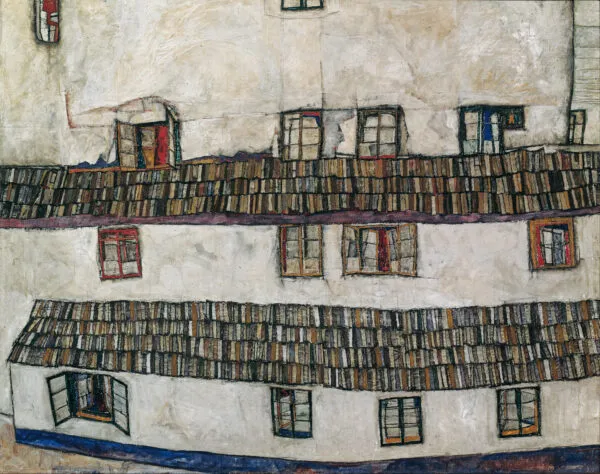
Among the few interiors in his output. From the same year and the same collection is the Self-Portrait with Black Clay Pot, also an oil on wood; four years earlier came Interior, one of the first rooms he painted, and from that same early period Houses in Winter (View from the Studio). The full selection is in the Egon Schiele gallery, with more on his life in our article about Egon Schiele; the works by Schiele in this collection are listed by the Wien Museum’s online collection search. Schiele was a younger contemporary of Gustav Klimt, and the Vienna Secession was the milieu he came out of; Viennese Expressionism is the movement he helped define, and Austrian art of those years is still read through those two names. As an expressionist painting of an empty room, it shows the person exactly by leaving them out.
How is our hand-painted version made?
Every canvas is painted by an artist in oils, stroke by stroke – not a machine impression but a hand-painted copy made for your order. Two things are hardest here. The first is the floor: a large yellow plane that has to stay alive rather than evenly coated, or the room loses its tilt and turns into a ground plan. The second is the points of colour – the red chair, the violet cloth, the fruit in the dish – which hold the balance across a small surface; let one darken or grow and the room tips over. At the larger sizes the bed is demanding too: its cover is built from broad strokes that must stay legible as brushwork and not become a pattern. When the work is finished we photograph it and send you the photograph for approval, and only then does it ship. We hold no studio photographs of this work yet – it has not been photographed in our workshop, and nothing has been removed; when it is painted, the images will be added here. As a canvas reproduction it arrives stretched on a wooden bar, ready to hang.
Which size suits which wall?
Short answer: this is a quiet motif that stands being close. Beside a bed, in a hallway or above a desk, 50 x 65 cm or 60 x 75 cm is enough; above a sideboard 80 x 100 cm or 90 x 115 cm; for a larger wall 120 x 150 cm and up to 160 x 205 cm. Our smallest size is 50 x 65 cm. As a canvas painting full of small objects it opens up with size: at the larger steps you can see that every piece of furniture is painted with its own stroke.
How do I order a made-to-measure size, stretcher bar and frame?
If none of the thirteen sizes suits your wall, we paint the work to your own measurement. The canvas comes stretched on a wooden bar; our 3D application is for choosing a frame only, not for showing the work on your wall. The frame is chosen separately and need not be part of the order.
How is it delivered and what do we guarantee?
We paint to order and deliver to sixteen countries in the European Union, among them Germany, France, Italy, the Netherlands and Poland; the United Kingdom and Ireland are not currently among them. Before dispatch we send you a photograph of the finished work for approval, and if you are not satisfied we correct the work or paint it again. Production time varies with the size and the studio’s workload.
Frequently asked questions
Why did Schiele live in Neulengbach?
In 1911 Schiele left Krumau and settled in Neulengbach, a small town west of Vienna, where he hoped for an inexpensive studio and quiet surroundings. Wally Neuzil, his model and companion in those years, lived there with him. The room in this work is his own; the museum also records it as „Mein Wohnzimmer“, my living room.
Is The Artist’s Room in Neulengbach inspired by Van Gogh’s Bedroom?
It is often read that way: the National Gallery of Victoria in Melbourne calls it Schiele’s direct homage to Van Gogh. Schiele had seen Van Gogh’s work at an exhibition in Vienna in 1909, among it a version of The Bedroom. Where Van Gogh wanted a restful room, Schiele’s, with its tilted floor and hard-edged furniture, feels tense.
Why is there nobody in the room?
No figure appears, only a bed, a chair, a chest, a cupboard and a small table with a jug and fruit. The empty room stands in for the person who lives in it: it shows him exactly by leaving him out. It is one of the few interiors in Schiele’s output.
What happened to Schiele in Neulengbach?
In April 1912 he was arrested there on suspicion of seducing a 13-year-old girl, and the police took more than a hundred drawings from his studio. The seduction and abduction charges were dropped, but he was convicted of showing erotic drawings in a place accessible to children. With 21 days already spent in custody and three more days of sentence, he was held for 24 days.
Where is The Artist’s Room in Neulengbach today?
In the Wien Museum in Vienna, under inventory number 117203. It is a small panel in oil on wood, 31.5 x 40 cm, dated 1911.
Does it work as a gift?
It does; if you are unsure which size to choose there is a gift voucher.
- Subject: an empty room in Neulengbach – yellow floor, black bed, red chair and a still life on a small table.
- Original: 1911, oil on wood, 31.5 x 40 cm, Wien Museum, Vienna, inv. 117203.
- Ours: hand-painted in oils on canvas, 13 sizes or a made-to-measure size.
- Worth knowing: the museum record carries no descriptive text, but it does say the work weighs three kilograms.