



Description
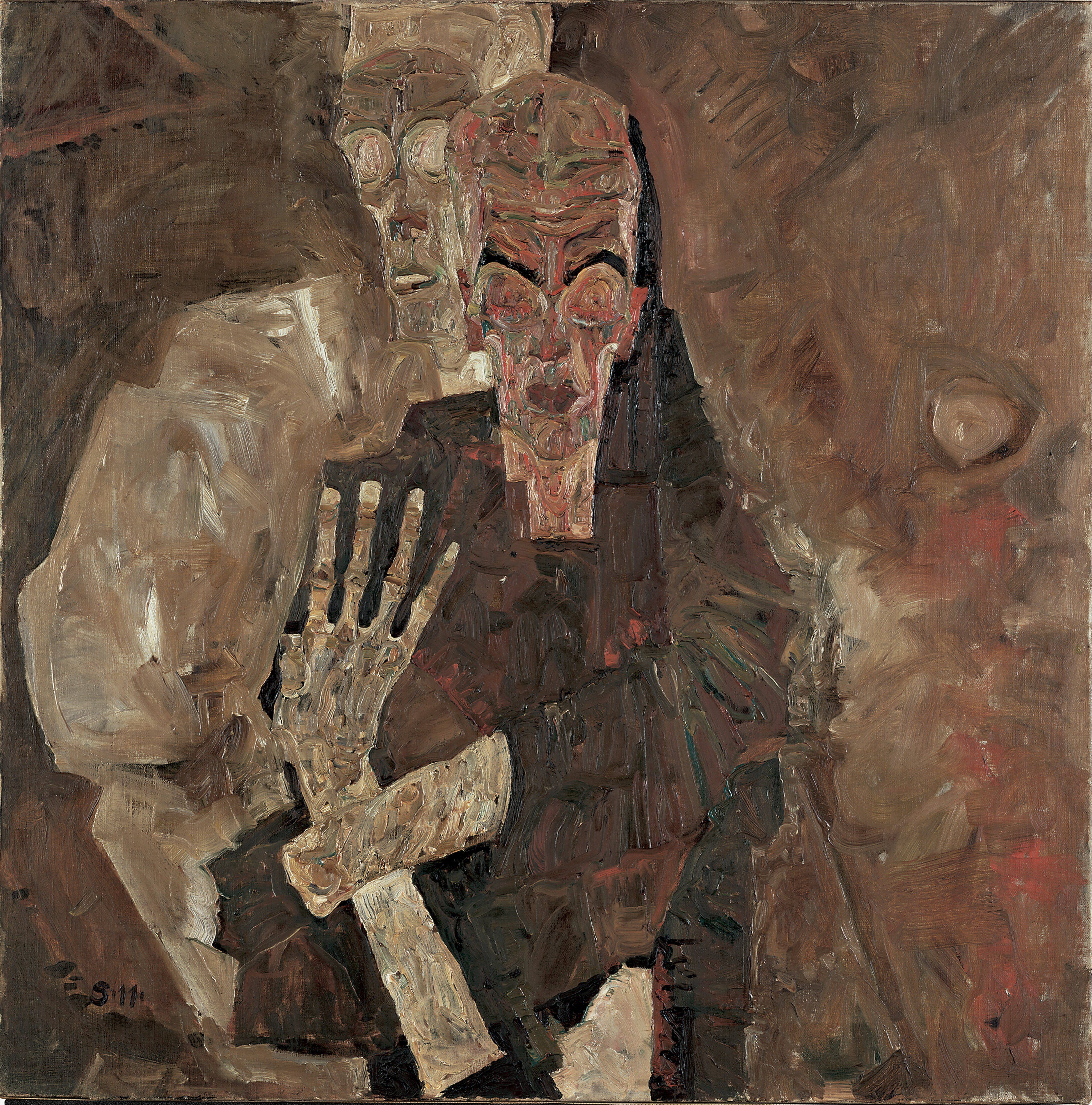
Self-Seers II (Death and Man) is a 1911 work by Egon Schiele in oil on canvas: a man seen from the front with a pale second head close behind his own and a large open hand rising across his chest, against a warm brown ground. We paint it by hand in oils at the size you choose, and before dispatch we send you a photograph of the finished work for approval.
| Title: | Self-Seers II (Death and Man) |
| Other titles: | Selbstseher II · Samovidec II |
| Painter: | Egon Schiele (1890–1918) |
| Year: | 1911, signed and dated lower left “S. 11.” |
| Original size (width × height): | 80.5 cm x 80 cm |
| Original technique: | Oil on canvas |
| Style: | Expressionism |
| Location: | Leopold Museum, Vienna |
| Our reproduction: | hand-painted oil on canvas, 15 sizes from 50 x 50 cm to 200 x 200 cm, or a made-to-measure size |
Self-Seers II (Death and Man) – Egon Schiele
What does the painting show?
A man, seen from the waist up, faces us in the middle of the canvas. His face is long and gaunt, built from thick ridges of pink, ochre, red and green; heavy black brows sit over eyes that look closed, and the mouth is a small dark shape. Just behind him and to the left rises a second head, paler and greyer, with round eyes of its own, partly hidden behind the first. The man wears a dark brown garment laid on in broad, heavy strokes. From the lower left a large pale hand with long, spread fingers comes up across his chest. To the left of the figures lies a broad light area in cream and grey. The ground is a warm brown with every stroke left visible; at the right a round light mark and a reddish patch stand out. At the lower left the Austrian painter signed and dated the canvas “S. 11.”
Why do people love it?
Because it is strong and strange at once. The subject is simple – one man and a second head behind him – yet it is hard to look away, because the double makes you ask who is who. The colours are few: browns, cream, and a little red and green in the face, so from across a room the work reads as one calm, warm surface, while the heads and the hand keep drawing you back. The paint is thick and physical; the ridges on the face catch the light, and close up the surface is as rewarding as the whole. And the two titles, Self-Seers and Death and Man, give you two ways into the same canvas.
Provenance
From Schiele’s estate (1919) the painting passed to Max Hevesi in Vienna (1919), then to Otto Nirenstein and the Neue Galerie in Vienna (before 1930 to 1948), the Galerie St. Etienne in New York (1948–1954) and Rudolf Leopold (1954–1994); it is now at the Leopold Museum in Vienna.
Where does it sit among Schiele’s works?
It belongs with his figure works and portraits. On our shelf you will also find Portrait of Herbert Reiner (Reiner Boy), The Lyricist and Cardinal and Nun (Caress); if you are choosing between them, open them side by side. The full selection is in the Egon Schiele gallery, with more on his life in our article about Egon Schiele.
How is our hand-painted version made?
A painter in our workshop paints every copy by hand in oils, stroke by stroke, for your order – it is not a machine print. Two things matter most here. The first is the face in front: it is built from thick ridges of paint, and those ridges have to stay, or the face goes flat. The second is the balance between the two heads: the one behind must stay paler and quieter, yet still read clearly as a head. The original is painted on canvas, and so is our copy. When the work is finished we photograph it and send you the photograph for approval, and only then does it ship. This work has not yet been photographed in our workshop; we will add photographs to this page once we have them. It can arrive stretched on a wooden stretcher bar; you choose that under the Stretcher option.
Which size for which wall?
The original measures 80.5 x 80 cm, so it already asks for a fair amount of wall. For a smaller wall, in a study or a hallway, 50 x 50 cm or 60 x 60 cm is enough. Above a sofa or a sideboard in a living room, 80 x 80 cm, 100 x 100 cm or 110 x 110 cm works well. On a large wall, in a stairwell or in a tall room, choose 150 x 150 cm or 200 x 200 cm and leave bare wall around it. A canvas painting of this kind needs distance: close up, the ridges of paint read one by one, and the two heads come together from a few steps back. Our sizes run from 50 x 50 cm to 200 x 200 cm. A hand-painted painting hangs best with its centre at eye level, roughly 145–150 cm from the floor; above a sofa, 15–25 cm above the backrest.
Custom size, stretcher bar and frame
If none of the fifteen sizes suits your wall, we paint the work to your own measurement. If you choose “YES” under the Stretcher option, the canvas comes stretched on a wooden stretcher bar, ready to hang. Our 3D application is for choosing a frame only, not for showing the work on your wall. The frame is chosen separately and need not be part of the order.
Delivery and guarantee
We paint to order and deliver to sixteen countries in the European Union, among them Slovenia, Croatia, Austria, Italy, Hungary, Germany and France; the United Kingdom and Ireland are not currently among them. The painting travels protectively packed. Before dispatch we send you a photograph of the finished work to approve. Production time depends on the size. Every order is covered by our Returns and Refund Policy.
Frequently asked questions
What does Self-Seers II (Death and Man) mean?
The Leopold Museum reads it as the portrait of a self in crisis: an individual that has lost the security of being “indivisible”. The man in front, sunk in introspection with his eyes closed, is paired with a pale revenant, and a hand rising from below belongs to neither figure, which deepens the sense of a split self.
Who is the second figure behind the man?
The museum calls it a shadowy double, a pale revenant of the man in front. Schiele gave the work two titles, Self-Seers and Death and Man, so the second head can be read both as the man’s own double and as death standing behind him.
Why is it called Self-Seers II?
Because Schiele had painted the theme once before: the museum mentions an earlier version, now lost, in which he likewise split the figure with a shadowy double. The title Self-Seers points to a heightened perception of oneself that goes beyond rational knowledge.
When did Schiele paint Self-Seers II?
In 1911: the canvas is signed and dated at the lower left with his initial and the year. It is painted in oils on canvas and is almost square, 80.5 x 80 cm.
Where is Self-Seers II today?
In the Leopold Museum in Vienna, under inventory number 451. The museum’s record lists its owners in this order: Schiele’s estate, Max Hevesi, Otto Nirenstein and the Neue Galerie in Vienna, the Galerie St. Etienne in New York and Rudolf Leopold, who held it from 1954 to 1994.
Does it work as a gift?
Yes; if you are unsure which size to choose, there is a gift voucher.