


Description
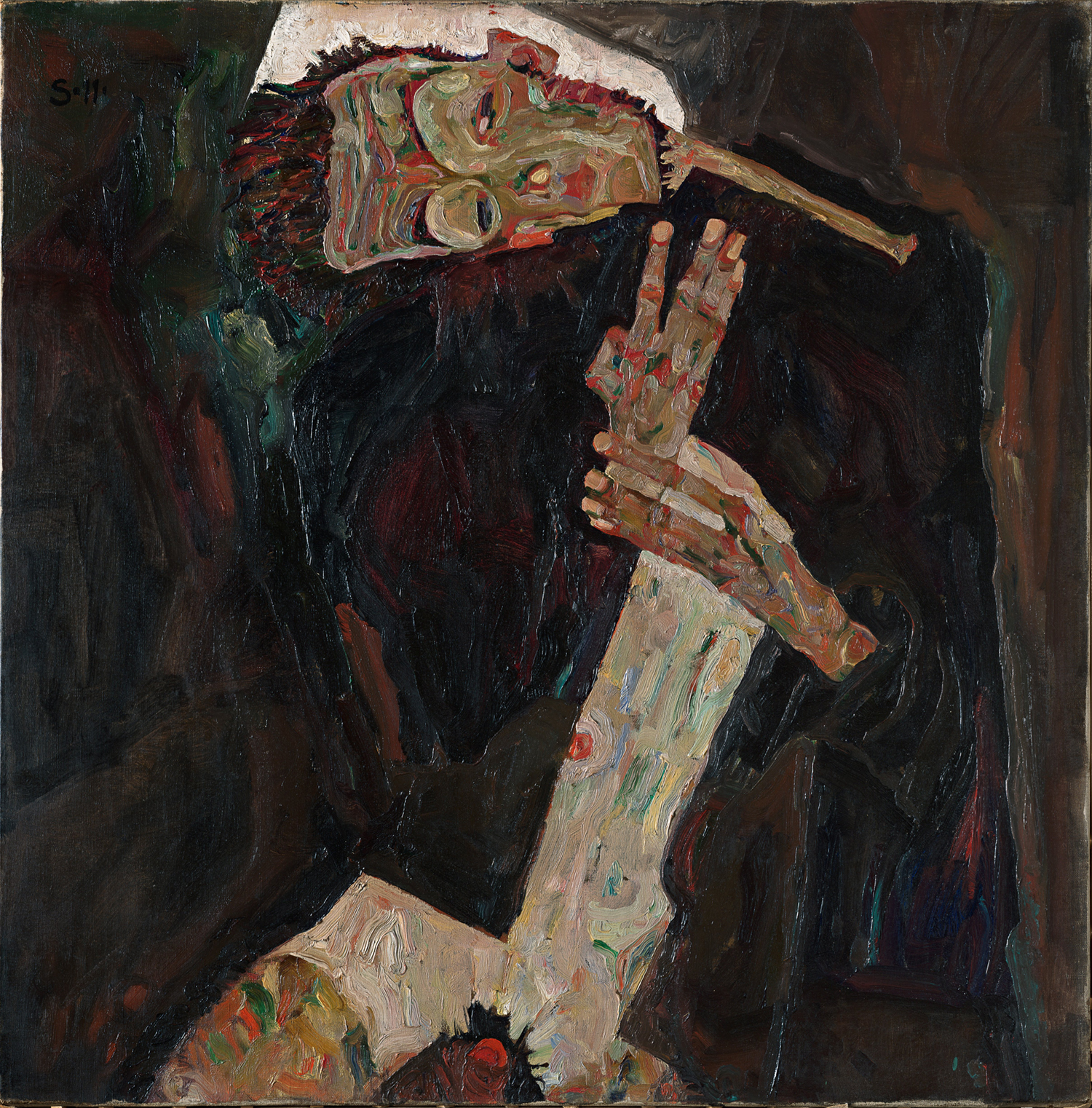
The Lyricist is a 1911 work by Egon Schiele: a self-portrait on an almost square canvas in which he presents himself as a “lyricist”, the head laid nearly on its side and the pale, twisted body set against a dark ground. The original is held by the Leopold Museum in Vienna under inventory number 450; it measures 80.5 x 80 cm. We paint it by hand in oils, in fifteen sizes or to your own measurement, and before dispatch we send you a photograph of the finished work for approval.
| Title: | The Lyricist |
| Other titles: | Der Lyriker · Lyricist |
| Painter: | Egon Schiele (1890–1918) |
| Year: | 1911, monogrammed and dated upper left “S. 11” |
| Original size (width × height): | 80.5 cm x 80 cm (the museum does not label the axes; almost square) |
| Original technique: | Oil on canvas |
| Style: | Expressionism |
| Location: | Leopold Museum, Vienna (inv. 450) |
| Our reproduction: | hand-painted oil on canvas, 15 sizes from 50 x 50 cm to 200 x 200 cm, or a made-to-measure size |
The Lyricist – Egon Schiele
Who is in the painting?
The artist himself: the Austrian painter Egon Schiele (1890–1918). The canvas was created early in 1911, and according to the Leopold Museum’s text Schiele presents himself in it as a “lyricist” – a poet – in an extremely contorted posture. The title therefore names a role rather than a sitter: Schiele plays the poet with his own face and body. Among its references the museum also lists an edition of his letters and poems of 1910–1912 from the Leopold collection, published in Munich in 2008 under the title Der Lyriker Egon Schiele.
What is on the canvas?
A half-naked figure that fills the square almost from edge to edge. At the top the head lies nearly on its side, the crown towards the left edge; the face is built from ochre, green and red strokes, one eye looks out sideways from under a raised brow, and the long neck runs off to the right. Above the head a patch of white paint sits against the top edge. Below the head, one hand is raised with its fingers spread, and the other lies across beneath it. From the hands a pale band of body runs diagonally down to the bottom edge, with a red mark for the navel halfway down and, at the very bottom, a dark patch with the red of the groin. Everything else – the jacket and the ground – is dark brown, black and bottle green. In the upper left corner, in black, stand the monogram and date “S. 11”. According to the museum, Schiele worked with rapid brushstrokes and without an underdrawing, and the surface shows it: the paint sits in thick, separate strokes across the whole canvas.
Why does this painting matter?
For two reasons, both on the museum’s record. The first is its first public appearance. Created early in 1911, the canvas was shown in April of the same year at Schiele’s first solo exhibition, at the Galerie Miethke in Vienna, and it was reproduced in the accompanying publication together with a text by Albert Paris Gütersloh (1887–1973). The second is how thoroughly the work has been documented since. The museum gives its number in five catalogues of Schiele’s paintings, from Otto Nirenstein’s of 1930, where it is number 78, to Tobias Natter’s of 2017, where it is number 52.
What does the painting mean?
In the museum’s reading, it is about the crisis of the subject. The head is unnaturally inclined and partly surrounded by a white, nimbus-like space; the eyes look out sideways from under raised eyebrows with a sceptical expression. Apart from a short jacket, which visually blends with the background, the figure is naked and pale, and only two places are painted in a shining red: the navel and the groin. The navel sits in an anatomically incorrect position, the text notes, yet it is exactly what directs the axial composition towards the hands. Following the convention of the square format, Schiele fills the canvas with what the museum calls raw, painful, abject corporeality, and so vividly expresses that crisis.
Where does the work come from?
The Leopold Museum publishes its own provenance research and lists four stages: the estate of Egon Schiele in Vienna (1918); Arthur Stemmer, Vienna and London (before 1930 to 1954); Dr Rudolf Leopold, Vienna (1954–1994); and the Leopold Museum Private Foundation, Vienna (1994). The object data add that the work was contributed to the foundation in 1994. The museum also names sources for two stages. The Stemmer entry rests on Otto Nirenstein’s Egon Schiele. Persönlichkeit und Werk (Berlin 1930, no. 78); the Leopold entry rests on a dossier by Sonja Niederacher titled Egon Schiele. „Der Lyriker“, dated 30 June 2010, and on Diethard Leopold’s book Rudolf Leopold – Kunstsammler (Vienna 2003, pages 54–61). The provenance note this page carries follows below.
Provenance
From Schiele’s estate (1918) the painting passed to Arthur Stemmer (Vienna/London, before 1930 to 1954) and then to Rudolf Leopold (1954–1994); it is now at the Leopold Museum in Vienna.
Where does this work sit among Schiele’s works?
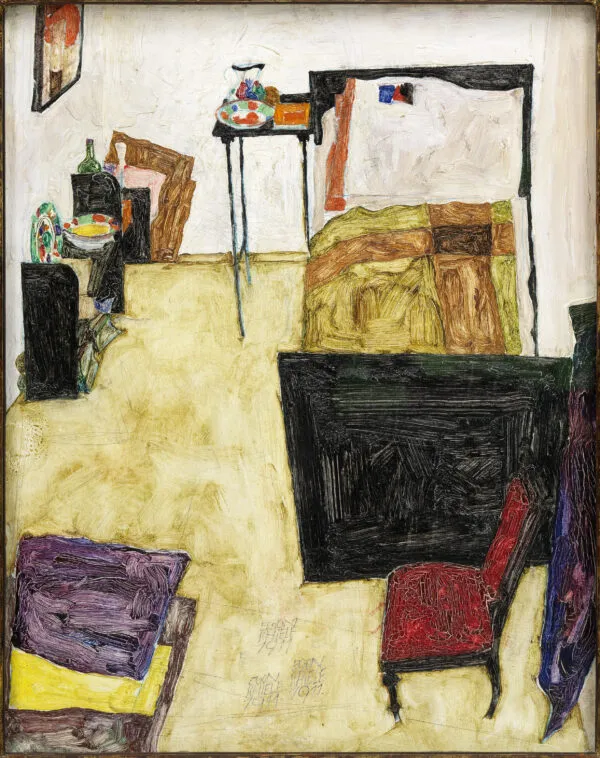
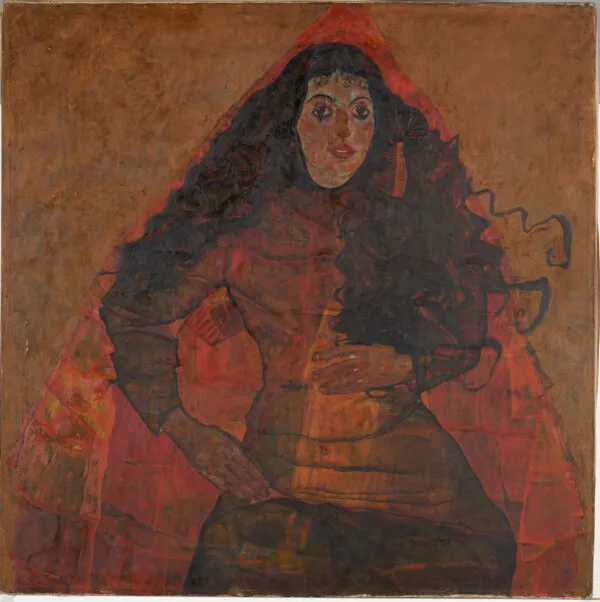
Among his canvases of 1911–1917 on our shelf, two are square, as this one nearly is. From the following year and the same collection comes The Hermits, also square but far larger at 181 x 181 cm, and from 1912–1913 the square portrait Trude Engel, 100 x 100 cm, today in the Lentos Kunstmuseum in Linz. Also of 1912 and also in the Leopold Museum is Cardinal and Nun (Caress), 70 x 80.5 cm, while Reclining Woman of 1917 is a long horizontal format, 96 x 171 cm, likewise in the Leopold Museum. The full selection is in the Egon Schiele gallery, with more on his life in our article about Egon Schiele.
How is our hand-painted version made?
A painter works every canvas in oils, stroke by stroke: a hand-painted copy made for your order, not a machine print. Two passages are the hardest here. The first is the skin: face, hands and body are built from separate strokes of ochre, green, pink and red, and if they are blended smooth the body turns an even pink and loses its tension. The second is the dark: jacket and ground are almost the same colour, and the copy has to keep them apart the way the original does, by the direction of the strokes alone. The original is painted in oils on canvas, and so is our copy. When the work is finished we photograph it and send you the photograph for approval, and only then does it ship. This work has not yet been photographed in our workshop; we will add photographs to this page once we have them. Like every canvas we send, it can arrive stretched on a wooden stretcher bar; you choose that under the Stretcher option.
Which size for which wall?
Short answer: the original is almost square, so the question is how much of the wall the figure should take. The museum gives 80.5 x 80 cm without saying which side is which; closest to it is our 80 x 80 cm, which equals the original on one side and is 5 mm shorter on the other. For a smaller wall, above a chest of drawers or a desk, 50 x 50 cm or 60 x 60 cm is enough; above a sofa in a living room, 100 x 100 cm or 110 x 110 cm; on a large wall, a stairwell or in a tall room, 140 x 140 cm, 170 x 170 cm or 200 x 200 cm. A canvas painting at these sizes needs distance: close up, the strokes of the skin read one by one, and the face only comes together from a few metres away. Hang it with its centre at eye level, roughly 145–150 cm from the floor, or 15–25 cm above the backrest of a sofa.
Custom size, stretcher bar and frame
If none of the fifteen sizes suits your wall, we paint the work to your own measurement. If you choose “YES” under the Stretcher option, the canvas comes stretched on a wooden stretcher bar, ready to hang. Our 3D application is for choosing a frame only, not for showing the work on your wall; seeing it on your wall is a separate service. The frame is chosen separately and need not be part of the order.
Delivery and guarantee
We paint to order and deliver to sixteen countries in the European Union, among them Slovenia, Croatia, Austria, Italy, Hungary and Germany; the United Kingdom and Ireland are not currently among them. Before dispatch we send you a photograph of the finished work to approve, and our returns policy applies to every order. Production time depends on the size and on the studio’s workload. Every work travels protectively packed.
Frequently asked questions
Who is the man in The Lyricist?
Egon Schiele (1890–1918) himself: the work is a self-portrait. According to the Leopold Museum, he presents himself in it as a “lyricist” – a poet – in an extremely contorted posture. The title therefore names a role, not a sitter.
Where is the original of The Lyricist?
In the Leopold Museum in Vienna, under inventory number 450. The canvas is almost square and measures 80.5 x 80 cm. It passed from Schiele’s estate to the collector Arthur Stemmer and then to Rudolf Leopold, and has belonged to the Leopold Museum Private Foundation since 1994.
When did Schiele paint The Lyricist?
Early in 1911; the monogram and the date stand in the upper left corner. In April of the same year the canvas was shown at Schiele’s first solo exhibition, at the Galerie Miethke in Vienna. It was reproduced in the accompanying publication together with a text by Albert Paris Gütersloh.
What does The Lyricist mean?
In the Leopold Museum’s reading, it is about the crisis of the subject. Schiele casts himself as a poet, half-naked and pale, with the head unnaturally inclined, and only the navel and the groin are painted in a shining red. The museum speaks of a raw, painful, abject corporeality that fills the square format.
Is Der Lyriker the same work?
Yes. Der Lyriker is the German title of the same canvas, and the museum’s English record lists it as Lyricist. Sonja Niederacher’s 2010 provenance dossier on the work carries the German title.
How did Schiele paint The Lyricist?
In oils, and according to the museum with rapid brushstrokes and without an underdrawing. The paint sits in thick, separate strokes across the whole surface: ochre, green and red for the skin, dark brown, black and bottle green for the jacket and the ground. Each copy on this page is a hand-painted painting that follows those strokes one by one.
Does it work as a gift?
Yes; if you are unsure which size to choose, there is a gift voucher.
- Subject: a half-naked self-portrait, the head laid nearly on its side, one hand raised with the fingers spread, a pale body against a dark ground.
- Original: 1911, oil on canvas, 80.5 x 80 cm, monogrammed and dated upper left, Leopold Museum, Vienna, inv. 450.
- Ours: hand-painted in oils, 15 sizes or made to measure, stretched on a stretcher bar if you choose Stretcher: “YES”.
- Worth knowing: in April 1911 the work was shown at Schiele’s first solo exhibition, at the Galerie Miethke in Vienna.