




Description
Four Breton Women – the museum calls this canvas a key work
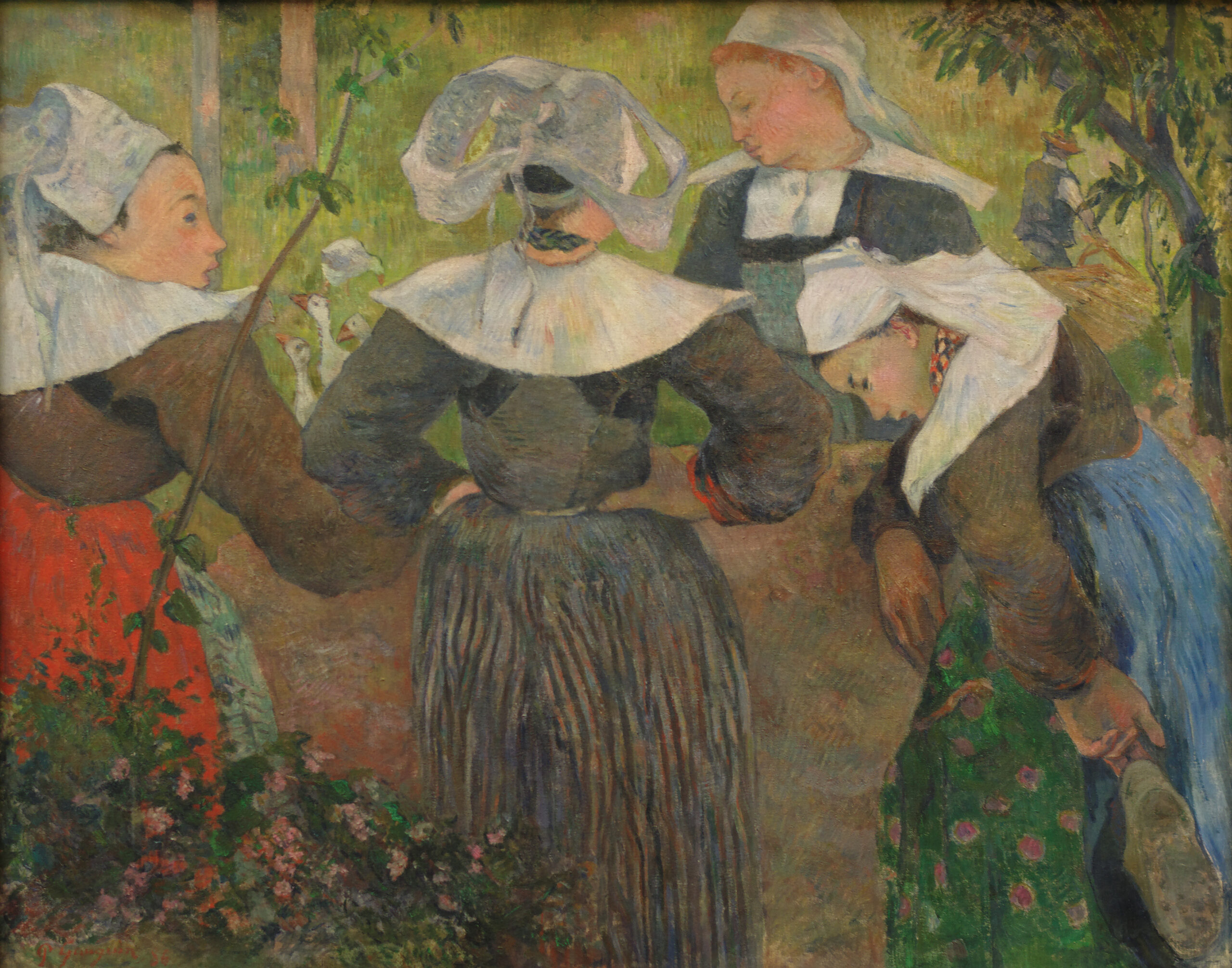
Four young women stand at a low stone wall, talking. All of them wear large white coifs with turned-back edges; one faces us with her hands on her hips and a striped apron, at the left edge one stands in profile in a red skirt, and at the right two lean towards each other. The ground is yellow-green, bushes with pink and red flowers grow along the wall, and a slender tree rises at the right. The colours are light and the strokes are short, set down in an even order. At the lower centre a signature with a year is painted onto the canvas in red. The work is held by the Neue Pinakothek in Munich under inventory number 8701; it was painted in 1886.
The museum calls it a key work in his development
The museum record does not speak of this canvas as a scene but as a turning point: in this key work of his development the artist’s interest in flat, decorative values is already apparent. The painter, the record says, was not concerned to render the wall and the figures with a marked bodily presence and so to create clear spatial relations. What emerges is something else: an arrangement of shapes across the surface.
Where it shows most
The record names the places too: the construction of the picture as a whole, and beyond that the curved forms of the white coifs and the patterned skirts. Those coifs are the lightest and largest closed shapes on the canvas; the eye reads them as a pattern before it reads them as headwear. The same is true of the stripes on the apron and of the flowers along the wall.
An impressionism already putting itself in order
The museum adds that the painter’s origin in impressionism can be recognised in the unpretentious motif, the light colours and the small brushstrokes. Those strokes, the record says, are here conspicuously ordered and fitted into an almost carpet-like system. This is impressionist craft already directed by a different intention.
The wall that encloses the fields
The record explains the object the women stand beside as well: one of those characteristic low walls with which land in Brittany is enclosed. On the canvas the wall runs diagonally and sets the figures into a row without separating them from us.
How a hand-painted reproduction is made
Every painting here is made by hand in oil on canvas, stroke by stroke. In this motif the white coifs are the hardest part: they are built from bluish, grey and yellowish tones that must stay distinct, or they collapse into one area of white and the painting loses its strongest pattern. Before dispatch you receive a photograph of the finished work for approval. Nothing on these pages is printed; the colour is mixed and laid on again for each canvas.
- Subject: four women in Breton dress at a low stone wall.
- Technique: oil on canvas, light colours and short, ordered strokes.
- Sizes: landscape format, from 40 x 32 cm to 200 x 160 cm; 80 x 64 cm and 100 x 80 cm are often chosen.
- Of note: the museum calls the canvas a key work in the painter’s development.
What came later in Brittany is shown by Breton Peasant Women, Breton Girls Dancing, Pont-Aven and The Gate (La Barrière). The museum record gives the measurement as height by width: 71.8 x 91.4 cm.