







































Description
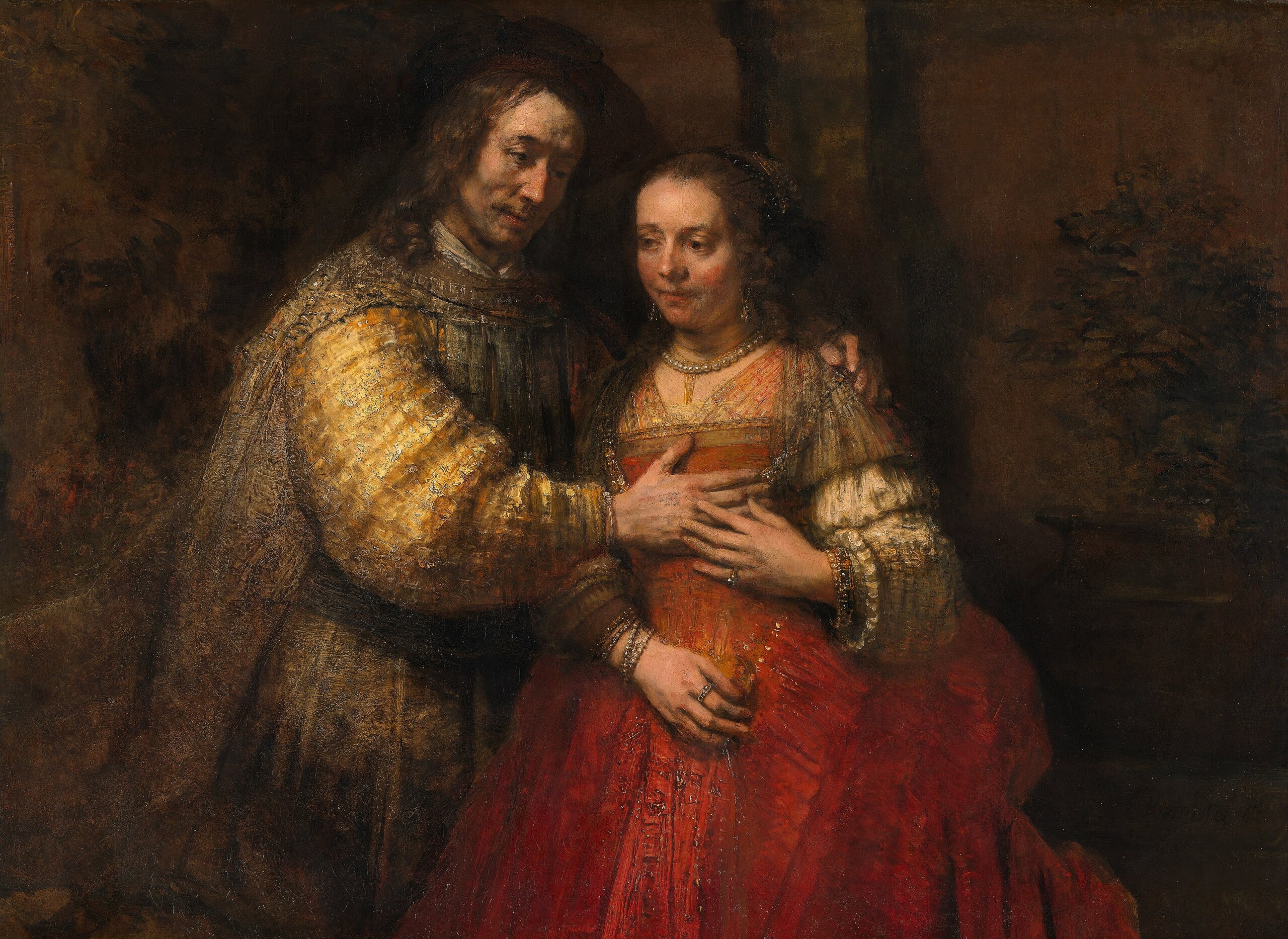
The Jewish Bride is Rembrandt’s double portrait of a couple from the last years of his life, dated by the Rijksmuseum to between about 1665 and 1669: the man in a golden-yellow cloak tenderly lays his hand on the breast of the woman in a red dress, and she rests her hand on his. The original, oil on canvas, is 121.5 cm high and 166.5 cm wide and hangs in the Rijksmuseum in Amsterdam. We paint it by hand in oil on canvas in 8 sizes, from 56 x 40 to 196 x 137 cm, or to your own measurement, and show you the finished painting in a photograph before we send it.
| Title: | The Jewish Bride |
| Other titles: | Isaac and Rebecca, Known as ‘The Jewish Bride’ · Het Joodse bruidje |
| Painter: | Rembrandt van Rijn (1606–1669) |
| Year painted: | c. 1665 – c. 1669, Amsterdam |
| Original size: | 121.5 cm x 166.5 cm (height x width) |
| Original technique: | Oil on canvas |
| Painting style: | Baroque, Dutch Golden Age |
| Located at: | Rijksmuseum, Amsterdam (acc. no. SK-C-216) |
| Our reproduction: | Hand-painted oil on canvas, 8 sizes or made to measure |
The Jewish Bride – Rembrandt
What does The Jewish Bride show?
A man and a woman stand in front of a dark wall, seen down to the knees. The man has long hair, a small cap and a wide cloak with huge, golden-yellow sleeves; his left arm goes round the woman’s shoulders and he has laid his right hand on her breast. The woman, in a red dress with a gold collar, pearls round her neck and jewels in her hair, looks ahead; with her left hand she touches his, and she holds her right hand in front of her body.
They do not look at each other, or at us. They are together, quiet, as if they had forgotten the world for a moment. The background is only suggested: some green shows in the shadow on the right, and everything else is a warm brown emptiness from which the red and gold glow.
Why is this painting so famous?
Because of a tenderness that is rare in painting. Rembrandt’s biographer Christopher White called it one of the greatest expressions of the tender fusion of spiritual and physical love in the history of painting. That makes this canvas painting a natural choice for a wedding or an anniversary.
The second reason is the way it is painted. The Rijksmuseum points out that Rembrandt works here with exceptional freedom: he lays the paint on thickly and, in the man’s sleeves, even scratches into it with the butt end of his brush. The golden sleeve is almost a relief as a result.
What does the painting mean, and who are the bride and groom?
The name The Jewish Bride is younger than the painting. It was given in the early nineteenth century, when an Amsterdam collector saw in it a Jewish father giving his daughter a necklace on her wedding day. That reading is no longer accepted, and nobody knows who the couple are: suggestions have included Rembrandt’s son Titus and his bride, an Amsterdam poet and his wife, and several couples from the Old Testament.
The Rijksmuseum calls the painting Isaac and Rebecca. In the biblical story Isaac hid from King Abimelech that Rebecca was his wife and passed her off as his sister, until their tenderness gave them away when they thought no one was watching. Rembrandt shows just such a moment. There is more on the different readings in the Wikipedia article on the painting.
Where is the original today?
In the Rijksmuseum in Amsterdam, which lists it under accession number SK-C-216 as a loan from the City of Amsterdam from the A. van der Hoop Bequest. The painting is signed ‘Rembrandt f. 16..’, the last two digits of the year cannot be read, and so the museum dates it to between about 1665 and 1669.
Because the signature sits at the lower left, researchers conclude that the canvas is today roughly the size it was when it was finished, even though Rembrandt may at first have planned a larger composition.
The Jewish Bride or another Rembrandt – which should you choose?
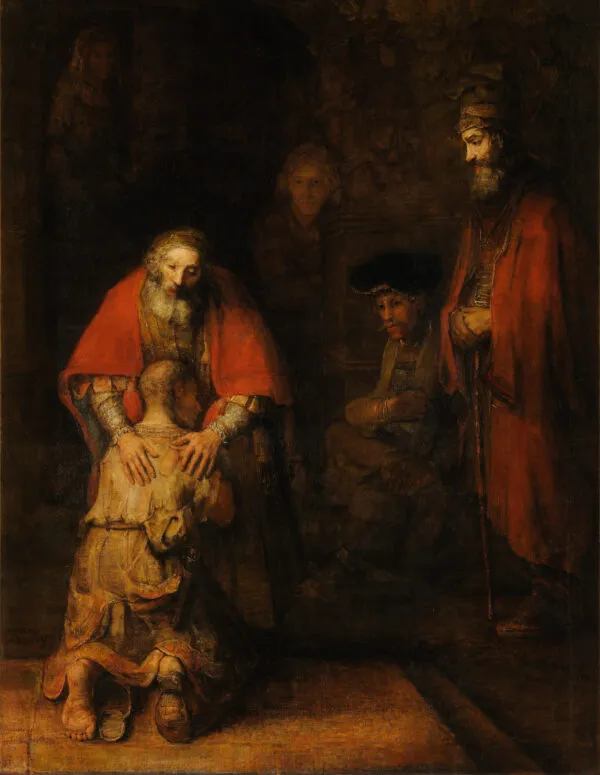
The Jewish Bride is a wide painting of two people, ideal above a bed, a sofa or in a dining room. From the same museum comes The Night Watch, far louder and full of people. From the same last years comes The Return of the Prodigal Son, Rembrandt’s other great story about love. A female figure in warm colours is also Bathsheba at Her Bath, and a quieter male portrait Aristotle with a Bust of Homer.
The famous Rembrandt paintings we make are gathered together on the Rembrandt page.
How is our hand-painted Jewish Bride made?
Our painter paints it by hand, in oil colours on canvas. First come the two faces and the hands, the heart of the painting, checked against the original. Then the dark background and the red dress are painted in several layers, so that the red takes on the depth it has in the original.
The golden sleeve is painted last, in dense strokes, rather as Rembrandt did: the paint here is not smooth but stands up from the canvas in ridges that catch the light. That is why this oil painting reproduction looks different on the wall from a print, which has only a flat surface.
Which size for which wall?
Short answer: 56 x 40 or 63 x 45 cm for a bedside, a hallway or a smaller wall, 80 x 59 or 90 x 66 cm above a chest of drawers or the bed in a smaller bedroom, 114 x 82 or 130 x 91 cm above a sofa or a double bed, and 167 x 120 and 196 x 137 cm for a large wall.
There are 8 landscape sizes (width x height): 56 x 40, 63 x 45, 80 x 59, 90 x 66, 114 x 82, 130 x 91, 167 x 120 and 196 x 137 cm. The original is 166.5 cm wide and 121.5 cm high; our nearest size is 167 x 120 cm, which is 5 mm wider and 1.5 cm lower. As a painting for the living room above a 2 m sofa, 130 x 91 cm looks best; above a double bed 160 to 180 cm wide, choose 114 x 82 cm.
Leave 20 to 30 cm between the bed or sofa and the bottom edge, and on an open wall hang it with its centre about 150 cm above the floor.
What if I need a custom size or a frame?
We can paint The Jewish Bride in any width and height; to keep the couple whole, we suggest the proportions of the original, about 4 : 3. Give us the dimensions and we will send you a price and a lead time.
We send it rolled, stretched on a wooden stretcher bar or framed, as you wish, and the stretching and framing are done in our workshop in Slovenia. You choose the frame profile in the 3D application, which is only for choosing the frame; seeing the painting on your own wall is a separate service. A gold moulding repeats the golden sleeve and the jewellery, while a dark red or brown one goes with the red dress.
How does delivery work, and what is the guarantee?
Ours is painted only once you order, so allow 15 to 45 working days. It travels across the EU with no customs. When the painting is finished we send you a photograph, and if anything needs correcting we do it before dispatch; our returns policy applies to every order.
For a wedding present when you do not yet know the wall, a wall art voucher lets the couple choose the painting and the size themselves.
Frequently asked questions
Where is the original Jewish Bride?
In the Rijksmuseum in Amsterdam, accession number SK-C-216. The painting belongs to the City of Amsterdam from the A. van der Hoop Bequest and is on loan to the museum.
Who are the man and the woman in the painting?
We do not know for certain. The Rijksmuseum calls them Isaac and Rebecca, a biblical couple; other scholars have seen in them Rembrandt’s son Titus and his bride, or an Amsterdam couple in the roles of biblical figures.
Why is the painting called The Jewish Bride?
The name was given in the early nineteenth century by an Amsterdam collector who saw in it a Jewish father with his daughter on her wedding day. That reading is no longer accepted, but the name has stayed.
Is your Jewish Bride a print?
No. It is a hand-painted copy in oil on canvas, painted specially for you. On our painting the golden sleeve has real, thick layers of paint.
When was it painted?
The Rijksmuseum dates it to between about 1665 and 1669, in the last years of Rembrandt’s life; the year beside the signature can no longer be read.
How big is the original?
It is 121.5 cm high and 166.5 cm wide. Our 167 x 120 cm size is very close to it: 5 mm wider and 1.5 cm lower.
Is it a good wedding present?
Yes, it is one of the loveliest paintings about the love of a couple and suits a wedding, an anniversary or a first home together. If you are unsure of the wall, a wall art voucher is the better choice.
Which size suits the wall above a double bed?
Above a bed 160 to 180 cm wide, choose 114 x 82 or 130 x 91 cm. The painting should take up about two thirds of the width of the bed, with its bottom edge 20 to 30 cm above the headboard.
- Subject: a man in a golden cloak and a woman in a red dress in a tender embrace, his hand on her breast, her hand on his.
- Original: c. 1665 – c. 1669, oil on canvas, 121.5 x 166.5 cm, Rijksmuseum, Amsterdam.
- Ours: a Rembrandt reproduction painted by hand in oil on canvas, in 8 landscape sizes from 56 x 40 to 196 x 137 cm or made to measure.
- Worth knowing: the name The Jewish Bride dates from the nineteenth century; the museum now calls the painting Isaac and Rebecca.