







































Description
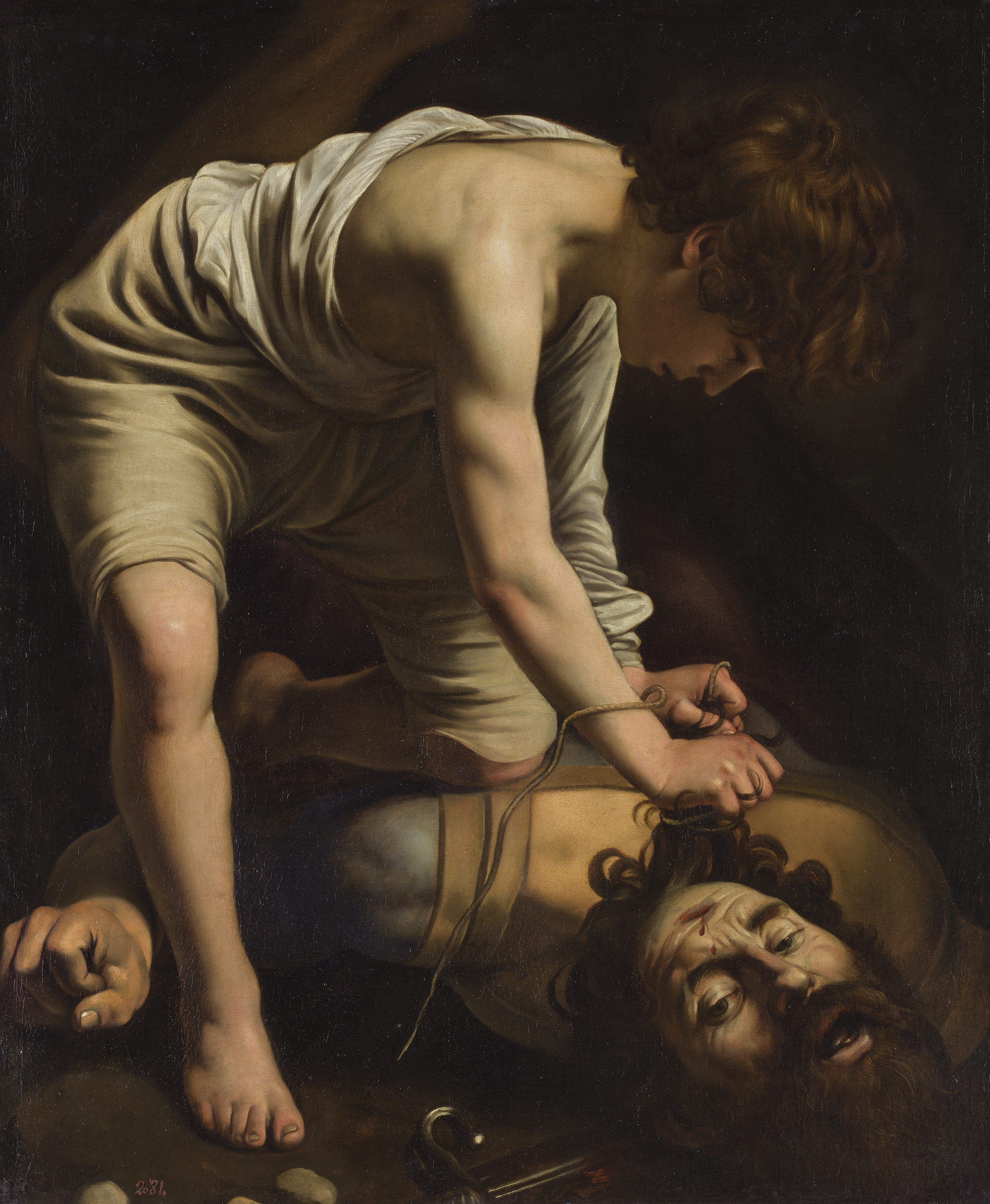
David and Goliath is a painting by Caravaggio from about 1600, held by the Museo del Prado in Madrid: the young David kneels on the body of the fallen giant and ties the hair of the severed head with a cord, while in the darkness the light picks out only the boy’s arm, leg and flank and Goliath’s face. The original, oil on canvas, is about 110 cm high and 91 cm wide. One of our painters paints it for you by hand in oils on canvas, in 8 portrait sizes from 43 x 53 to 172 x 200 cm or to a size you choose, and before it leaves us we send you a photograph of the finished painting.
| Title: | David and Goliath |
| Other titles: | Davide e Golia · David und Goliath |
| Painter: | Michelangelo Merisi da Caravaggio (1571–1610) |
| Year painted: | c. 1600 |
| Original size: | 110.4 cm x 91.3 cm (height x width) |
| Original technique: | Oil on canvas |
| Painting style: | Baroque, tenebrism |
| Located at: | Museo del Prado, Madrid, Spain |
| Our reproduction: | Hand-painted oil on canvas, 8 sizes or made to measure |
David and Goliath – Caravaggio
What does David and Goliath show?
On the tall canvas a boy bends over a defeated giant. David is barefoot, in a pale, loose tunic that leaves one shoulder and both arms bare. He rests one knee on Goliath’s body and keeps his head lowered, and his face all but disappears in shadow.
At the lower right lies the giant’s severed head, turned towards us. On the forehead is the wound left by the stone from the sling; the eyes and mouth are open. David holds it by the dark curls and binds them tightly with a cord.
The background is close to black. Light comes from the left and falls only on David’s leg, arm and flank, on the massive shoulders from which the head was cut, and on the head itself; everything else stays dark.
What story lies behind the scene?
The scene comes from the Bible. Goliath was a giant and the champion of the Philistines; David was a boy who stood up to him. He brought the giant down with a stone from his sling, and Caravaggio shows the moment after the fight, when the head is already apart from the body.
There is no triumph here, no army and no victory celebration. What remains is a quiet, almost private moment in which the boy goes about his task calmly and with full attention.
X-rays have shown that Caravaggio first painted Goliath’s face in wild terror, mouth wide open and eyes rolled to the edges of their sockets. In the finished painting this melodrama is gone, and the tension has passed to David, who works intently with his hands in his enemy’s hair.
Why is this painting so admired?
Because it already shows the Caravaggio we know: a single beam of light, deep darkness and real people instead of idealised heroes.
It was painted while Caravaggio lived in the household of Cardinal Francesco Maria del Monte in Rome. Soon afterwards it was taken to Spain, where it was frequently copied and left a deep mark on the country’s art.
According to Wikipedia, what had first caught the cardinal’s eye was The Cardsharps, in which two cheats at a card table trick a young man dressed in black. More on the Madrid David can be found in the Wikipedia article, written in English.
Where is the original, and how did it get there?
The original belongs to the Museo del Prado in Madrid, where its inventory number is P000065.
Caravaggio painted it early in his career, in Rome, while staying with Cardinal del Monte. Together with two paintings from about the same time, the first version of the Sacrifice of Isaac and the first John the Baptist, it soon travelled to Spain.
Caravaggio painted the same story twice more later on. Those two versions, both titled David with the Head of Goliath, hang in the Kunsthistorisches Museum in Vienna and the Galleria Borghese in Rome. The Madrid painting is the earliest of the three.
David and Goliath or another Caravaggio?
David and Goliath is a canvas painting for anyone who likes a story told with few means: two figures, one light and a great deal of darkness.
To see how Caravaggio came back to the story later, look at David with the Head of Goliath from the Galleria Borghese in Rome. There David stands with a sword in one hand and holds the giant’s head out towards us with the other; in Madrid he kneels and is still binding the hair.
Two more paintings in our range deal with a head parted from its body. Judith Beheading Holofernes shows the moment of the act itself, as the young widow in a white blouse grips the general by the hair, while Salome with the Head of John the Baptist shows a young woman who holds out a silver platter and turns her face away. David and Goliath sits alongside the other famous Caravaggio paintings our painters copy, all listed on the Caravaggio page.
How does our painter paint David and Goliath?
The painter first lays a dark ground, then draws the boy’s bent body, the giant’s head and the hand on the floor with a fine brush, so that the diagonals are right before the first light stroke goes on.
Then he works layer by layer from shadow to light. David’s skin takes a warm, soft tone, the pale tunic folds in which the light breaks.
This Caravaggio reproduction has the real surface of oil: under your fingers you feel the brushstrokes, and in the dark passages the colour is deep rather than flat black. An oil painting reproduction like this stays quiet by day, while in the evening, under a lamp, the boy’s shoulder and leg step out of the dark.
Which size works on which wall?
In short: 43 x 53 or 55 x 66 cm for a narrow wall or above a shelf, 64 x 76 or 80 x 96 cm for a hallway, study or bedroom, 90 x 107 or 115 x 145 cm above a sofa or sideboard, and 130 x 162 or 172 x 200 cm for a tall wall, a stairwell or a spacious living room.
We paint David and Goliath in 8 portrait sizes (width x height): 43 x 53, 55 x 66, 64 x 76, 80 x 96, 90 x 107, 115 x 145, 130 x 162 and 172 x 200 cm. The closest to the original is 90 x 107 cm, just 1 cm narrower and 3 cm shorter than its rounded 91 x 110 cm.
As a painting for the living room it works best at 90 x 107 or 115 x 145 cm above the sofa, with the giant’s head a little below eye level.
Can I have another size or a frame?
Yes. For a size that is not on the list we adapt the composition so that the giant’s head, his hand on the floor and the boy’s bare foot stay whole. Tell us which width and height you need, and we will come back with a price and a lead time.
The painting leaves us rolled, stretched on a stretcher bar or framed. Our workshop in Slovenia does the stretching and framing and packs every painting with care. You choose the frame in our 3D app, which is only for picking the moulding; showing the painting on your own wall is a separate service.
How long does it take, and how is it delivered?
As soon as you confirm the order, the painter sets to work, and the painting is ready to travel within 15 to 45 working days. Before that we send you a photograph of the finished painting, and if you want anything changed, we do it before packing. Shipments within Slovenia and the rest of the EU carry no customs charges, and every order is covered by our returns policy.
It also makes a thoughtful gift for anyone who loves Bible stories or the Prado. If you are unsure of the size, give a wall art voucher and let the recipient choose.
Frequently asked questions
Where can I see the original?
In the Museo del Prado in Madrid, which lists it under number P000065.
What is David doing in the scene?
He kneels on the defeated Goliath and ties the hair of the severed head together with a cord.
Is this a print or a real painting?
A real one: a hand-painted copy, made by our painter with brush and oil paints on canvas.
How big is the original?
About 110 cm high and 91 cm wide; our nearest size is 90 x 107 cm.
Is it the same painting as David with the Head of Goliath?
No. The Madrid painting is earlier; the later versions, with a different scene, are in Vienna and in the Galleria Borghese in Rome.
Does it suit a bedroom or a living room?
A living room, study or hallway suits it better; not everyone wants a severed head in the bedroom.
Is a size outside your list possible?
Yes. Send us the width and height, and we will reply with a price and a delivery date.
How long is the wait?
Between 15 and 45 working days, and you see a photograph of your painting before we ship it.
- Subject: the young David in a pale tunic kneels on the defeated Goliath and binds the hair of the severed head with a cord, darkness all around.
- Original: c. 1600, oil on canvas, 110.4 x 91.3 cm, Museo del Prado, Madrid.
- Ours: painted by hand in oils on canvas, in 8 portrait sizes from 43 x 53 to 172 x 200 cm or made to measure.
- Worth knowing: X-rays show that Goliath’s face was first painted twisted in terror; Caravaggio later calmed it.