







































Description
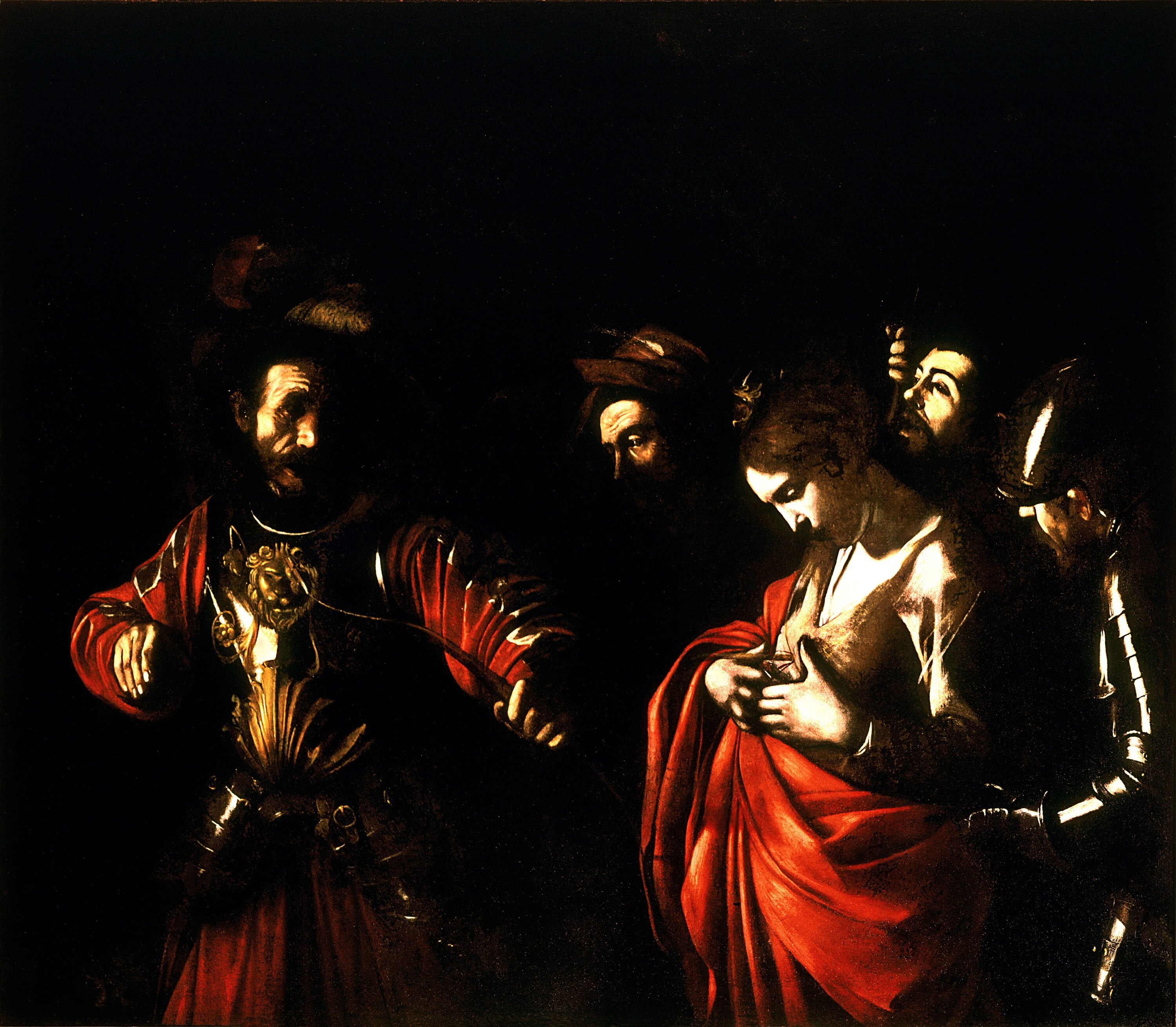
The Martyrdom of Saint Ursula is a painting by Caravaggio from 1610, thought to be his last: in the darkness the armoured king of the Huns, on the left, has just loosed an arrow at close range, Saint Ursula in a red cloak looks down at the arrow in her breast, and soldiers crowd behind her. The original, oil on canvas, 154 cm high and 178 cm wide, belongs to the Intesa Sanpaolo Collection and hangs in the Gallerie d’Italia at Palazzo Zevallos Stigliano in Naples. Our painter paints it for you by hand in oil on canvas in 7 landscape sizes, from 120 x 100 to 249 x 208 cm, or made to measure, and shows you the finished work in a photograph before it ships.
| Title: | The Martyrdom of Saint Ursula |
| Other titles: | Martirio di sant’Orsola · Das Martyrium der heiligen Ursula |
| Painter: | Michelangelo Merisi da Caravaggio (1571–1610) |
| Year painted: | 1610 |
| Original size: | 154 cm x 178 cm (height x width) |
| Original technique: | Oil on canvas |
| Painting style: | Baroque, tenebrism |
| Located at: | Gallerie d’Italia – Palazzo Zevallos Stigliano, Intesa Sanpaolo Collection, Naples, Italy |
| Our reproduction: | Hand-painted oil on canvas, 7 sizes or made to measure |
The Martyrdom of Saint Ursula – Caravaggio
What does The Martyrdom of Saint Ursula show?
The light picks a few faces, hands and glints of metal out of a thick darkness. On the left the armoured king of the Huns has just let an arrow fly at close range.
To his right stands Saint Ursula, wrapped in a red cloak. She bows her head and looks down at the arrow lodged in her breast. Her face shows no scream and no horror, only mild surprise, as if she has not yet grasped what happened.
Soldiers press close behind her, little more than faces and armour. At the very back a man stares open-mouthed; some take him for a self-portrait of the painter. Behind them lies only a dark void.
What is the legend of Saint Ursula?
In one version of the legend, the Huns captured Ursula and her eleven thousand virgin companions and slaughtered the companions. Overcome by Ursula’s modesty and beauty, their king begged her forgiveness if only she would marry him. She refused, and he shot her with an arrow.
Caravaggio leaves out both the conversation and the massacre and keeps only the instant after the shot: the king, Ursula and a few witnesses struck dumb.
Marcantonio Doria, a 25-year-old Genoese nobleman and ardent collector of Caravaggio, commissioned it in Naples in 1610 to mark his stepdaughter’s entry into a religious order as Sister Ursula.
Why does this painting matter so much?
First, because it is thought to be the last painting Caravaggio made. It was finished shortly before 11 May 1610, when Doria’s agent in Naples, Lanfranco Massa, wrote that the work was done. In July the painter set off by boat to seek a papal pardon and died at Porto Ercole, north of Rome; how is unclear, though a fever is most often cited.
Second, because it marks another change of style. In Sicily he had kept to small groups of figures dwarfed by massive architecture; here the action comes right into the viewer’s space, at the moment the king releases the arrow. The English Wikipedia article gives more detail.
And because it shook its first viewers: Massa reported that everyone who saw it was stunned. Doria received it in Genoa on 18 June and placed it among his works by Raphael and Leonardo.
Where is the original of The Martyrdom of Saint Ursula?
It is back in Naples, where it was painted: part of the Intesa Sanpaolo Collection, it is on view in the Gallerie d’Italia at Palazzo Zevallos Stigliano.
In his will of 1651 Doria left his collection to his eldest son Nicolò, Prince of Angri. Maria Doria Cattaneo moved the estate to Naples in 1832, and an inventory of 1854–55 lists the painting in the Palazzo Doria d’Angri.
Damage came early: it was set out in the sun to hurry the drying of the varnish, which softened and obscured some details. Several repairs had little success; a 2025 restoration by Laura Cibrario and Fabiola Jatta, aided by X-ray analysis, is reported to have brightened the colours and revealed hidden details.
The Martyrdom of Saint Ursula or another Caravaggio?
The Martyrdom of Saint Ursula is a serious canvas painting for anyone drawn to Caravaggio at the very end: little space, deep darkness and one decisive instant. It wants a generous wall and some quiet around it.
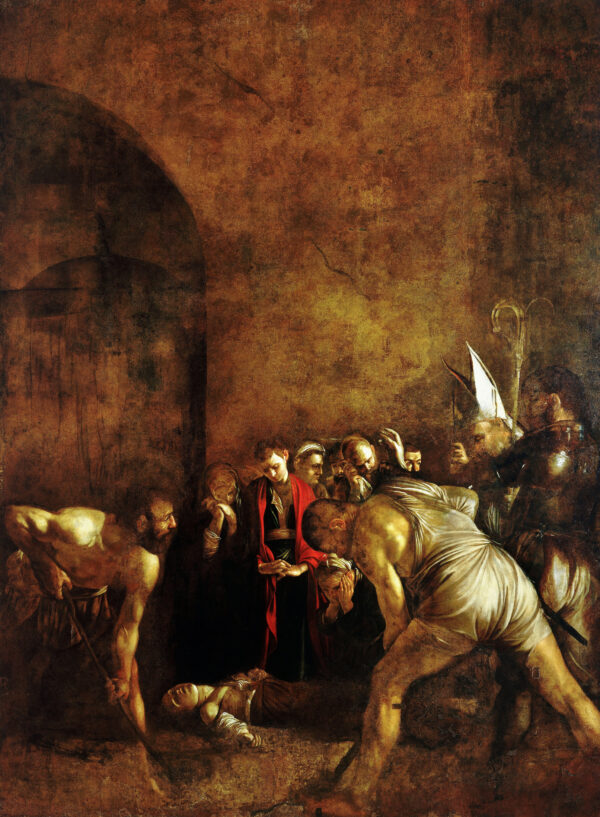
If the late Caravaggio draws you, look too at Salome with the Head of John the Baptist, in which Salome holds out the silver platter and turns her face away, or at The Crucifixion of Saint Andrew of 1607. The Sicilian years just before Ursula are represented by The Burial of Saint Lucy of 1608.
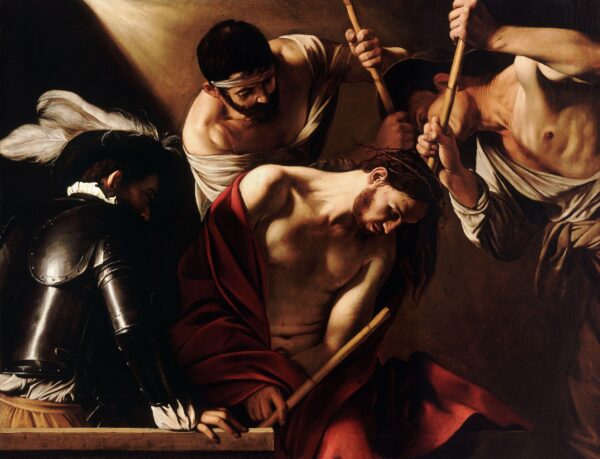
An earlier, tighter story is The Crowning with Thorns, where two tormentors press the crown of thorns onto Christ’s head with sticks. You will find the rest of the famous Caravaggio paintings we offer on the Caravaggio page.
How does our painter paint your Martyrdom of Saint Ursula?
Every Martyrdom of Saint Ursula is painted to order, in oil on canvas, layer by layer. The painter starts with a dark underpainting and then places the king, Ursula and the heads at the back, so the crowd does not melt into one mass.
Then he builds the light outwards from the brightest points, Ursula’s face, the red cloak and the glints on the armour, and lets the soldiers at the back sink half into shadow, as Caravaggio left them.
With so many figures close together this is a demanding composition, so we paint it only in larger sizes. This Caravaggio reproduction shows brushstrokes in the lit passages and a depth in the darkness that print cannot reach. An oil painting reproduction like this changes under an evening lamp, when the red cloak glows out of the dark.
Which size for which wall?
In short: Ursula needs a big wall, since even the smallest size is 120 cm wide.
Because the composition is complex and crowded, we paint it in 7 landscape sizes (width x height): 120 x 100, 135 x 112, 150 x 126, 170 x 140, 190 x 160, 215 x 190 and 249 x 208 cm. The closest to the original is 190 x 160 cm, which is 12 cm wider and 6 cm higher.
120 x 100 and 135 x 112 cm sit well above a sofa or a long sideboard. As a painting for the living room with an ordinary ceiling, 150 x 126 cm is the most balanced choice. From 170 x 140 cm up it needs a large empty wall, a dining room, a staircase or an entrance hall; 249 x 208 cm wants a truly high ceiling.
Can I have another size or a frame?
Yes. With the king at the left edge and the witnesses at the back on the right, we adapt the composition without cutting off any figure. Tell us the width and height you have in mind and we will come back with a price and a production time.
We send Ursula rolled, stretched on a stretcher bar or framed. Stretching and framing are handled by our workshop in Slovenia, where each painting that leaves us is made ready for the journey.
You pick the frame in our 3D app, which is only for choosing frames; seeing the painting on your own wall is a separate service. A dark wooden frame or a slim antique-gold moulding suits this dark scene.
When and how will my painting arrive?
The painter starts once we confirm your order, and the painting is ready to ship in 15 to 45 working days. Before dispatch we send you a photograph of the finished work, and any correction you ask for is made first. No customs apply within Slovenia and the EU, and our returns policy covers every order.
As a gift it suits a lover of Baroque art or someone named Ursula. Unsure of the recipient’s wall? A wall art voucher lets them choose.
Frequently asked questions
Where can I see the original?
In Naples, in the Gallerie d’Italia at Palazzo Zevallos Stigliano, as part of the Intesa Sanpaolo Collection.
What is happening in the scene?
The king of the Huns shoots Ursula with an arrow at close range because she refused him; she looks quietly at the arrow in her breast.
Is this a print?
No. It is a hand-painted copy, made by our painter with a brush and oil paints on canvas.
What size is the original?
It is 154 cm high and 178 cm wide; of our sizes, 190 x 160 cm comes closest.
Why are there no smaller sizes?
The canvas is crowded with figures, so we start at 120 x 100 cm, where every face has room.
Could you make it in a size other than the ones listed?
Yes: give us the width and height and we will quote a price and a delivery date.
Is it right for a bedroom?
A martyrdom scene is probably too serious for a bedroom; it does better in a living room, a library or on a staircase.
How many days does it take to make?
15 to 45 working days, and before dispatch you receive a photograph of the finished painting.
- Subject: the king of the Huns shoots Saint Ursula with an arrow at close range, with soldiers and witnesses behind her.
- Original: 1610, oil on canvas, 154 x 178 cm, Gallerie d’Italia – Palazzo Zevallos Stigliano, Naples.
- Ours: painted by hand in oil on canvas, in 7 landscape sizes from 120 x 100 to 249 x 208 cm or made to measure.
- Worth knowing: it is thought to be Caravaggio’s last painting, finished in spring 1610, a few months before his death.