







































Description
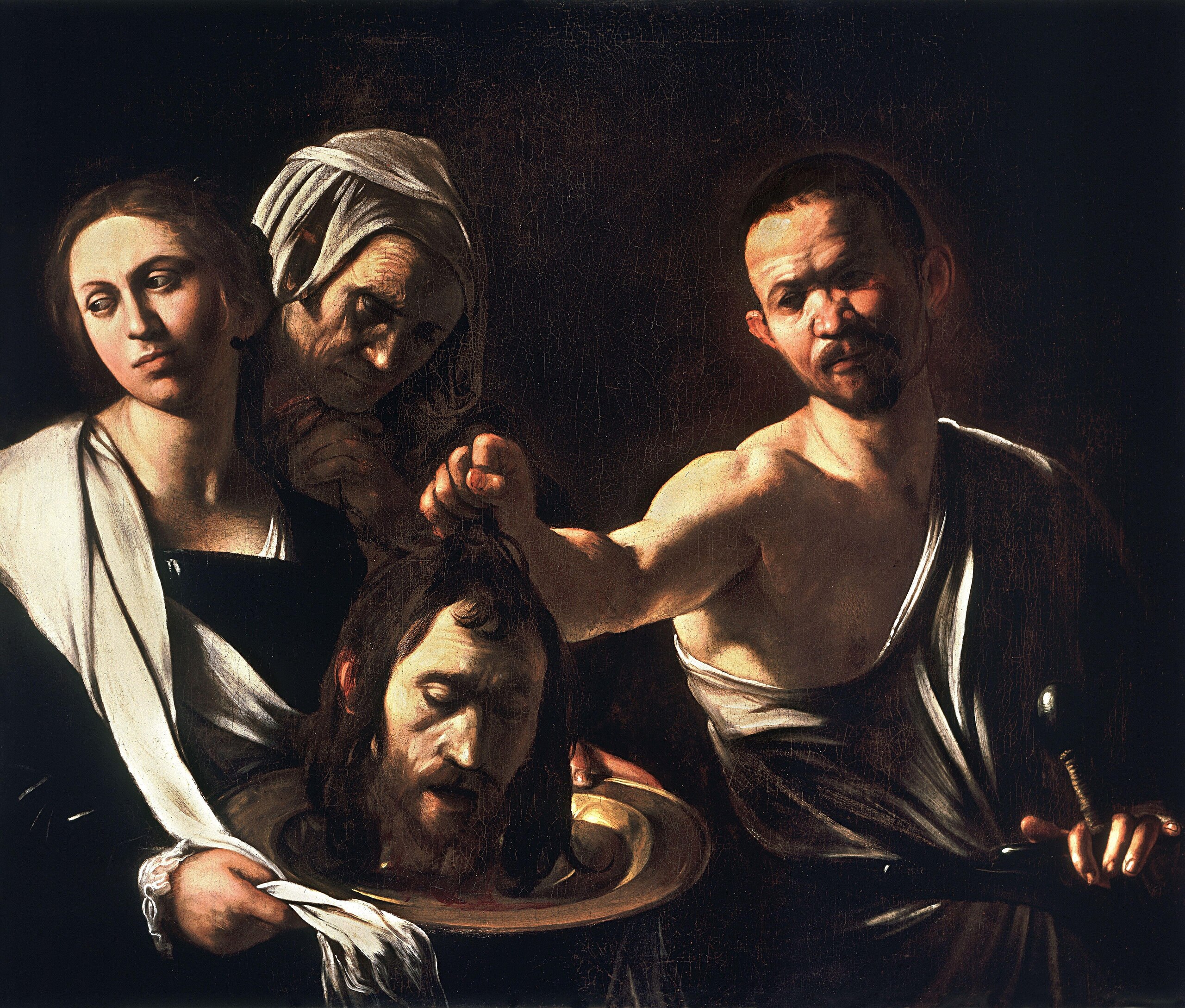
Salome with the Head of John the Baptist is a painting by Caravaggio from about 1607: a bare-armed executioner holds the Baptist’s head by the hair over a silver platter that Salome holds out while she turns her face away, and behind them an old woman with clasped hands looks down. The original, oil on canvas, is 91.5 cm high and 106.7 cm wide and belongs to the National Gallery in London. Our painter paints this scene for you by hand in oil on canvas in 8 landscape sizes, from 50 x 45 to 200 x 163 cm, or to a size you give us, and before it leaves us you see the finished painting in a photograph.
| Title: | Salome with the Head of John the Baptist |
| Other titles: | Salomè con la testa del Battista · Salome mit dem Haupt Johannes des Täufers |
| Painter: | Michelangelo Merisi da Caravaggio (1571–1610) |
| Year painted: | c. 1607 |
| Original size: | 91.5 cm x 106.7 cm (height x width) |
| Original technique: | Oil on canvas |
| Painting style: | Baroque, tenebrism |
| Located at: | The National Gallery, London, United Kingdom |
| Our reproduction: | Hand-painted oil on canvas, 8 sizes or made to measure |
Salome with the Head of John the Baptist – Caravaggio
What does Salome with the Head of John the Baptist show?
The canvas is only a little wider than it is tall, and the scene is reduced to three figures pressed close together. The executioner, his arms bare, holds the head of John the Baptist by the hair and lowers it over a silver platter. Salome holds the platter in front of her but turns her face away from it.
Behind them an old woman emerges from the shadow. Her hands are clasped and her gaze is turned down towards the platter.
Around the figures there is no room and no landscape, only deep darkness. The light comes in from the side, raking across bare arms, faces and the rim of the metal platter. The Baptist’s head is painted calmly, without emphasis, as part of a silent scene.
What story lies behind the scene?
The Gospels of Matthew and Mark tell how Salome received the head of John the Baptist on a platter. Caravaggio takes a single instant from that story, the one in which the head has just reached the platter.
He also painted the subject in a second canvas, now in the Royal Palace in Madrid. Writing in 1673, the early Caravaggio biographer Giovanni Bellori mentions a Salome with the head of the Baptist that the painter sent to the Grand Master of the Knights of Malta, hoping to win back his favour after being expelled from the Order in 1608.
According to Wikipedia, however, Bellori was more likely referring to the Madrid painting than to this one in London.
Why is this painting so admired?
First for its restraint. Caravaggio does not paint the deed itself but the moment after it, and three people who each answer it in their own way: the executioner holds the head, Salome turns her face aside, the old woman clasps her hands.
Then for its light. The raking light and the handling, Wikipedia says, link the work to the pictures he made during his brief stay in Naples in 1606–1607. How scholars dated it and compared it with other works is set out in the English Wikipedia article.
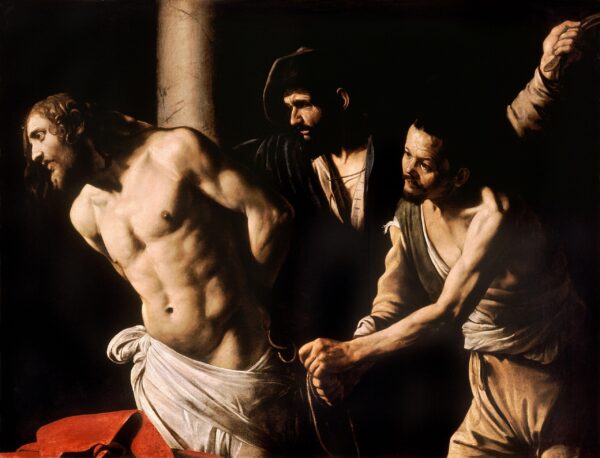
And finally for faces we meet elsewhere. Wikipedia notes that Salome recalls the Virgin of the Madonna of the Rosary, while the executioner recalls one of the torturers in Christ at the Column and The Flagellation of Christ. Caravaggio painted from live models.
Where is the original of Salome with the Head of John the Baptist?
The original belongs to the National Gallery in London, where its inventory number is NG6389. It was discovered only in 1959, in a private collection.
In 1961 Alfred Ernest Allnatt acquired it and lent it to the Gallery; after his death the Gallery bought it from his estate.
Its date is not entirely settled. Wikipedia places it around 1607, while some specialists move it later, to 1609–1610.
Salome or another Caravaggio?
Salome with the Head of John the Baptist is a serious, composed canvas painting for a study, a library or a hallway. From the same painter’s last years comes The Martyrdom of Saint Ursula, which Wikipedia describes as thought to be his last work: the king of the Huns strikes the saint in the red cloak with an arrow, and she looks down.
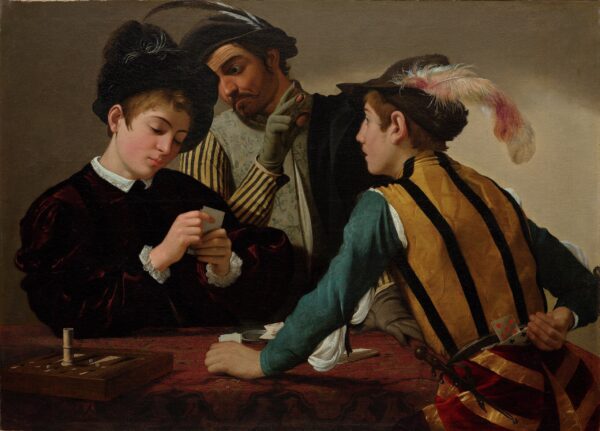
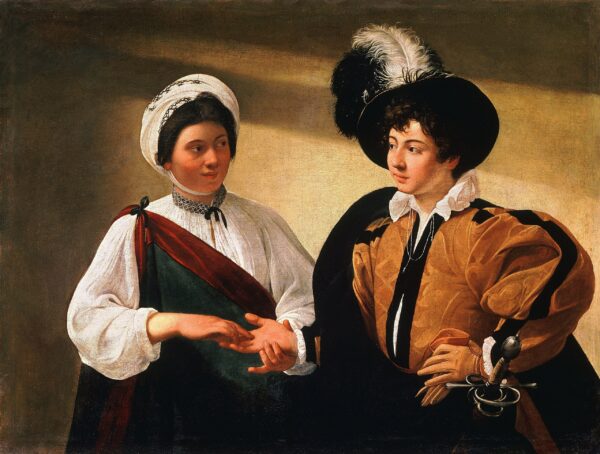
A similarly tight crop with few figures marks The Denial of Saint Peter of about 1610, where a soldier and a maidservant point at Peter, who raises his hands to his chest and denies knowing Jesus. A quieter, almost private scene is Saint Jerome Writing, and worldly lightness comes with The Fortune Teller, in which a girl reads a young man’s palm.
More scenes, from worldly genre pieces to late stories of the saints, wait on the Caravaggio page, which lists the famous Caravaggio paintings in our range. Salome belongs among those in which hands, faces and a single object in the light tell the whole story.
How does our painter paint your Salome?
Every Salome is painted to your order, layer by layer, in oil on canvas. The painter first lays a dark underpainting over the whole canvas and places on it the three heads, the hands and the platter.
Only then does he build up the light: the warm tone of the executioner’s bare arms, Salome’s pale face, the cool gleam of the silver and the soft half-shadow on the old woman’s face.
This Caravaggio reproduction keeps visible brushstrokes in the light passages and depth in the dark ones, which no print can do. An oil painting reproduction like this lives with the light in your room: by day the scene stays quiet, and in the evening under a lamp the faces come out of the darkness more strongly still.
Which size for which wall?
In short: 50 x 45 or 67 x 55 cm for a smaller wall, 75 x 65 or 97 x 80 cm above a chest of drawers, 110 x 90 or 136 x 116 cm above a sofa, and 150 x 134 or 200 x 163 cm for a large wall.
We paint Salome in 8 landscape sizes (width x height): 50 x 45, 67 x 55, 75 x 65, 97 x 80, 110 x 90, 136 x 116, 150 x 134 and 200 x 163 cm. The closest to the original is 110 x 90 cm, which is 3.3 cm wider and 1.5 cm lower.
Because the format is nearly square, it also fits narrower walls. As a painting for the living room it is strongest at 110 x 90 cm, where the faces are roughly the size they are in the original.
Can I order another size or a frame?
Yes. The figures stand close together, so we adapt them to other proportions in a way that cuts off no hand or face. Tell us the width and height you need for your Salome, and a price and production time will follow by return.
Your Salome travels rolled, stretched on a stretcher bar or framed. Our workshop in Slovenia does the stretching and framing, so that the painting comes through the journey safely. The frame itself is picked in our 3D app, built for choosing frames and nothing more; seeing the painting on your own wall is a separate service.
When and how will the painting arrive?
We start painting your Salome as soon as your order arrives, and within 15 to 45 working days it is ready to travel. Before dispatch we send you a photograph of the finished painting; if you would like a change, we still make it. Deliveries within Slovenia and the rest of the EU carry no customs, and our returns policy applies to every order.
As a gift it suits a lover of Baroque painting or someone who likes to read the Gospel stories. Anyone who would rather leave size and frame to the recipient can give a wall art voucher.
Frequently asked questions
In which gallery does the original hang?
In the National Gallery in London, under inventory number NG6389.
What is happening on this canvas?
The executioner lowers the Baptist’s head onto the silver platter Salome is holding, and an old woman with clasped hands stands behind them.
Is it a print?
No. You receive a hand-painted copy, made with a brush and oil paints on canvas.
How big is the original?
It is 91.5 cm high and 106.7 cm wide; of our sizes, 110 x 90 cm comes closest.
Could this one be painted in a size we do not list?
Yes. Send us the width and height and we will tell you the price and the date in advance.
How long does it take to make?
Allow 15 to 45 working days for your Salome; the photograph of the finished painting reaches you before it ships.
Is it suitable for a bedroom?
The scene is too grave for most bedrooms; it does better in a study, a library or a quiet corner of the home.
What does the scene mean?
It shows the end of John the Baptist as the Gospels of Matthew and Mark tell it: his head is brought to Salome on a platter.
- Subject: a bare-armed executioner lowers the Baptist’s head onto a silver platter, Salome turns her face away, and an old woman with clasped hands stands behind.
- Original: c. 1607, oil on canvas, 91.5 x 106.7 cm, National Gallery, London.
- Ours: painted by hand in oil on canvas, in 8 landscape sizes from 50 x 45 to 200 x 163 cm or made to measure.
- Worth knowing: the painting was discovered only in 1959 in a private collection; a second Salome by Caravaggio is in the Royal Palace in Madrid.