







































Description
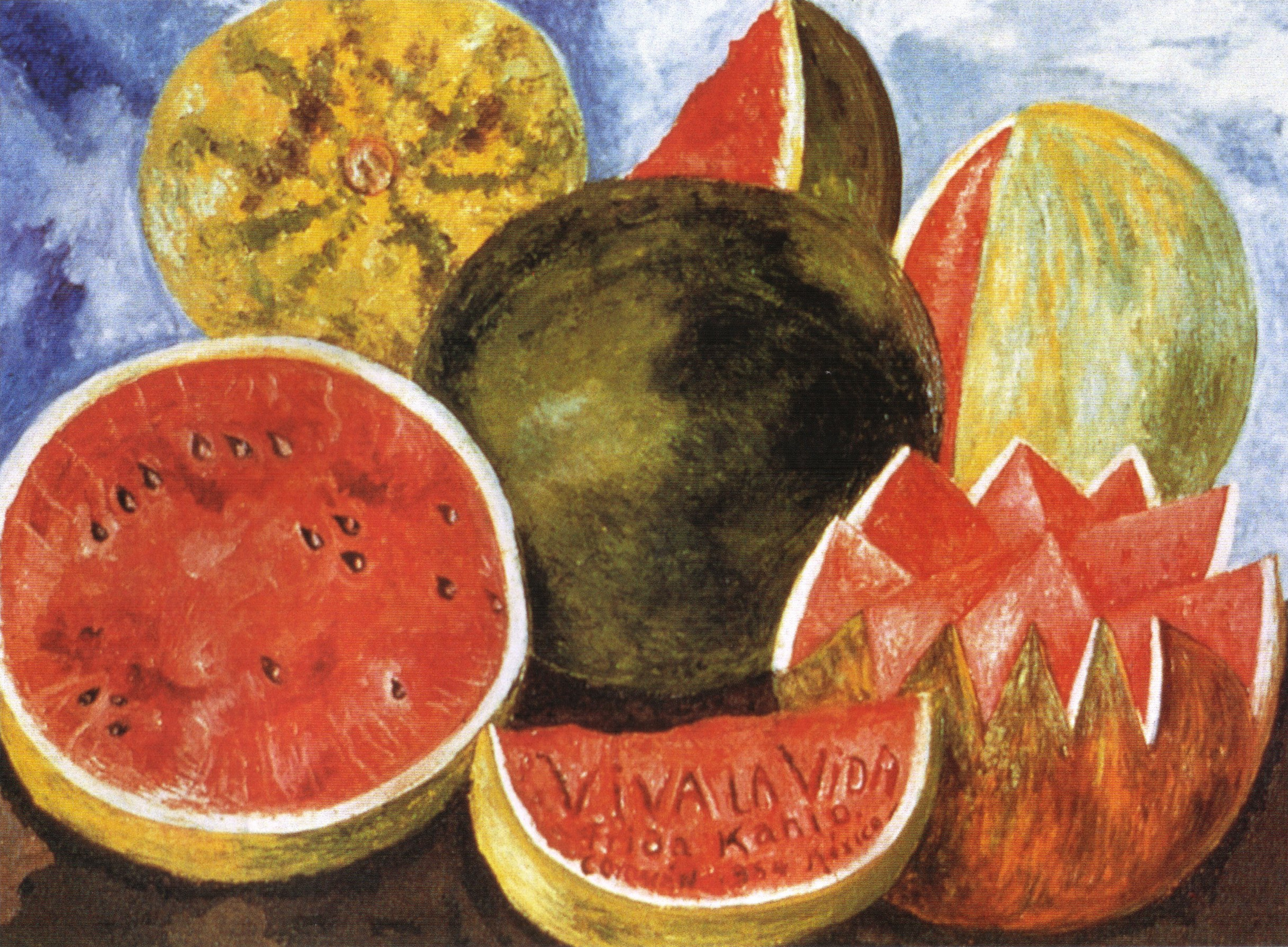
Viva la Vida (Watermelons) is a still life Frida Kahlo painted in 1954, in the last months of her life: whole and cut watermelons with red flesh and black seeds lie beneath a blue sky, and one slice carries the words Viva la Vida. The original, oil on masonite, is 52 cm high and 72 cm wide and belongs to the Frida Kahlo Museum, the Blue House in Coyoacán. Our painter paints it in oil colours on canvas, in one of 8 landscape sizes from 53 x 38 to 200 x 140 cm or made to measure; before it leaves us, you get a photograph of the finished work.
| Title: | Viva la Vida (Watermelons) |
| Other titles: | Viva la vida · Viva la Vida (Wassermelonen) |
| Painter: | Frida Kahlo (1907–1954) |
| Year painted: | 1954 |
| Original size: | 52 cm x 72 cm (height x width) |
| Original technique: | Oil on masonite |
| Painting style: | Mexican modernism |
| Located at: | Frida Kahlo Museum (La Casa Azul), Coyoacán, Mexico City |
| Our reproduction: | Hand-painted oil on canvas, 8 sizes or made to measure |
Viva la Vida (Watermelons) – Frida Kahlo
What does Viva la Vida (Watermelons) show?
Fruit fills the composition from edge to edge. Bottom left lies a halved watermelon: its red heart is dotted with black seeds. Behind it rises a round, yellowish fruit with green stripes, and in the centre rests a large dark green melon, whole and uncut.
Behind the dark fruit an upright wedge of red flesh stands on end. On the right sits a pale green melon with a wedge cut out of it, so that its red interior shows. Bottom right lies a fruit cut in a zigzag, its red points rising like a crown.
In the foreground a slice faces the viewer, and across its red surface the words Viva la Vida are written in large letters. The background is a sky of blue and white, laid in with dense, restless strokes, while a dark brown ground closes the scene at the bottom.
What is the story behind this still life?
Frida Kahlo made the work in 1954, when she was already gravely ill. After failed operations on her spine she spent her final years mostly at the Blue House (La Casa Azul) in Coyoacán. In August 1953 her right leg was amputated at the knee because of gangrene.
She was in hospital again in April and May 1954, and that spring, after a year’s break, she took up painting once more. Alongside two political works from the same year, this still life counts among her last paintings. She died on 13 July 1954, aged 47.
In those last years she painted mostly still lifes of fruit and flowers, some with political symbols such as flags or doves. Her handling changed as well: brushstrokes that had once been delicate and careful grew hastier, her colour bolder and the whole more intense.
Why is this still life so well known?
When people picture famous Frida Kahlo paintings, they usually think of self-portraits, since those make up most of her work. This one is the exception: neither her face nor her figure appears, and the fruit and the inscription carry all the meaning.
In Spanish, Viva la Vida means “long live life”. She wrote the words on a fruit in the year she died and never explained them, so each viewer finds a meaning of their own.
For more on her life, her illness and her final works, see the English Wikipedia article on Frida Kahlo, which lists this still life among her last paintings; there is no separate article on the work itself.
Where is the original today?
The original belongs to the Frida Kahlo Museum in Coyoacán, Mexico City. This is the Blue House, the family home where the artist spent most of her childhood and adult life.
The house opened as a museum in 1958 and is now one of the most visited museums in Mexico City, with about 25,000 visitors a month. Her ashes are kept there too, in a pre-Columbian urn.
The original is painted in oil on masonite, a hard fibreboard panel, and measures 52 cm high by 72 cm wide.
Our hand-painted copy has real layers of paint and a surface you can feel, which no print offers.
Viva la Vida or another Kahlo still life?
This canvas painting is in landscape format and full of warm reds, balanced nicely by the cool blue sky. It is at home in a kitchen, a dining room or above a sideboard.
Two years earlier came Living Nature, a still life of cut fruit, oranges, a white dove and words running along the bottom edge. Older still is Fruits of the Earth from 1938, with corn cobs, mushrooms and other produce laid out on a wooden table.
White blossoms take the place of fruit in Magnolias from 1945. Collectors may also like The Frame, bought by the Louvre, which made Kahlo the first Mexican artist in its collection. Every work of hers that we paint to order is gathered on our Frida Kahlo page.
How does our painter paint the watermelons?
Frida Kahlo painted this work on masonite; our painter transfers it to canvas in oil colours.
He starts by setting down the outlines of the fruit and laying out the large areas of colour: red flesh, green rinds, blue sky. Then he builds up volume in thin layers; the dark melon in the middle needs several coats of green and near-black to gain weight, while the red flesh comes alive with lighter touches.
He leaves the sky restless, with visible strokes as in the original, and gives each cut edge a fine white line. Last come the black seeds, the points of the zigzag-cut fruit and the inscription on the front slice, written with a thin brush. The result is a Frida Kahlo reproduction with real body to its paint.
Because each order is painted on its own, every oil painting reproduction that leaves our hands differs a little from the one before, as handwork should.
Which size is right for your room?
In short: 53 x 38 or 65 x 49 cm for a kitchen or a hallway, 74 x 55 or 98 x 70 cm above a dining table or a sideboard, 110 x 78 or 139 x 100 cm above a sofa, and 160 x 110 or 200 x 140 cm for a large empty wall.
It comes in 8 landscape formats (width x height): 53 x 38, 65 x 49, 74 x 55, 98 x 70, 110 x 78, 139 x 100, 160 x 110 and 200 x 140 cm. Closest to the original is 74 x 55 cm, which is 2 cm wider and 3 cm taller; 65 x 49 cm is 7 cm narrower and 3 cm shorter.
As a painting for the living room above a sofa, 110 x 78 and 139 x 100 cm are good choices, because the landscape format follows the long line of the backrest.
Can I have a different size or a frame?
The original is about a third wider than it is tall, so we can also paint it in a size that is not on the list. Send us the width and height you want, and we will reply with a quote and a delivery time.
The still life can come rolled, stretched on a stretcher bar or ready framed. What holds for every painting we ship holds here too: our workshop in Slovenia stretches and frames it. You choose the frame in our 3D app, which is meant for that alone; a view of the painting on your own wall is a separate service.
How long does it take, and how is it delivered?
The painter sets to work as soon as you confirm the order, and in 15 to 45 working days the painting is ready to travel. Before dispatch you receive a photograph of it and can still ask for changes.
Parcels within Slovenia and the rest of the EU go through no customs, and every order is covered by our returns policy.
If you are unsure which size would suit the person you are giving it to, give a wall art voucher and let them choose.
Frequently asked questions
Where can I see the original?
At the Frida Kahlo Museum, the Blue House in Coyoacán, Mexico City.
What does the writing on the watermelon mean?
Viva la Vida is a Spanish exclamation meaning “long live life”; the artist wrote it on the front slice.
Is this a print?
No. The painter paints each one with a brush and oil colours on canvas.
How big is the original?
It is 52 cm high and 72 cm wide; our nearest size is 74 x 55 cm.
Can I order it in another size?
Certainly: give us the dimensions you need and we will quote the price before we start painting.
When will the painting reach me?
Allow 15 to 45 working days for the painting, plus shipping, which is customs-free within the EU.
Does it suit a kitchen or a dining room?
Yes, fruit and warm reds seem made for a room where people cook and eat.
Is this really one of the artist’s last works?
English Wikipedia lists it among her last paintings; it dates from 1954, the year she died.
- Subject: whole and cut watermelons under a blue sky, with the inscription Viva la Vida on the front slice.
- Original: 1954, oil on masonite, 52 x 72 cm, Frida Kahlo Museum (La Casa Azul), Coyoacán.
- Ours: oil on canvas, hand-painted only once you order; pick one of 8 landscape formats from 53 x 38 to 200 x 140 cm or name your own size.
- Worth knowing: The still life dates from the last year of the artist’s life, when she picked up the brush again after a year’s pause.