







































Description
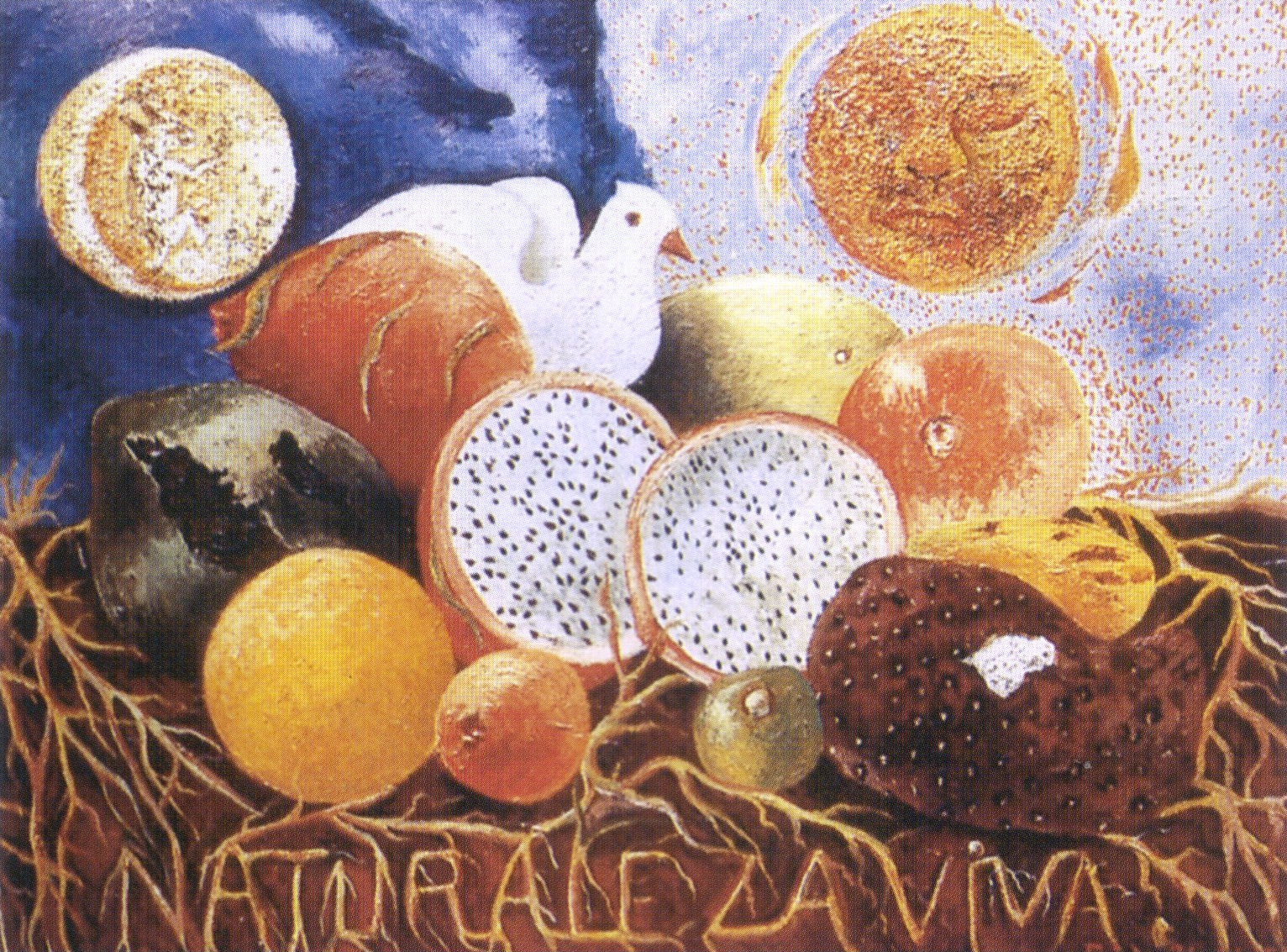
Living Nature is a still life Frida Kahlo painted in 1952: on brown ground laced with roots, fruits crowd together, some cut open and full of seeds, a white dove sits among them, and two round discs hang in the sky. The original, oil on canvas, is 44 cm high and 59.7 cm wide and belongs to a private collection in Mexico City. Our painter paints it for you in oil colours on canvas, in one of 8 landscape sizes from 53 x 38 to 120 x 90 cm or made to measure; before it leaves us, you receive a photograph of the finished painting.
| Title: | Living Nature |
| Other titles: | Naturaleza viva · Lebendige Natur |
| Painter: | Frida Kahlo (1907–1954) |
| Year painted: | 1952 |
| Original size: | 44 cm x 59.7 cm (height x width) |
| Original technique: | Oil on canvas |
| Painting style: | Mexican modernism |
| Located at: | Private collection, Mexico City |
| Our reproduction: | Hand-painted oil on canvas, 8 sizes or made to measure |
Living Nature – Frida Kahlo
What does Living Nature show?
The scene is wide and full of fruit. On a dark brown ground, which could be earth or a tabletop, lies a heap of fruits, and thin golden-brown roots wind around and between them.
At the centre lie the two halves of a cut fruit, its white flesh dotted with black seeds. Around them are a large orange, a dark grey fruit split open, a long reddish one, a yellow-green one, a big orange-red one and a dark brown speckled fruit with a pale cut.
Among the fruits a white dove sits facing right, with a short reddish beak. The sky is split in two: dark blue on the left with a pale round disc, light and almost white on the right, sprinkled with tiny orange dots, with an orange disc in which a face can be made out.
Along the bottom edge the roots form large letters running across the whole width: they spell out the Spanish title of the work.
When and how was Living Nature painted?
The painting dates from 1952, from the last years of Kahlo’s life. She had spent most of 1950 in a hospital in Mexico City, where she had another operation on her spine; a serious infection and several further operations followed.
After leaving hospital she was mostly confined to the Blue House (La Casa Azul) in Coyoacán and relied on a wheelchair and crutches to get about. As far as her health allowed, she gave her time to politics: in 1948 she had rejoined the Mexican Communist Party, and she campaigned for peace.
In this period she painted mostly still lifes of fruit and flowers, often adding political symbols such as flags or doves. Living Nature is one of this late group.
Why does this painting hold a special place in her work?
Kahlo is known above all for her self-portraits, but her face is absent here; fruit, dove, roots and sky speak instead.
The title itself is a play on words. In Spanish a still life is usually called naturaleza muerta, literally “dead nature”; Kahlo gave hers the opposite name.
Many of her paintings set opposites side by side, such as life and death; here the sky divides into a dark half and a light one. There is no single agreed reading of the motif. For more on the painter and her final years, see the Wikipedia article on Frida Kahlo (in English); the painting has no article of its own.
Where is the original, and where do the details come from?
The original belongs to a private collection in Mexico City, so no museum shows it on a permanent basis. It is oil on canvas, 44 cm high and 59.7 cm wide, a fairly small landscape format.
We took the year, technique, measurements and collection from the list of Kahlo’s paintings on the English Wikipedia. That source says nothing more about the path the painting took to its present collection.
A hand-painted copy is the simplest way to have it on your own wall.
Living Nature or another Kahlo still life?
This painting is wide, its colours stretched between warm orange, brown and yellow below and cool blue above. It suits a kitchen, a dining room or any space where the family gathers round a table.
Also a still life is Viva la Vida (Watermelons) of 1954, with whole and cut watermelons under a blue sky. Fruits of the Earth of 1938 brings together corn cobs, mushrooms and other fruit and vegetables on a wooden table.
White blossoms and dark leaves fill Magnolias of 1945, and a red sun with a face amid plants is the subject of Sun and Life of 1947. Our Frida Kahlo page gathers every one of the famous Frida Kahlo paintings we offer to order.
How does our painter paint the fruit, the dove and the roots?
The original is also oil on canvas, so our painter works on the same kind of support Frida Kahlo used. According to the English Wikipedia, her brushwork grew hastier and her colour bolder in her last years.
First the painter sets out the composition and lays in the dark areas of sky and ground. Thin layers then model the fruits until they gain roundness and sheen; the white flesh stays light until the tip of the brush sets the black seeds into it one by one.
Small things come last: the orange dots in the right-hand sky, the dove’s feathers, the face in the orange disc and the web of roots, drawn with a fine brush together with the letters along the bottom. Every oil painting reproduction we make is painted for one customer, so this Frida Kahlo reproduction is one of a kind, with real layers of paint that no print has.
Which size for which wall?
In short: 53 x 38 or 60 x 43 cm for a kitchen or a hallway, 65 x 50 or 74 x 55 cm above a sideboard or a dining table, 87 x 62 or 98 x 70 cm above a sofa, and 110 x 78 or 120 x 90 cm for a large empty wall.
The landscape sizes (width x height) in which we paint this still life are 53 x 38, 60 x 43, 65 x 50, 74 x 55, 87 x 62, 98 x 70, 110 x 78 and 120 x 90 cm. Closest to the original is 60 x 43 cm, which is 0.3 cm wider and 1 cm lower.
If you want a painting for the living room above a three-seater sofa, choose 98 x 70 or 110 x 78 cm so that it does not look lost on the wall.
Can I order another size or choose a frame?
The original is a landscape format with proportions close to 4 : 3, so it adapts easily to a size not on the list without losing the letters or the discs. On our page for paintings made to order, give us the width and height you want, and we reply with a price and a delivery time.
The painting travels rolled, on a stretcher bar or already framed. Stretching and framing are done by our workshop in Slovenia, which prepares every canvas painting that leaves us.
The frame for this still life is chosen in our 3D app, which does nothing else; a view of the painting on your own wall is a separate service. A dark wood frame suits the warm browns, while a gold moulding brings out the orange fruits and the disc in the sky.
When will the painting reach me, and how does it travel?
The painter starts as soon as you confirm the order, and after 15 to 45 working days the painting is ready to travel. Before dispatch you receive a photograph of the completed painting; if you would like a change, the painter still makes it.
Shipments to Slovenia and other EU countries face no customs, and every order is covered by our returns policy.
A still life of fruit makes a welcome housewarming gift. If you are unsure which size would suit, give a wall art voucher and let the recipient choose.
Frequently asked questions
Where is the original of Living Nature?
In a private collection in Mexico City; no museum shows it permanently.
What can I see in it?
Fruits, among them a cut fruit with black seeds, a white dove, two discs in the sky and roots across the ground.
Is it printed?
No. Our painter lays every stroke onto the canvas by hand in oil colours, with a brush; there is no printing involved.
How large is the original?
It is 44 cm high and 59.7 cm wide; our nearest size is 60 x 43 cm.
Can I have it in my own size?
Yes, tell us the width and height, and we give you the price before work begins.
How long will I wait?
From 15 to 45 working days for the painting, then shipping, with no customs inside the EU.
Does it suit a kitchen or a dining room?
Yes, the fruit and warm colours sit well there, and the larger sizes also above a sofa in the lounge.
What does the title mean?
In Spanish a still life is usually called “dead nature”; Kahlo called hers living.
- Subject: fruits, a white dove, roots and two discs in a divided sky, with letters made of roots along the bottom edge.
- Original: 1952, oil on canvas, 44 x 59.7 cm (height x width), private collection, Mexico City.
- Ours: hand-painted in oil on canvas to your order, 8 landscape sizes from 53 x 38 to 120 x 90 cm or made to measure.
- Worth knowing: it was painted in Kahlo’s last years, when she painted mostly still lifes of fruit and flowers.