



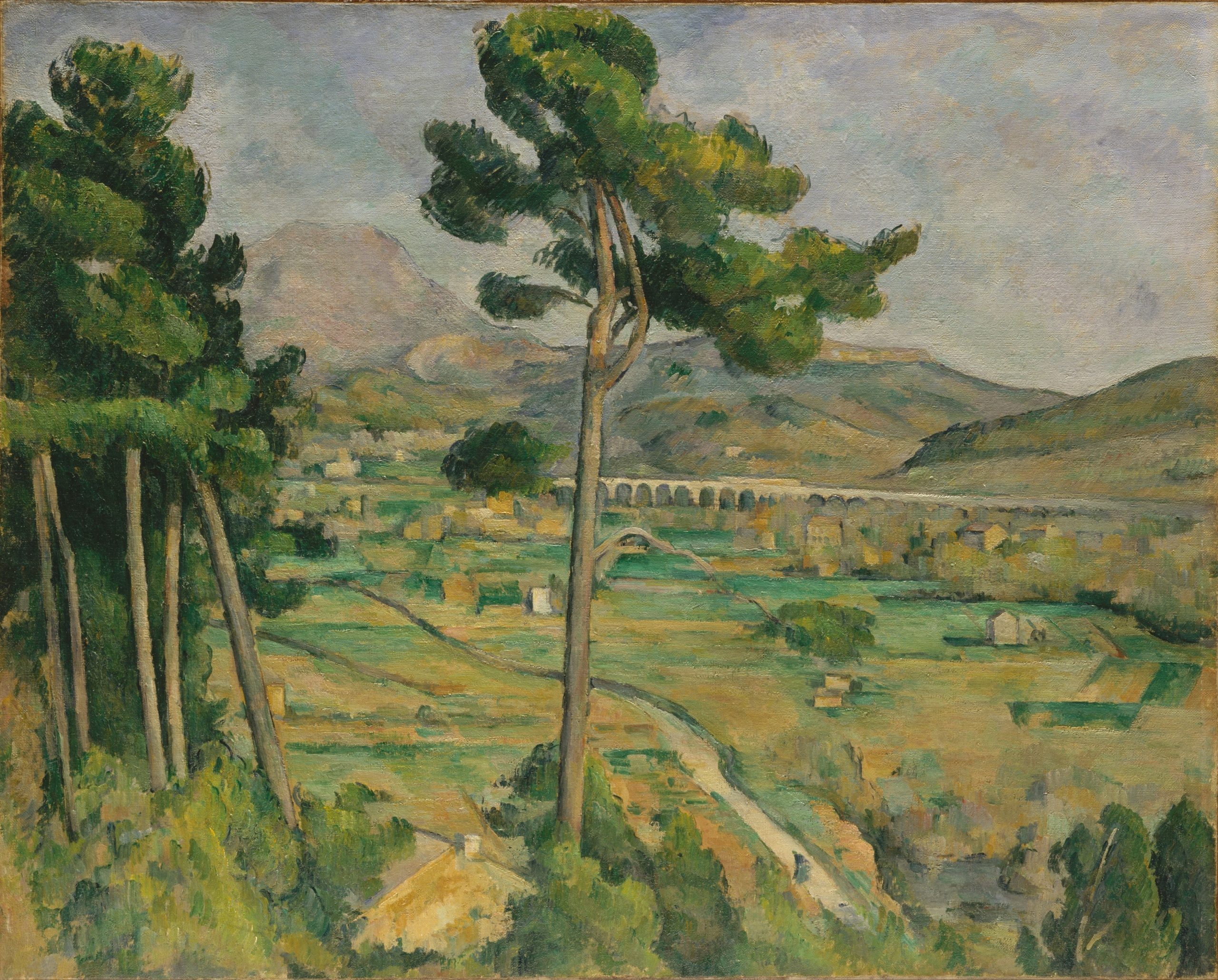
Paul Cézanne (1839–1906) is the French painter regarded as one of the founders of modern painting. Out of impressionism he drew an order of his own: he laid the colour in separate, parallel strokes and built form without traditional light and shade. You will find his motifs among the hand-painted reproductions on canvas.
Aix, Zola and the move to Paris
Cézanne was born on 19 January 1839 in Aix-en-Provence. His closest schoolfriend was Émile Zola, the future novelist, who drew him to Paris in 1861. There Cézanne came close to the impressionists and for some years painted beside Camille Pissarro at Pontoise and Auvers. Pissarro taught him the light palette and working out of doors, but Cézanne soon took his own road: instead of the moment, he wanted to paint the lasting structure of the motif.
The constructive stroke: modulating instead of modelling
Cézanne’s technique has a name he used himself. Rather than modelling form with light and shade, he spoke of modulating colour – form should arise from a sequence of coloured planes, not from shadow. That is why his strokes are short, parallel and diagonal; in the catalogue raisonné the “parallel brush stroke” is even a technical heading of its own. Between the strokes he lets the light ground of the canvas breathe, and in some works the grey priming stays openly visible. It was precisely this openness that later delighted the cubists.
The last years at Les Lauves
Four years before his death Cézanne built himself a studio on the edge of Aix, at Les Lauves. From there he painted Mont Sainte-Victoire again and again – the same motif in dozens of versions, each time further broken into planes of colour. In October 1906 a storm caught him painting out of doors; he was carried home, and a few days later, on 22 October 1906, he died.
Why he is regarded as the father of modern painting
Cézanne founded no movement, yet cubism and abstraction are hard to imagine without him. His insistence on the same motif – the mountain, the basket of fruit, the card players – turned painting from the scene towards the structure. The generation after him drew the conclusion that a canvas can be a self-standing construction of colours and planes.
Frequently asked questions about Paul Cézanne
Who was Paul Cézanne?
A French post-impressionist painter (1839–1906), born in Aix-en-Provence. He is regarded as one of the founders of modern painting; his works are held by the Musée d’Orsay, the National Gallery of Art in Washington, the Museum of Modern Art and other museums.
What characterises Cézanne’s technique?
Short, parallel brush strokes and the building of form with colour instead of shadow – he called it modulating. Between the strokes the light ground of the canvas often stays visible.
What did he paint most often?
Still lifes with apples, portraits, bathers and above all Mont Sainte-Victoire, which he recorded in dozens of versions.
Can I buy a hand-painted reproduction of a Cézanne?
Yes. Our gallery offers 80 hand-painted Paul Cézanne reproductions on canvas, in fifteen sizes and, by arrangement, in a made-to-measure size. Before delivery you receive a photograph of the work for approval.
Leave a Reply