



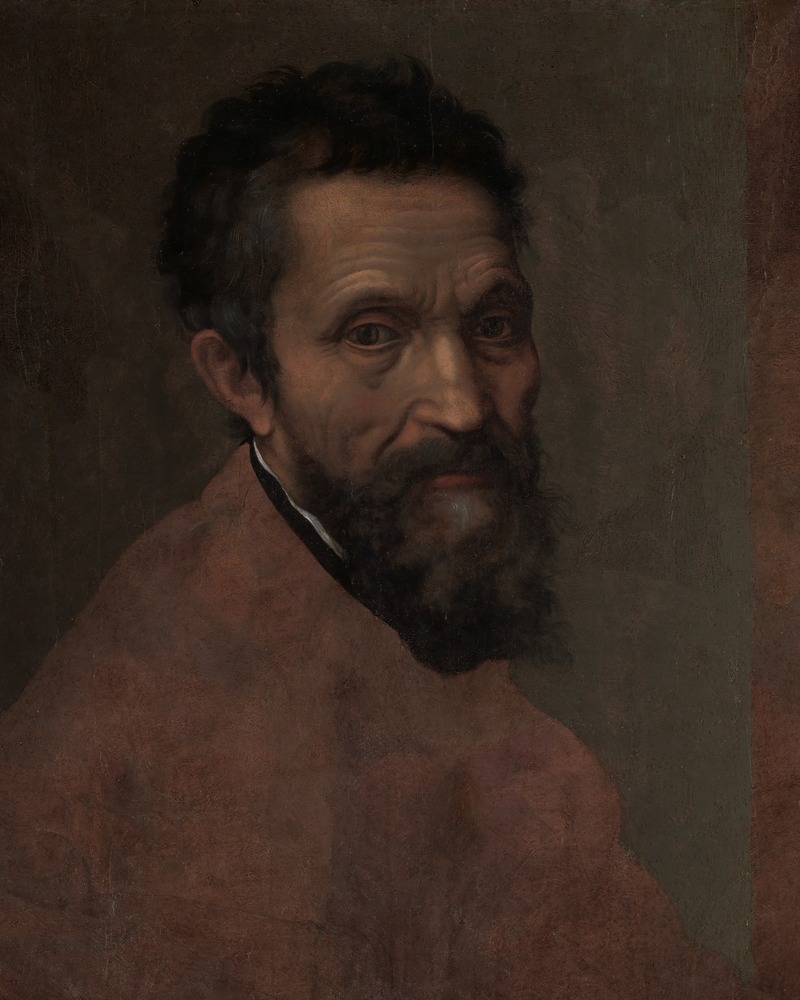
Michelangelo Buonarroti (1475–1564) was a Florentine sculptor, painter, architect and poet of the High Renaissance, the man who filled the ceiling of the Sistine Chapel with more than 300 figures. He never thought of himself as a painter, yet his frescoes in the Vatican rank among the most influential works of Western art. His works are part of our collection of hand-painted reproductions of Michelangelo paintings on canvas.
Each Michelangelo painting is painted by hand for you, in oil on canvas, to order and in the size you pick; before it ships, we send you a photograph of the finished painting.
Michelangelo paintings in our gallery
Life: from Caprese to Rome
Michelangelo was born on 6 March 1475 in Caprese, near Arezzo, and grew up in Florence. At 13 he was apprenticed to the painter Domenico Ghirlandaio, and soon afterwards he was learning in the circle of Lorenzo de’ Medici. In Rome he carved the Pietà, finished when he was 24, and back in Florence he completed the marble David in 1504. In 1505 Pope Julius II called him to Rome to build his tomb, and between 1508 and 1512 he painted the Sistine Chapel ceiling for the same pope. Later he painted the Last Judgment on the chapel’s altar wall (1534–1541), and in 1546 he became architect of St Peter’s Basilica, whose dome was finished to his design after his death. He died in Rome on 18 February 1564, aged 88, and was buried in Florence, in the Basilica of Santa Croce.
Style: a sculptor on the ceiling
Michelangelo saw himself above all as a sculptor and took on the ceiling reluctantly. He persuaded the pope to give him a free hand, and in place of the twelve apostles first planned he devised a far richer scheme: nine scenes from the Book of Genesis down the centre, and along the sides seven prophets of Israel and five sibyls of the classical world. The painting covers more than 500 square metres and holds over 300 figures, among them the nude youths he called the ignudi. The frescoes were painted into wet plaster about 20 metres above the floor, and the restoration of 1980–1989 brought their bright colours back to light. His figures are powerful, often twisting bodies, seen with a sculptor’s eye.
His most famous works
His best-known works are the marble Pietà in St Peter’s Basilica, the David in the Accademia in Florence and the frescoes of the Sistine Chapel. From the ceiling, our gallery holds The Deluge (1508–1509), among the first scenes he painted, together with the Delphic Sibyl and the prophets Isaiah, Ezekiel and Daniel (1509–1511). The Doni Tondo (c. 1505–1506), a Holy Family, is the only finished panel painting of his maturity to survive and hangs in the Uffizi in Florence. The unfinished Manchester Madonna (c. 1497) and Entombment (c. 1500–1501) are in the National Gallery in London, and The Torment of Saint Anthony (c. 1487–1488), possibly his earliest painting, is in the Kimbell Art Museum in Fort Worth. To see where he stands beside the other great masters, read our overview of the most famous paintings in the world.
Frequently asked questions about Michelangelo
Who was Michelangelo?
A Florentine sculptor, painter, architect and poet of the High Renaissance (1475–1564), creator of the David, the Pietà and the frescoes on the Sistine Chapel ceiling.
What did Michelangelo paint?
Mostly religious frescoes: the Sistine Chapel ceiling and the Last Judgment, as well as two frescoes in the Pauline Chapel. Only a few of his panel paintings survive, the Doni Tondo among them.
Where can I see Michelangelo’s original works?
The frescoes are in the Sistine Chapel in the Vatican, the Doni Tondo in the Uffizi in Florence, the Manchester Madonna and the Entombment in the National Gallery in London, and The Torment of Saint Anthony in the Kimbell Art Museum in Texas.
Can I buy a hand-painted reproduction of a Michelangelo painting?
Yes, our online gallery offers hand-painted reproductions of Michelangelo paintings on canvas in the size you choose. We paint the frescoes and panels in oil on canvas, and the round Doni Tondo on a square canvas without its carved frame. Before delivery we send you a photograph of the painting to approve.
Leave a Reply