



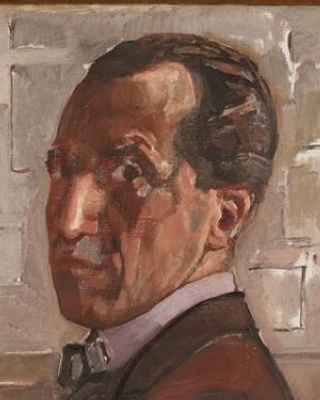
Piet Mondrian (1872–1944) is the painter of the famous grids: black lines on white, with planes of red, yellow and blue. Fewer people know that he spent his first twenty years painting Dutch windmills, farms and trees, and that the grid grew slowly out of them. His path shows how a landscape painter became one of the founders of abstract art.
We hand-paint every Mondrian in oil or acrylic on canvas, to order and in the size you choose; before dispatch we send you a photo of the finished painting.
Paintings by Piet Mondrian in our gallery
Life
Pieter Cornelis Mondriaan was born on 7 March 1872 in Amersfoort. His father was a teacher and an amateur draughtsman, and his uncle Frits Mondriaan was a painter. He qualified as a drawing teacher and in 1892 entered the Rijksakademie in Amsterdam. For years he lived from landscapes, copies in museums and portraits on commission. In 1911 he saw Cubist works by Picasso and Braque in Amsterdam, and in 1912 he moved to Paris, where he began to sign himself Mondrian. The First World War kept him in the Netherlands, and in 1917 he co-founded the magazine and movement De Stijl with Theo van Doesburg. From 1919 he lived in Paris again. In 1938, as war approached, he moved to London, and in 1940 to New York. He died there of pneumonia on 1 February 1944, leaving Victory Boogie Woogie unfinished.
Style
His early paintings follow the Hague School: grey skies, water and mills at dusk. Around 1908, in Domburg in Zeeland, his colour turned bright and pure, and he began to simplify. The trees he painted between 1908 and 1912 show the change better than anything else: the branches become curves, then short lines, and finally a rhythm across the whole canvas. From 1920 he used only straight horizontal and vertical lines, the three primary colours, white, grey and black. He called this Neo-Plasticism and wrote that equilibrium comes from the balance of unequal but equivalent parts. In New York the black lines gave way to coloured bands that echo jazz and city traffic.
Most famous works
Composition II in Red, Blue and Yellow (1930) is the image most people know as “a Mondrian”. Broadway Boogie Woogie (1942–43) at the Museum of Modern Art is his tribute to New York. The Red Tree, Gray Tree and Blossoming Apple Tree at the Kunstmuseum Den Haag show the road to abstraction. Composition 10 in Black and White, also known as Pier and Ocean, turns the sea into rhythm. All of them are available as hand-painted copies in oil or acrylic on canvas on our Piet Mondrian page.
Frequently asked questions
Why did Mondrian change his name?
When he moved to Paris in 1912 he dropped one “a” from Mondriaan, which made the name easier to read in French.
What is De Stijl?
A Dutch art movement and magazine founded in 1917 by Mondrian, Theo van Doesburg and others. It aimed at a universal style of straight lines and primary colours in painting, architecture and design.
Where can I see Mondrian’s paintings?
The largest collection is at the Kunstmuseum Den Haag; others are at the Museum of Modern Art and the Guggenheim in New York, the Centre Pompidou in Paris and the Kunsthaus Zürich.
Can I buy a Mondrian painting for my home?
The originals are in museums, but we paint hand-made copies in oil or acrylic on canvas in many sizes, or in your own size.
Leave a Reply