
Description
Nave nave moe (Sacred Spring) – a Tahitian scene painted in France
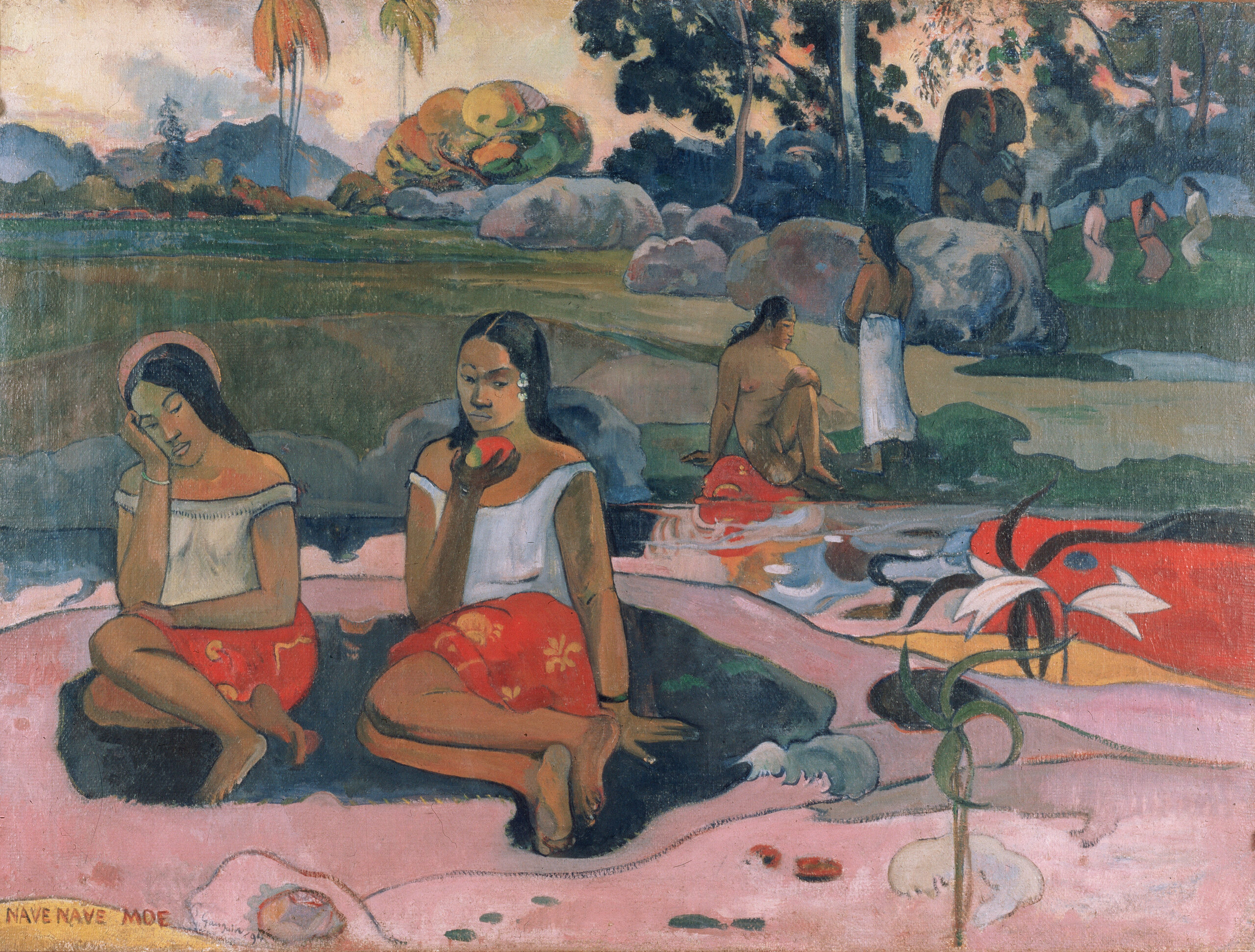
In the foreground two women sit on a broad pink surface. The one on the left has rested her head on her hand and closed her eyes; the one on the right sits upright and holds a small red and yellow fruit in her raised hand, with a white blossom behind her ear. Both wear a white top and a red patterned skirt. Behind them lies dark water with reflections, beside which one figure sits with her back turned and another stands wrapped in white cloth. On the right a tall white flower grows on a slender stem. In the background come green turf, grey-blue rocks, an orange and yellow flowering tree and palms; at the very top right a few small pale figures can be made out in the grass. The work is held by the State Hermitage Museum in Saint Petersburg under the inventory number GE-6510.
An island motif made on the mainland
The most surprising detail comes from the museum record: the place of execution is given as France, and the date as 1894. The picture was therefore not made in Tahiti but in the interval between the painter’s two voyages to the Pacific, when Gauguin had already returned to Europe. The scene is memory rather than observation, which explains why the colours are so free and why the whole reads as an image assembled from remembered parts rather than a view through a window.
The title painted into the lower left corner
At the lower left, on the pink ground, the title Nave nave moe is painted, with the signature and the year beside it. The museum lists the work under a Russian title that translates as the wonderful spring; in other collections and in books it often appears as sacred spring or sweet dreams. Different names describe the same canvas, so we give them together.
One waking, one asleep
The two figures in the foreground are set against each other. The left one is drowsy, bowed, withdrawn into herself; the right one is awake and looks straight out at the viewer. It is this difference that keeps the scene taut, although outwardly nothing happens. Everything else – water, rocks and trees – is arranged in quiet horizontal bands that rise one above another without depth.
How a hand-painted reproduction is made
Every reproduction here is hand-painted in oil on canvas, stroke by stroke. In this motif the pink surface in the foreground is the hardest part: it has to carry both figures and stay light at the same time, or the scene goes dull. Before dispatch you receive a photograph of the finished work for approval.
- Subject: two seated women on pink ground, behind them water, rocks and a flowering tree.
- Technique: oil on canvas, flat areas of colour and quiet horizontal bands.
- Sizes: landscape format, from 40 x 30 cm to 200 x 150 cm; 80 x 60 cm and 100 x 75 cm are often chosen.
- Of note: the museum record gives France as the place of execution, although the scene is Tahitian.
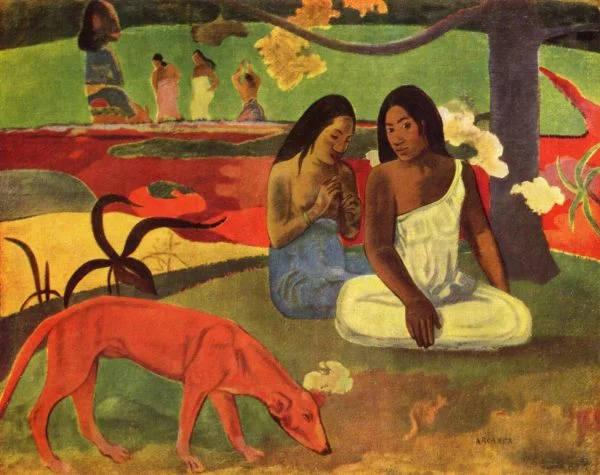
If the same period interests you, see also Mahana no atua (Day of the God), Te arii vahine (The King’s Wife) and Arearea (Joyousness), in which Gauguin builds the scene from the same quiet bands of colour. The museum gives the measurement as height by width: 74 x 100 cm, a landscape format.