


Description
Te arii vahine (The King’s Wife) – the canvas Gauguin itemised in his own letter
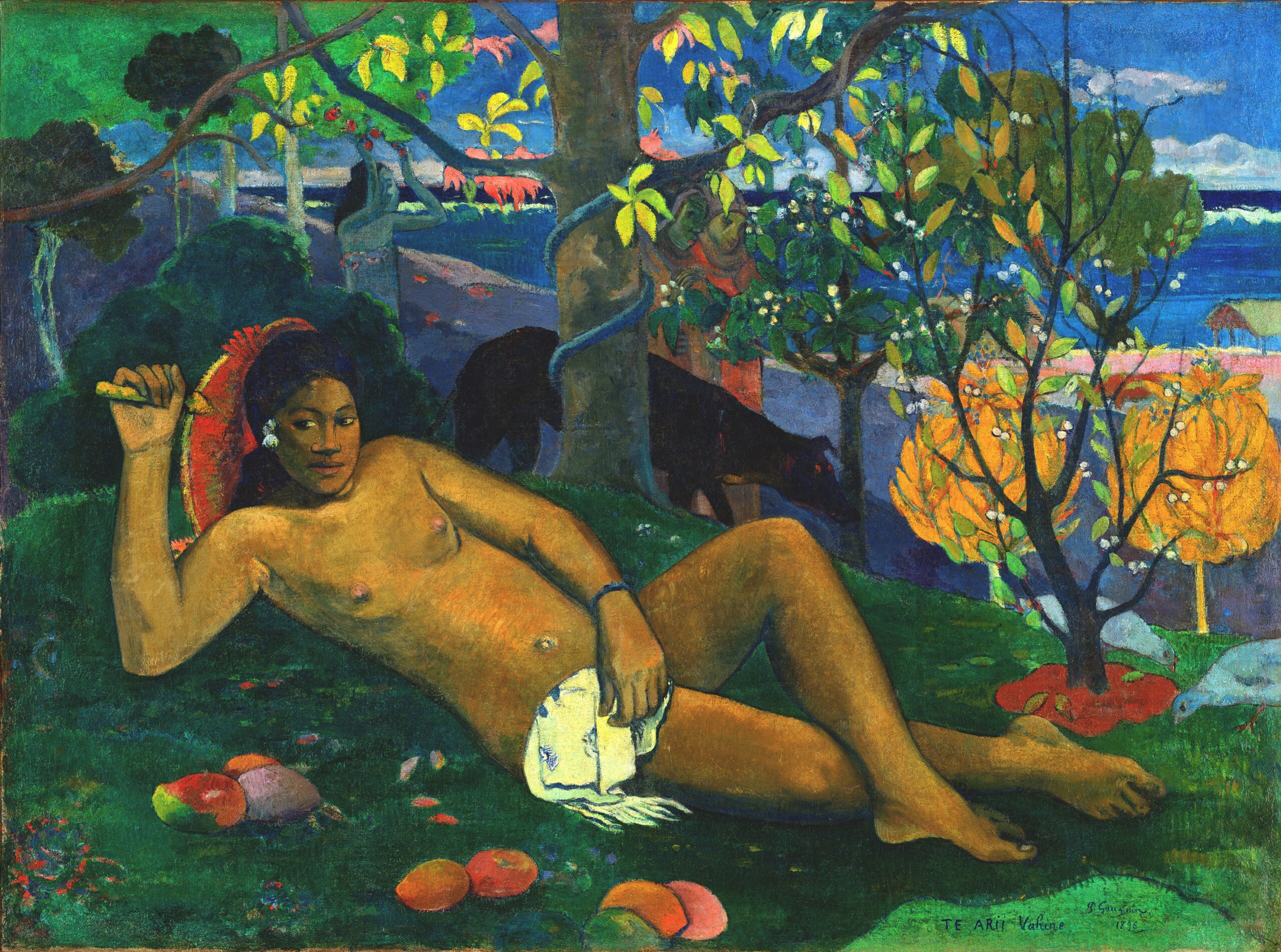
In 1896, during his second stay on Tahiti, Paul Gauguin painted a woman lying on green grass, a red fan behind her head and a white flower at her ear. In front of her, on the grass, lie mango fruits. Behind her back a thick trunk rises, someone reaches for fruit among the branches, and behind the trunk stands a dark animal that the painter himself called a dog. To the right a tree is in blossom with white flowers, and at its foot stand two pale birds. A blue band of sea runs across the back. The work is held by the Pushkin Museum of Fine Arts in Moscow under inventory number Ж-3265. The format is landscape – the museum states height first and width second, so 97 x 130 cm.
What Gauguin himself wrote
In April 1896 he wrote to a friend about this canvas and listed exactly what one notices first: the trees in blossom, the dog on guard and the two doves cooing at the right. He added that in his own view he had never made anything so strong. This is not our reading of the picture but the painter’s own inventory of it, and all three things really are on the canvas, precisely where he says.
The woman, the fan and a throne of grass
The central figure lies on the grass, propped on her left arm, looking straight out at the viewer. Behind her head is a red fan that works like the back of a throne; that red plane is the strongest colour in the upper half. In front of her lie the fruits for which the work is also known in Italian as the woman with mangoes. The title means the king’s wife, and Gauguin painted the figure as though she lay on a throne of grass.
Where the original is, and where it came from
The original is at the Pushkin Museum of Fine Arts, inventory number Ж-3265, oil on canvas, measuring 97 x 130 cm. Until 1918 the canvas was in the Shchukin collection, then until 1948 in the Museum of New Western Art, and since 1948 it has been at the Pushkin Museum. The museum record and the public art database agree on both the measurement and the year.
The signature and the title on the canvas itself
In the lower right corner the title TE ARII VAHINE and the signature P. Gauguin with the year 1896 are painted in blue. It is the painter’s own stroke and part of the original work, not a mark added afterwards and not a watermark. On the reproduction they are painted just like the rest of the scene, because they belong to the work.
How a hand-painted reproduction is made
Our famous paintings on canvas are painted by hand, in oils, brushstroke by brushstroke. On this subject the green grass is the hardest part: it has to carry the weight of the whole figure and stay alive at the same time, or the figure sinks into it. Before dispatch you receive a photograph of the finished piece for approval.
- Subject: a reclining woman with a red fan on green grass, fruits before her, a blossoming tree at the right and a blue band of sea behind.
- Technique: oil on canvas, saturated planes of colour and dark outlines.
- Sizes: landscape format, from 40 x 30 cm to 200 x 150 cm; the most frequently chosen are 80 x 60 cm and 100 x 75 cm.
- Of note: this is not the same work as the far smaller painting of the same title, recorded as Te arii vahine II – this is the large Moscow canvas.
If the same period interests you, look also at Her Name was Vairaumati, also at the Pushkin Museum, Mahana no atua (Day of the God) and Woman Holding a Fruit, where Gauguin likewise sets a Tahitian figure in a saturated field of colour.