




Description
An Orchard under the Church of Bihorel – a title that promises more than can be seen
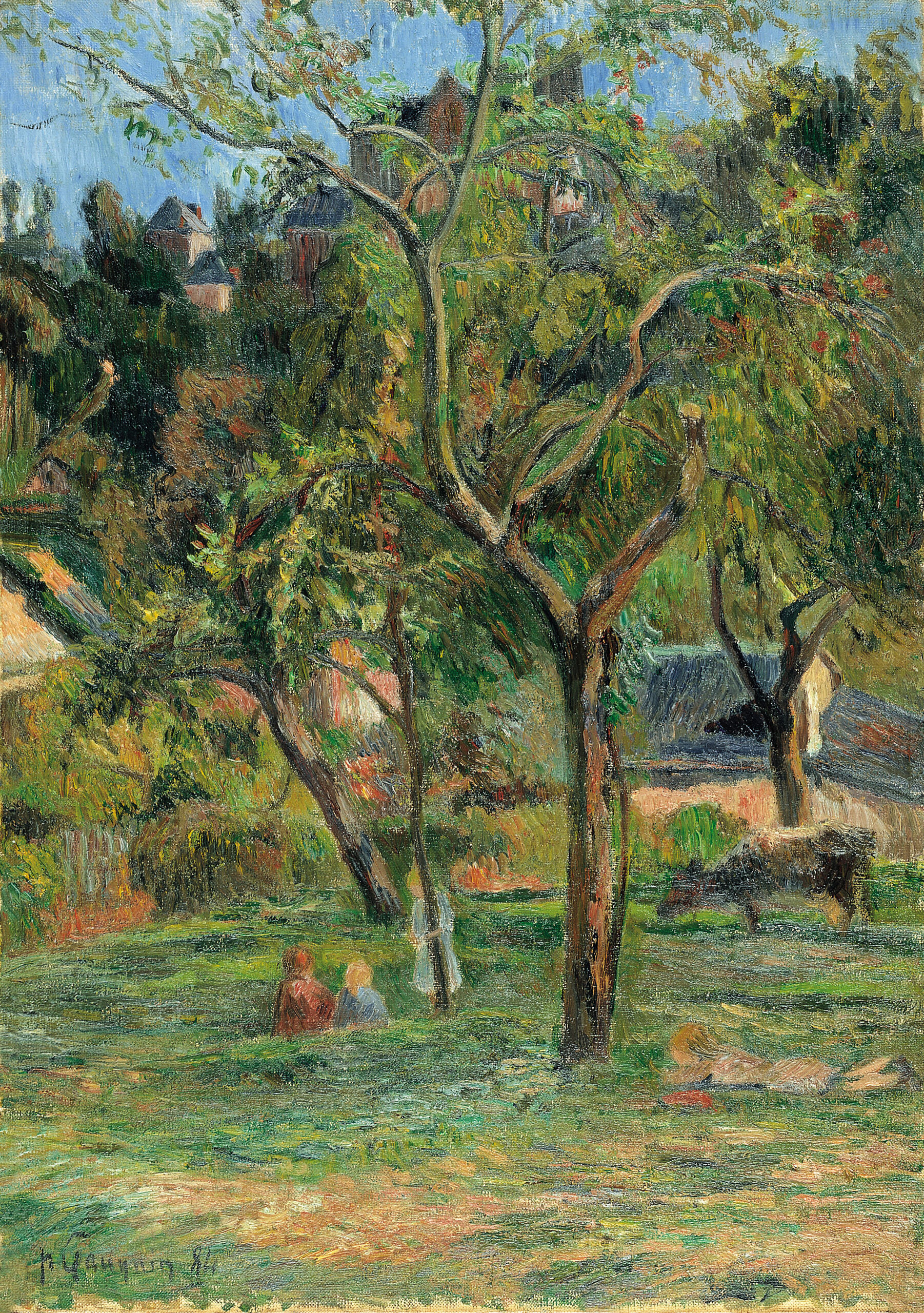
The picture is filled by two slender fruit trees that grow out of the pale grass and spread their branches across almost the whole height of the canvas. The grass in front is painted in small, short strokes of green, yellow and pink. At the lower left two tiny figures sit in the grass, one in orange-red, the other in pale blue; between them stands another light figure, and at the lower right someone lies down. On the right a low building with a grey-blue roof can be seen, and beside it a dark animal. Above, roofs and gables appear between the leaves, and over everything stands a blue sky. At the lower left the signature is painted with the year. The work is held by the Museo Nacional Thyssen-Bornemisza in Madrid under the inventory number CTB.1992.6, and the year is 1884.
Where is the church
The title names the church below which the orchard is supposed to lie. In the picture itself it is not easy to find. Up among the branches roofs and at least one steep gable really can be seen, but none of those shapes can be recognised with confidence as a church; the foliage covers them. The museum record we were able to read gives title, painter, year, technique and measurement, and says nothing about the buildings. What we cannot make out we therefore do not assert: we say only that we do not recognise it, not that it is absent.
The orchard takes everything
What is certain in the picture is the orchard. The trunks of the two trees stand almost in the middle, and their branches reach to all four edges, so that the sky is divided into small blue patches between the leaves. The people are small and set along the bottom edge, as though they belonged to the grass. The picture really is what the first half of the title says, while the second half stays a promise.
Grass made of strokes
The lower third of the canvas is the most fully worked part of the picture. The grass is not one green surface but a dense weave of short strokes, among which yellow, pink and white appear. It is this density that holds the foreground up and gives the picture its brightness, although it contains not one strong accent of colour.
How a hand-painted reproduction is made
Every reproduction here is hand-painted in oil on canvas, stroke by stroke. In this motif the grass is the hardest part: it is built from very many small strokes, and if they merge the foreground empties out. Before dispatch you receive a photograph of the finished work for approval.
- Subject: two fruit trees across the whole height, tiny figures in the grass, a low building at the right.
- Technique: oil on canvas, small short strokes and blue sky between the leaves.
- Sizes: portrait format, from 35 x 50 cm to 140 x 200 cm; 50 x 70 cm and 65 x 90 cm are often chosen.
- Of note: the church of the title cannot be identified with confidence in the picture.
If the same period interests you, see also The Market Gardens of Vaugirard, Winter Landscape (Vinterlandskap) and Breton Peasant Women. The museum gives the measurement as height by width: 65.5 x 46 cm.