


Description
Vincent van Gogh Painting Sunflowers – Gauguin’s portrait of a painter at work
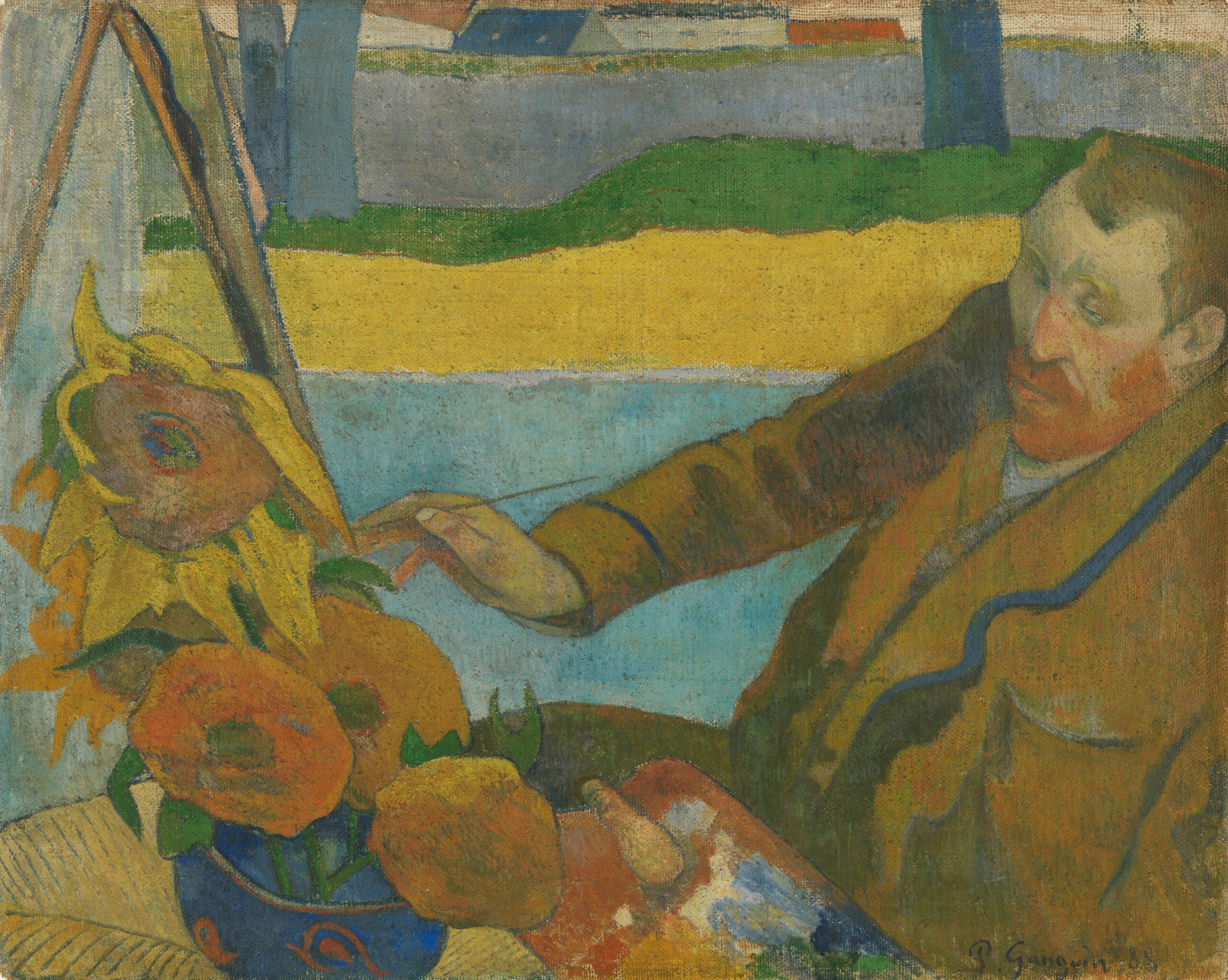
In December 1888, during the nine weeks Paul Gauguin and Vincent van Gogh shared a house in Arles, Gauguin painted his host at work. Van Gogh is at the right of the canvas, in three-quarter view, with a reddish beard and half-closed eyes, in a mustard-yellow coat; a thin brush is held in his outstretched hand. The palette lies at the lower right. To the left stands a blue vessel with a red device, and from it sunflowers rise. Behind them run horizontal bands of colour, and small houses appear at the very top. The work is held by the Van Gogh Museum in Amsterdam under accession number s0225V1962. The format is landscape – the measurement 73 x 91 cm is recorded as height by width.
A painter painting a painter
This is the only portrait in our Gauguin collection showing another well-known painter at his work. Gauguin did not paint his friend posing but working: the gaze drops to the canvas, the hand is in motion, the body leans slightly forward. That is why it is not simply the portrait of a face but the portrait of a trade.
Sunflowers inside another painter’s work
The sunflower was van Gogh’s subject, not Gauguin’s. Here it appears inside another painter’s work: the blue vessel with its red device stands to the left, and the blooms are painted broadly and flatly, without the thick paint by which their real author was recognised. Gauguin therefore painted the very thing his host was known for.
The coarse weave showing through the paint
The paint is laid on thinly, so the weave of the support shows clearly through it in places, most of all in the pale band at the upper right. It is that coarse weave which gives the work its grain. In a reproduction this is the hardest effect of all: lay the paint on too thickly and the scene loses the airiness of the original.
The signature and the year
In the lower right corner the signature P. Gauguin and the year 88 are painted in with the brush. The name and the year sit in the paint layer itself, which is why they are neither a stamp nor a watermark. On our canvas we paint them as part of the scene, not onto it.
Where the original is, and what the sources say
The original is at the Van Gogh Museum in Amsterdam, accession number s0225V1962, made in December 1888. The museum’s record gives the measurement as 73 x 91 cm. On the support the museum’s two own sources disagree: the collection record says oil on canvas, while the museum’s scholarly catalogue says oil on burlap. We name both rather than silently choosing one.
How a hand-painted reproduction is made
Reproductions of famous paintings are painted by hand here, in oils on canvas, brushstroke by brushstroke. On this subject the face is the hardest part: lose the lowered gaze and the quiet concentration and the work becomes merely a man holding a brush. Before dispatch you receive a photograph of the finished piece for approval.
- Subject: Vincent van Gogh painting sunflowers, the brush in his outstretched hand and the palette beside him.
- Technique: oil on coarse cloth, thinly laid paint and broad planes of colour.
- Sizes: landscape format, from 40 x 32 cm to 200 x 160 cm; the most frequently chosen are 80 x 64 cm and 100 x 80 cm.
- Of note: the sunflower was van Gogh’s subject; here Gauguin painted it, inside his own work about him.
If the same period interests you, look also at Portrait of the Artist with the Yellow Christ, Breton Girls Dancing, Pont-Aven and Breton Boy, where Gauguin likewise paints people from his own circle.