


Description
Blue Segment is a painting by Wassily Kandinsky from 1921: a slightly landscape-format canvas on a white ground, crossed on the diagonal by a long black curve, with circles, wedges, saw-toothed bands and small coloured bars crowding around it. The original is held by the Guggenheim Museum in New York. We make it as a hand-painted reproduction in oil on canvas, in eight sizes or to your measurements, and before dispatch you receive a photograph of the finished work for approval.
| Title: | Blue Segment |
| Other titles: | Blaues Segment · Siny segment |
| Painter: | Wassily Kandinsky (1866–1944) |
| Year: | 1921 |
| Original size: | 140 cm x 120.7 cm |
| Original technique: | Oil on canvas |
| Painting style: | Abstract art |
| Location: | Solomon R. Guggenheim Museum, New York (inv. 49.1181) |
| Our reproduction: | hand-painted oil on canvas, 8 sizes from 60 x 50 cm to 160 x 140 cm, made to measure on request |
Blue Segment – Wassily Kandinsky
What is on the canvas?
Everything stands on a white, slightly warm ground. From the lower left edge a long, thick black curve rises towards the centre, with a thin yellow glow running beside it; in the middle it turns upwards and disappears into a crowd of forms. From that crowd a second black stroke falls towards the lower right corner, where it ends in a broad tail and a tuft of thin black fingers above two brown half-discs. Right of centre stands a large pale blue form, curved like a segment of a circle, darkening towards the right edge; a grey, stippled band edges it. Above it sits a blue-violet half-dome with a yellow rim, and below that two circles like two targets: the left one with a red ring and a turquoise centre, the right one with a blue ring and a yellow and red centre. At the upper left lies a black saw-toothed band, beneath it a pink plane with a brown wedge and a blue half-disc, and from the left edge a grey, stippled ribbon reaches towards it. In the left half stand a yellow disc crossed by a black bar and a smaller blue disc crossed by thin lines; three thin black lines come in from the left, run through the yellow disc and bend back on the right like a hairpin. The lower half is filled with red, orange, yellow, blue and green bars, wedges and hooks, and a long brown wedge lies across the middle at a slant. Along the right edge are small overlapping circles in blue, yellow and pink, and at the lower right a turquoise triangle with a yellow dot. At the lower left are a monogram and the figures 21.
How is the painting built?
Around two black strokes. The first crosses the canvas from the lower left to the centre, the second falls from the centre to the lower right corner, so that together they make a wide arc that carries everything else. The painting is densest right of centre and at the top, where circles, wedges and the blue form press against one another; the left half is airier, with more white ground and a few isolated signs. The grey bands are not smooth: they are made of fine dots, so that between the sharply drawn forms they read as shadow or dust. As an abstract painting it has no subject to recognise, but it has a clear rhythm between dense and empty, heavy and light.
Why is it called Blue Segment?
In geometry a segment is the part of a circle cut off by a straight line. The largest blue form on the canvas is curved in just that way: a pale blue plane right of centre that darkens towards its edge and is bordered by a grey, stippled band. The museum’s record gives the title in three languages – Siny segment in Russian, Blaues Segment in German and Blue Segment in English – but does not say which form it refers to. So we do not claim it; we only say what on the canvas is blue and curved.
When was it painted, and where is it now?
The museum dates it to 1921; the record does not give a place of execution. The original is oil on canvas and, according to the museum, measures 120.7 x 140 cm, height first. It belongs to the Guggenheim Museum in New York, to the Solomon R. Guggenheim Founding Collection, under inventory number 49.1181. From 8 October 2021 to 5 September 2022 it hung in the museum’s rotunda in the exhibition Vasily Kandinsky: Around the Circle.
Why does this painting matter?
Because the museum places it among works of 1920 and 1921: in the exhibition checklist it lists it together with Red Oval of 1920 and White Center of 1921, directly after its text on Circles on Black, also of 1921. Of that work the museum writes that it is the last Kandinsky painted before his return to Germany, after he had largely spent the years of the First World War and the Russian Revolution in his native Moscow. His encounters with the Constructivist and Suprematist artists there, in the museum’s words, led him to expand his use of geometric forms and overlapping, flat planes; yet he distanced himself from their art by insisting that even his most abstract works retained expressive content. In Blue Segment sharply drawn wedges and circles stand beside a freely running black curve.
How is our hand-painted version made?
The painter works from a high-resolution reference and builds the painting up in layers, with brush and oil colours. With this subject the edges decide everything: the black strokes have to keep their weight and their sweep, the coloured planes their clean borders, and the grey bands their fine dots, which we set by hand, one at a time. An oil painting reproduction keeps its colour for many years, because oil does not fade the way the colour of a print does. We have no studio photographs of this work yet; once the next copy is painted, we will add them here. Because every hand-painted copy is made on its own, no two are alike in every detail; what they share is the subject, the proportions and the colours.
Which size for which wall?
The original measures 140 x 120.7 cm; our 140 x 120 cm is the same width and 7 mm lower. As a painting for the living room it works best at 120 x 100 or 140 x 120 cm, where the small circles and bars stay legible from a few metres away. The 60 x 50 and 70 x 60 cm sizes suit a desk or a hallway, 80 x 70 and 90 x 80 cm a bedroom, and 100 x 90 cm a larger wall. The largest size, 160 x 140 cm, is bigger than the original and meant for open spaces.
Custom sizes, stretcher and frame
If none of the eight sizes fits your wall, we paint the work to your measurements; that is our painting made to measure, and we tell you how the composition adapts to the new proportion. Every canvas is stretched on a wooden stretcher. A frame is optional and not included in the base price.
Delivery and guarantee
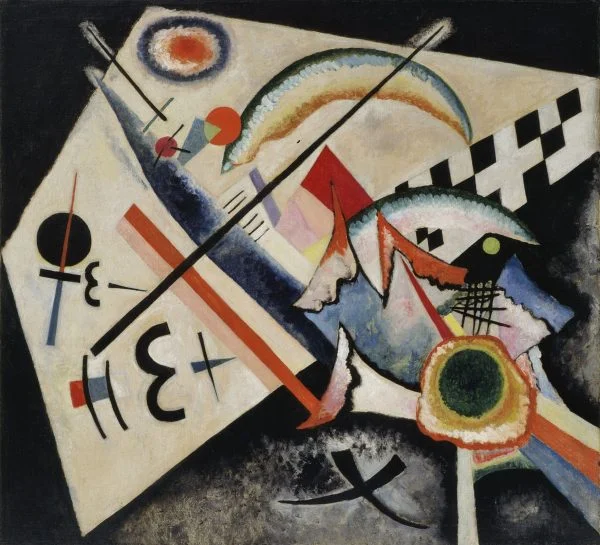
Every canvas here is painted only after it is ordered, in our studio in Slovenia, so allow 15 to 45 days depending on the size. We send it protected, insured and tracked, across the EU without customs. If something is wrong on arrival, write to us and we will put it right. All of Kandinsky’s works here are gathered in our Wassily Kandinsky gallery, and the painter is introduced in our article about Wassily Kandinsky. Related works we paint include Red Spot II, White Cross and In the Black Square; from the same Guggenheim collection we also paint Dominant Curve.
Frequently asked questions
Where is the original?
In the Guggenheim Museum in New York, in the Solomon R. Guggenheim Founding Collection, inventory number 49.1181. The museum lists it in the checklist of the exhibition Around the Circle.
How large is the original?
It measures 140 x 120.7 cm. We give the width first; the museum gives the height first, as 120.7 x 140 cm, or 47 1/2 x 55 1/8 inches. Our nearest size, 140 x 120 cm, is the same width and 7 mm lower.
When was it painted?
The museum dates it to 1921. At the lower left, beside the monogram, the figures 21 are painted.
What is shown in the painting?
Nothing figurative: black curves, circles, wedges, saw-toothed bands and coloured bars on a white ground, and right of centre a large pale blue curved plane.
Is this a print?
No. This is a canvas painting: it is painted by hand in oil, and the brushstrokes are visible in raking light and can be felt.
Which size should I choose?
For a living room 120 x 100 and 140 x 120 cm work best, for a desk or a hallway 60 x 50 or 70 x 60 cm. Before deciding, tape paper of that size to the wall for a day.
Can I have a size that is not on the list?
Yes. We also paint sizes that are not on the list, in the proportion your wall needs, and tell you how the forms will fall.
How is it delivered?
Insured and tracked, across the EU without customs. Before dispatch you receive a photograph of the finished Kandinsky reproduction for approval.
What are the two circles at the top?
The two circles below the blue-violet half-dome are built from rings: the left one has a red ring and a turquoise centre, the right one a blue ring and a yellow and red centre. We give them no meaning, because no source we could check gives one.
Is the original for sale, and what is it worth?
It is not for sale, so it has no market price. It belongs to a public museum collection and stays there; what we offer is a copy painted by hand, not the original, and we never confuse the two.
Does it make a good gift?
It does, especially for someone who likes strong colour and movement. If you are unsure about the subject or the size there is a gift voucher, and the decision stays with them.
- Subject: black curves, circles, wedges and coloured bars on a white ground, right of centre a large pale blue curved plane
- Original: Solomon R. Guggenheim Museum, New York, inv. 49.1181, 1921, 140 x 120.7 cm
- Our version: hand-painted oil on canvas, eight sizes from 60 x 50 to 160 x 140 cm, on a wooden stretcher, framed on request
- Worth knowing: the museum gives the title in three languages: Russian, German and English