







Description
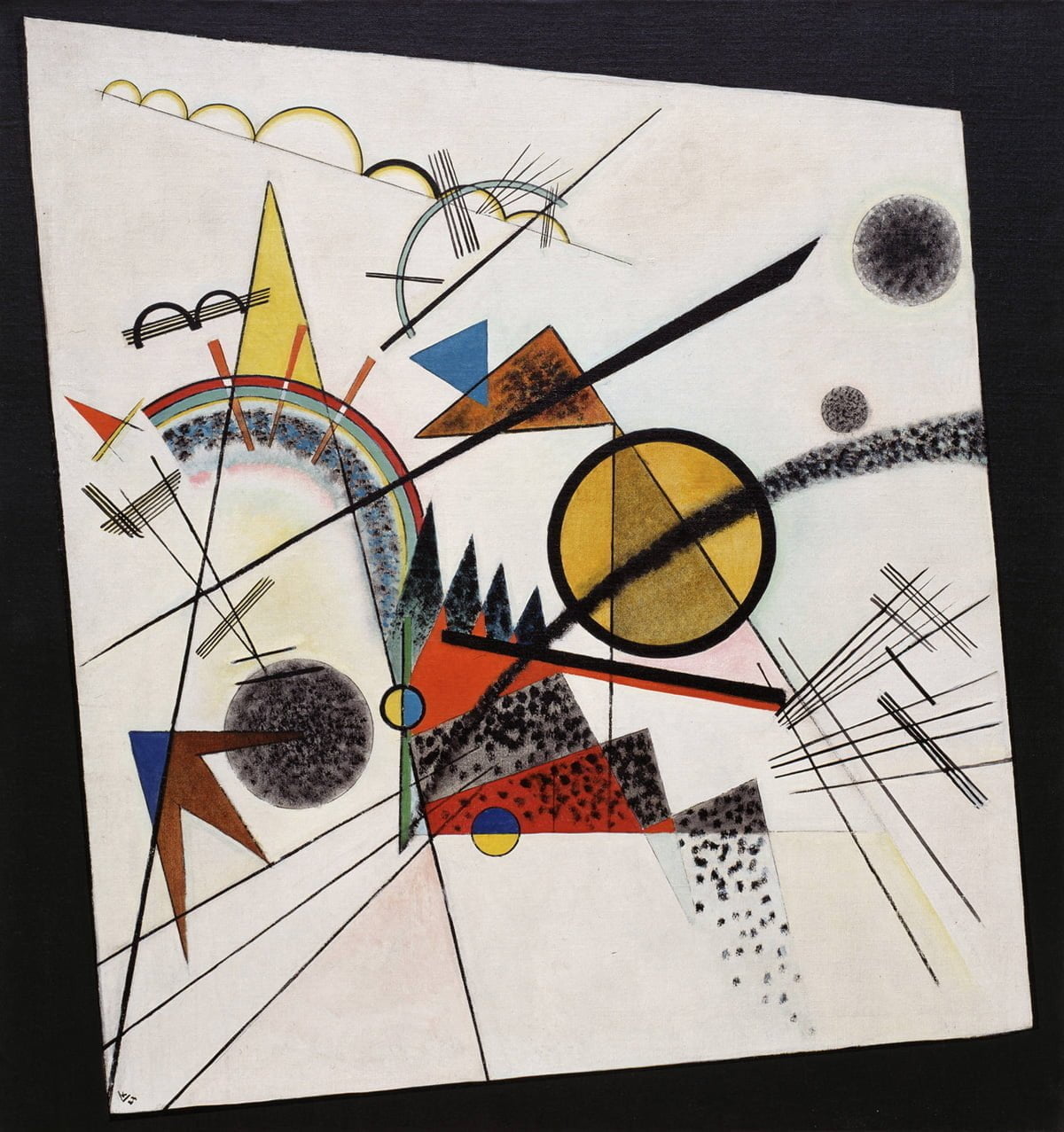
In the Black Square is a painting by Wassily Kandinsky from June 1923: a tilted white plane on a black ground, crossed by thin black lines, with circles, triangles and a rainbow arc floating on it and a row of yellow half-circles along its upper edge. The original is held by the Solomon R. Guggenheim Museum in New York. We make it as a hand-painted reproduction in oil on canvas, in eight sizes or made to measure, and before dispatch you receive a photograph of the finished work to approve.
| Title: | In the Black Square |
| Other titles: | Im schwarzen Viereck |
| Painter: | Wassily Kandinsky (1866–1944) |
| Year: | 1923 |
| Original size: | 93.3 cm x 97.5 cm |
| Original technique: | Oil on canvas |
| Style: | Abstract art |
| Location: | Solomon R. Guggenheim Museum, New York (inv. no. 37.254) |
| Our reproduction: | hand-painted oil on canvas, 8 sizes from 50 x 50 cm to 150 x 160 cm, made to measure on request |
In the Black Square – Wassily Kandinsky
Why is it called In the Black Square?
Because everything that happens in the painting stands on a white plane, and that plane lies within a black square that surrounds it on every side. The white plane is not a rectangle: it is a tilted trapezoid that rises at the upper left and falls to the right, so it seems to float. The museum notes that this white trapezoid recalls the Suprematist paintings of Kazimir Malevich. Kandinsky does not stop at pure geometry, though: he sets a whole landscape of signs on it.
What can be seen in the painting?
At the upper left a thin slanting line runs, with a row of yellow half-circles with black outlines along it. Below them stands a tall yellow triangle, and at its foot a rainbow arc of red, green and blue spans, with a grey speckled edge and a pale yellow glow inside. Right of centre is a large yellow circle with a black outline, crossed by a thick black diagonal; from the circle a speckled black band runs to the right edge. At the upper right two grey speckled circles float, one larger and one smaller. In the middle a row of dark green jagged triangles rises, below them a red triangle with a thick black bar, and lower down stepped planes in black, red and grey, strewn with dots that scatter towards the lower right. Above the centre sit a blue and a brown triangle. At the lower left is a grey speckled circle, and before it a brown arrow-like form with a blue triangle. Thin straight black lines run across everything, with bundles of parallel strokes on the left and right. In the bottom left corner is a monogram.
Clouds, mountains, sun and rainbow?
According to the museum the painting has elements resembling clouds, mountains, a sun and a rainbow, and these still refer to the landscape. As an abstract painting it is not to be read literally, but with the museum’s record in mind the row of yellow half-circles at the top can be read as clouds, the jagged triangles as mountains, the yellow circle as the sun and the coloured arc as a rainbow. The museum sees in this painting Kandinsky’s synthesis of Russian avant-garde art and his own lyrical abstraction.
When and where was it painted?
In June 1923, in Germany. The museum describes the road to it: after the outbreak of the First World War Kandinsky returned to his native Moscow and met the utopian experiments of the Russian avant-garde there. The geometric forms of Kazimir Malevich, Aleksandr Rodchenko and Liubov Popova encouraged him to widen his pictorial vocabulary; from Suprematism and Constructivism he took overlapping flat planes and clearly delineated shapes. But because he believed in the expressive content of abstract forms, he grew apart from most of his Russian colleagues, who argued for more rational principles, and in 1921 he returned to Germany. Two years later this painting was made.
What did Kandinsky look for at the Bauhaus?
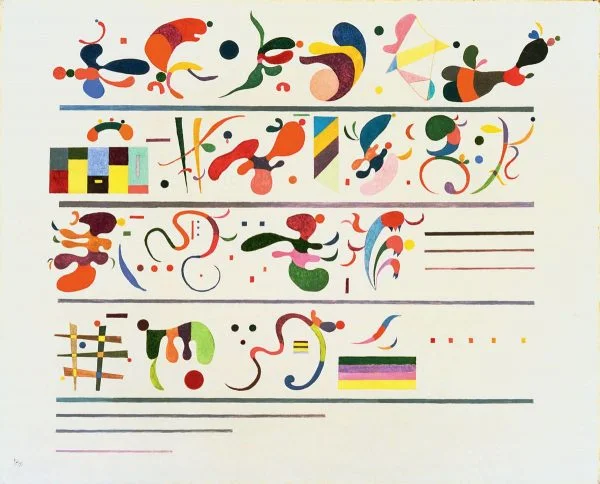
In 1922, in the museum’s words, he joined the teaching staff of the Bauhaus in Weimar, where he found a setting more sympathetic to his art. There he went on exploring how colours and forms correspond and how they act psychologically and spiritually. The museum adds that the Bauhaus began from a German, expressionist approach and that its aesthetic came to reflect Constructivist concerns, which by the mid-1920s had become international. The same museum owns Composition 8 of July 1923, in which, according to the museum, the circles announce the part they would play in later works, up to Several Circles. In Composition 8, according to the museum, the colourful geometric forms create a pulsating surface that shifts between movement and calm.
How is our hand-painted version made?
The painter works from a high-resolution reference and builds the painting up in layers, with brush and oil paint. With this subject what matters is precision: the thin lines must be straight and even, the outlines of the circles clean, and the speckled areas laid on with small, even touches of the brush. The white plane has to stay warm and calm, the black border around it deep. An oil painting reproduction keeps its colours for many years, because oil does not fade the way a print does. Since every reproduction is made individually, no two copies match down to the last detail; the subject, the proportions and the colours do.
Which size for which wall?
The original measures 93.3 x 97.5 cm; at our 93 x 98 cm size the width is 3 mm less and the height 5 mm more. As a painting for the living room it works best at 80 x 80 or 93 x 98 cm, where the thin lines still show well. The 50 x 50 and 60 x 60 cm sizes suit a desk or a hallway, 70 x 70 cm a bedroom, and 110 x 120 cm and up large walls. Because the work already has a black border of its own, it can hang without a frame.
Custom sizes, stretcher and frame
If none of the eight sizes fits your wall, we paint this Kandinsky reproduction to your measurements; that is our painting made to measure, and we tell you how the composition adapts to the new proportions. Every canvas is stretched on a wooden stretcher. A frame is optional and not included in the base price.
Delivery and guarantee
Because every painting on canvas is painted only after the order, in our studio in Slovenia, allow 15 to 45 days depending on the size you choose. We ship protected, insured and tracked, within the EU without customs. If anything is wrong on arrival, get in touch and we will put it right. All our works by Kandinsky are collected in the Wassily Kandinsky gallery, and the painter is introduced in our article about Wassily Kandinsky. Related works we paint include White Cross and Red Spot II.
Frequently asked questions
Where is the original?
In the Solomon R. Guggenheim Museum in New York, where it belongs to the museum’s founding collection under inventory number 37.254. The museum’s record is on the Guggenheim website.
How big is the original?
It measures 93.3 x 97.5 cm. We give the width first; the museum puts the height first, 97.5 x 93.3 cm. At our 93 x 98 cm size the width is 3 mm less and the height 5 mm more.
When was the painting made?
In June 1923, two years after Kandinsky returned from Moscow to Germany.
What does the painting show?
Nothing figurative: a white trapezoid in a black square, with circles, triangles, a rainbow arc and thin lines on it. According to the museum, some of them resemble clouds, mountains, a sun and a rainbow.
Is this a print?
No. It is a canvas painting, painted by hand in oil; the brushstrokes show in raking light and can be felt with the fingertips.
Which size should I choose?
For a living room 80 x 80 and 93 x 98 cm work best, for a desk or hallway 50 x 50 or 60 x 60 cm. Before deciding, tape a sheet of paper of the chosen size to the wall and leave it there for a day.
Can I have a size that is not on the list?
Yes. We also paint sizes outside the list and tell you how the forms will be arranged.
How is it delivered?
Insured and tracked, within the EU without customs. Before dispatch you receive a photograph of the finished painting to approve.
What did Kandinsky take from Suprematism and Constructivism?
According to the museum, overlapping flat planes and clearly delineated shapes. He did not share the belief that art had to be rational and systematic; he believed in the expressive content of forms.
Is the original for sale, and what is it worth?
It is not for sale and has no market price. It belongs to a public museum collection and stays there; what we offer is a hand-painted copy, not the original, and we never confuse the two.
Is the painting suitable as a gift?
Yes, especially for someone who likes clear forms and pure colour. If you are unsure about the subject or the size, there is a gift voucher, and the choice stays with the person who receives it.
- Subject: a white trapezoid in a black square, with circles, triangles, a rainbow arc and thin black lines on it
- Original: Solomon R. Guggenheim Museum, New York, inv. no. 37.254, 1923, 93.3 x 97.5 cm
- Our version: hand-painted oil on canvas, eight sizes from 50 x 50 to 150 x 160 cm, on a wooden stretcher, framed on request
- Worth knowing: according to the museum it joins the Russian avant-garde with Kandinsky’s lyrical abstraction