


Description
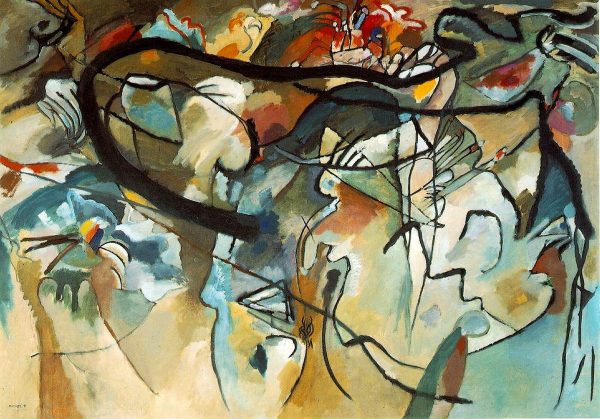
Composition VI is an abstract painting by Wassily Kandinsky from 1913, a large canvas of 300 x 195 cm that grew out of the theme of the flood. The original is held by the Hermitage Museum in Saint Petersburg under inventory number ГЭ-9662. We make it as a hand-painted reproduction in oil on canvas, in eight sizes or to your measurements, and before dispatch you receive a photograph of the finished painting to approve.
| Title: | Composition VI |
| Other titles: | Komposition VI · Kompozicija VI · Композиция VI |
| Painter: | Wassily Kandinsky (1866–1944) |
| Year of creation: | 1913 |
| Original size: | 300 cm x 195 cm |
| Original technique: | Oil on canvas |
| Painting style: | Abstract art |
| Located: | Hermitage Museum, Saint Petersburg (inv. ГЭ-9662) |
| Our reproduction: | hand-painted oil on canvas, 8 sizes from 70 x 50 cm to 300 x 195 cm, custom size on request |
Composition VI – Wassily Kandinsky
Is there anything recognisable in it?
At first sight, no. No horizon, no figure, no object the eye can name at once – only patches of colour, arcs and lines overlapping across the whole canvas. The work did not come from nowhere, though. According to the record of the Lenbachhaus in Munich, which holds one of the preparatory studies, this group of works begins with a lost reverse-glass painting of biblical judgment – nudes, the ark, animals and palaces – and the subject of Composition VI is the flood. Kandinsky spent more than eighteen months moving away from that concrete imagery until nothing was left of it but an independent relation of forms. A viewer who knows what stood at the beginning can sense waves and hulls low on the canvas; one who does not will see pure abstraction.
What is on the canvas?
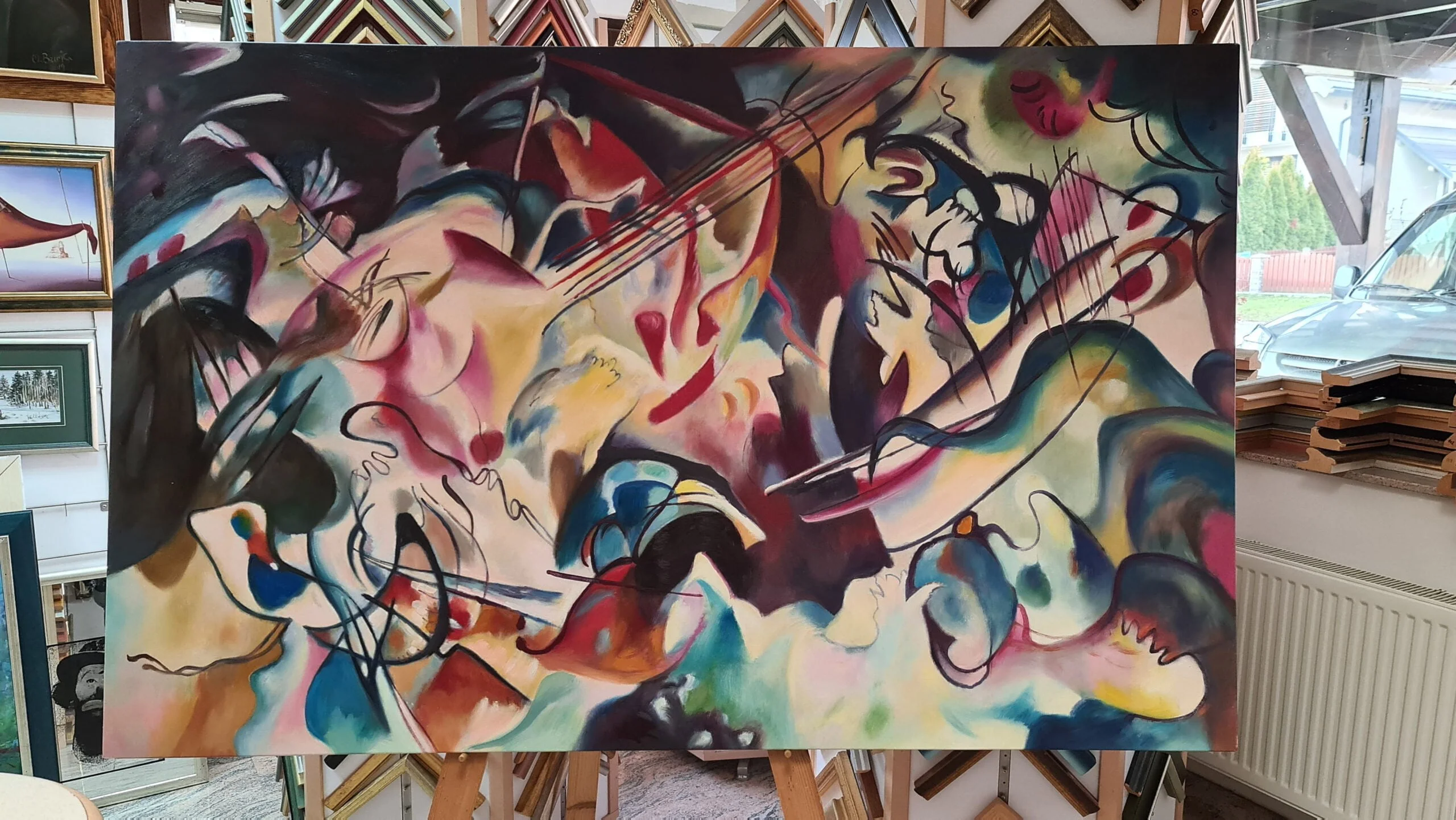
The canvas is landscape, in a ratio of about 3 : 2, and three metres wide. The upper left corner is closed by a heavy dark, almost black-brown mass that slides down towards the middle. Below and to the right of it a wide pale field opens – cream white, faint pink and soft green – and it carries the whole centre. From the top edge a fan of long straight red and black lines falls across that field, as if rain had been drawn with a ruler; it is the sharpest gesture on the surface. Along the left edge stand dark blue and black wedges turned inwards, with a white form below carrying a blue and an orange dot. Right of centre a large blue-green mass rises, crossed by black arcs and thin parallel lines, with small magenta and pink accents above it. The lower edge is darker: black wavy lines, blue and brown clusters, a warm red-brown patch in the right corner. No form has a firm outline – the edges run into one another, so everything seems to move at once, and the work carries two centres of gravity, left and right of the middle.
Why does this painting matter?
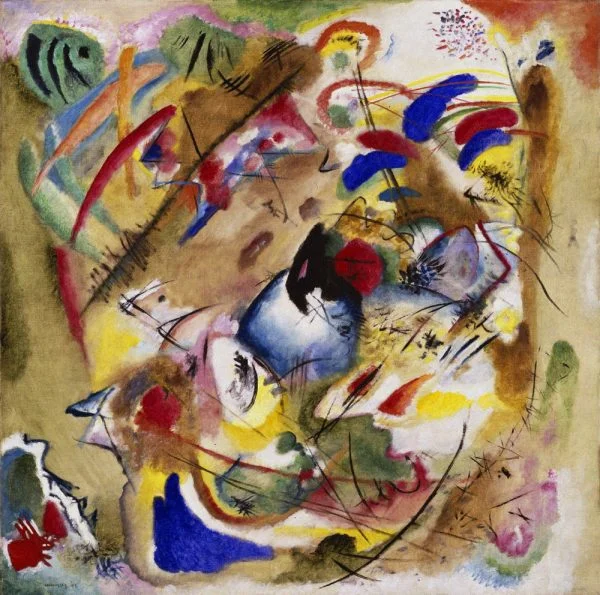
Composition VI is one of the works in which Kandinsky finally moved from motif to pure form, and the road to it is documented. The Lenbachhaus holds Improvisation Sintflut of 1913 as one of many preparatory studies for this canvas, and its record states that the painter needed more than eighteen months to get from concrete imagery to an independent formal conception in which the inner rather than the outer quality of things counts. The result hangs in the Hermitage: an oil painting measuring 195 x 300 cm, larger than many a wall. On a canvas this wide a viewer cannot take everything in at once but has to move along the work, and that movement is part of it.
What does the painting mean?
Meaning here is not guessed at; it is read from the record. The subject is the flood: destruction and a new beginning at once, taken from that lost reverse-glass painting. Kandinsky did not want to narrate that story but translated it into relations of colour and form, so that, in the museum’s words, the inner quality remains rather than the outward look of the event. So there is no scene to read as a story, and yet everything a flood does to form is there: masses tipping over, lines falling like rain, light holding out in the middle. Let the work act like music – colour beside colour, stroke beside stroke – and the subject shows itself.
Why is it called Composition VI?
Kandinsky divided his work of these years into three kinds in Concerning the Spiritual in Art. An Impression is a direct impression of outward nature in purely artistic form. An Improvisation is the largely unconscious, spontaneous expression of inner processes – which is exactly the name the Lenbachhaus study carries. A Composition expresses a slowly formed inner feeling that comes to utterance only after long maturing, checked by reason and intention. The number VI marks the sixth work in that series; the next large canvas of the same series is Composition VII, painted a few months later. The study Improvisation Sintflut (1913, 95.8 x 150.3 cm) is held by the Lenbachhaus in Munich. The other Compositions in our range are Composition IV and Composition X.
How is our hand-painted version made?
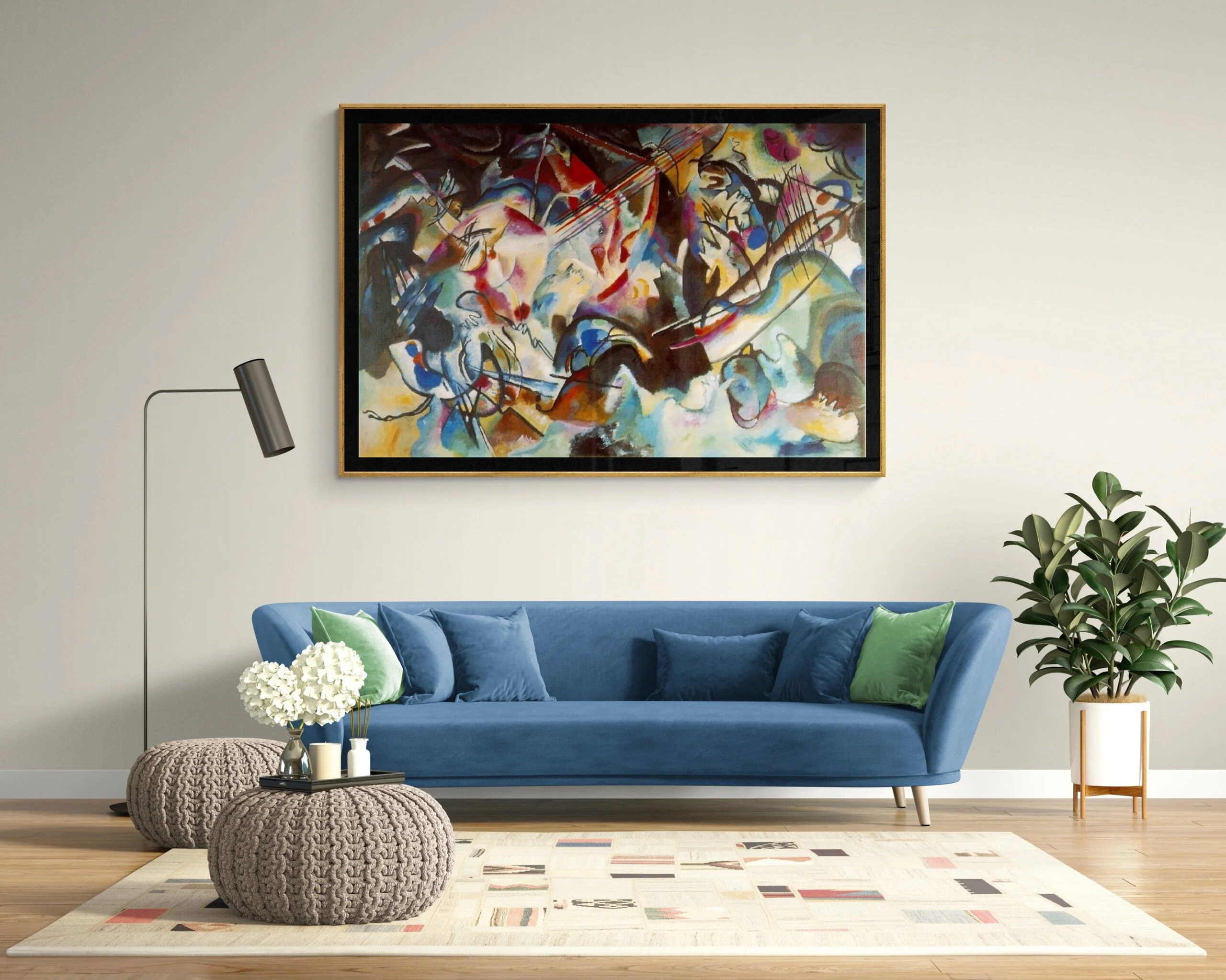
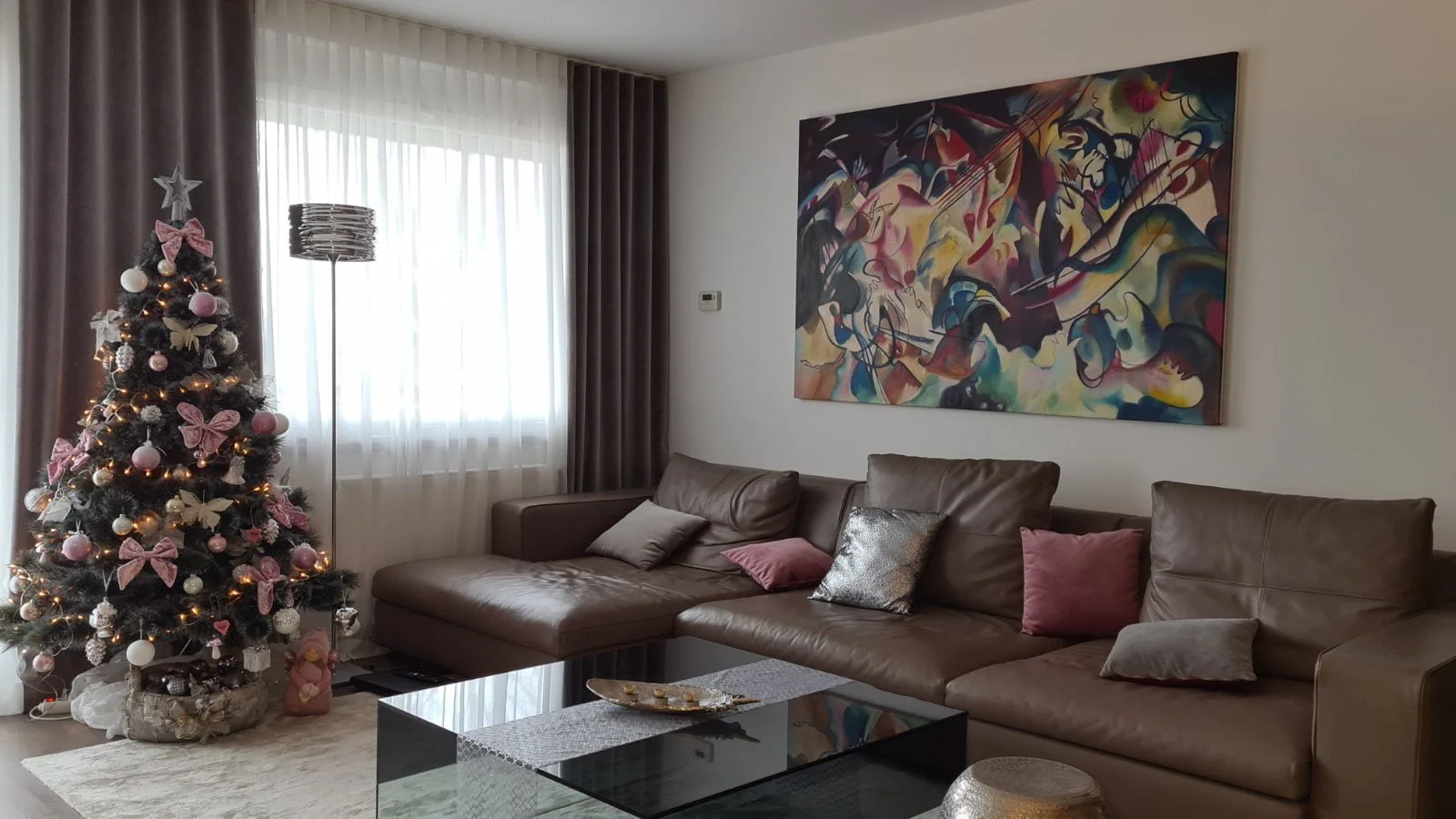
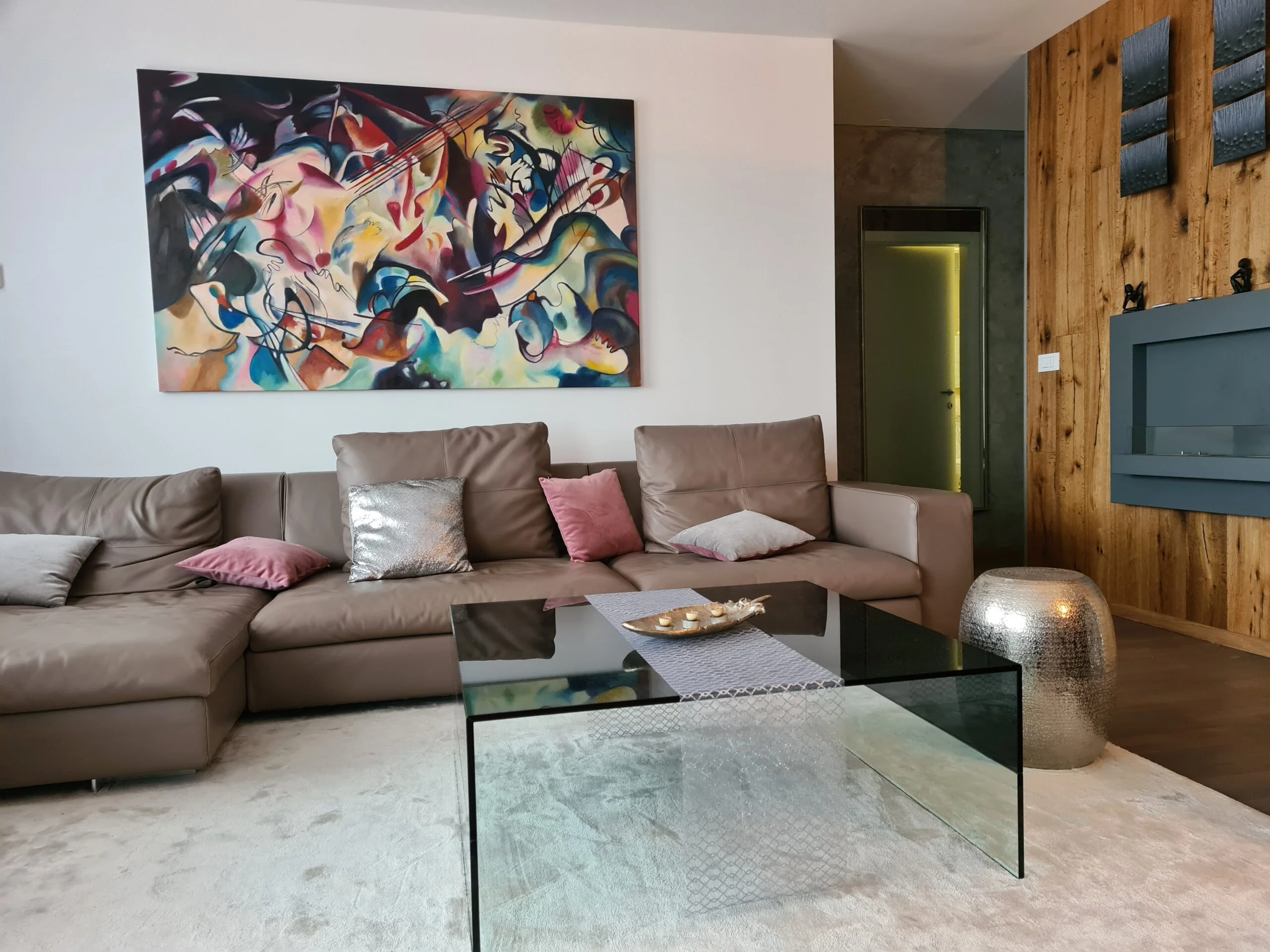
This is a canvas painting made with a brush and oil paint, not with a printer. The painter works from a high-resolution museum image and builds the surface in layers: the pale field first, then the dark masses at the edges, and last the long straight lines, drawn in a single pass. In an abstract work it is the relation between the colours that holds everything together: a Kandinsky reproduction stands or falls on them, so the painter checks them against the museum image at every stage. In the second photograph our finished canvas stands on the easel in our studio, unframed and as it will leave for the customer, with the frame samples you choose from behind it. In the third photograph the same work hangs in a customer’s flat above a leather sofa, next to the Christmas tree, and in the fourth the same room is shown more widely, with the glass table in front of the sofa. The first photograph is a room rendering – a visualisation in a gold frame, not a photograph of our canvas. Because everything is done by hand, every hand-painted copy is unique and no two are quite the same.
Which size for which wall?
If you are unsure: 150 x 100 cm. Our largest size, 300 x 195 cm, matches the original one to one – the painting for really large walls, foyers and stairwells, where it can work as it does in a museum. 150 x 100 cm is the natural painting for the living room above a sofa three metres wide, while 120 x 80 cm suits a narrower wall or a bedroom. The smaller 70 x 50 and 90 x 60 cm sizes sit above a chest of drawers, a desk or in a hallway; 190 x 120, 220 x 140 and 250 x 160 cm are for open-plan rooms, dining rooms and offices. The 70 x 50 cm size is slightly taller than the proportions of the original, so the composition reads a shade more compressed. Because the work is dense, it needs some empty wall around it.
Custom size, stretcher and frame
If none of the eight sizes fits your wall, we paint the work to your measurements and keep the proportions of the original; that is our made-to-measure painting. Like all our paintings on canvas, this copy arrives stretched on a wooden stretcher, ready to hang. For the frame, use our 3D app: it shows every one of our frame profiles on this motif, so you can compare gold, silver, black, white and natural wood before deciding – the app is only for choosing the frame. If you want to see how the work will look on your own wall, that is our separate room-visualisation service.
Delivery and guarantee
Every copy is made to order in our studio in Slovenia, so allow 15 to 45 days depending on the size. We ship it stretched and protected for transport, framed if you chose one, across the EU with no customs. Before dispatch you receive a photograph of the finished work to approve, and every order is covered by our returns policy. You will find the whole range in our Wassily Kandinsky gallery, and our article on Wassily Kandinsky tells the story of his life.
Frequently asked questions
Where is the original?
In the Hermitage Museum in Saint Petersburg, under inventory number ГЭ-9662; according to the museum’s record it came there in 1948 from the State Museum of New Western Art.
What does the painting show?
Nothing figurative: a pale field in the middle, dark masses at the edges and a fan of straight lines across it. The subject the work grew out of is the flood.
Is Komposition VI the same work?
Yes. Composition VI, Komposition VI and Композиция VI are all titles of the same 1913 canvas.
Is this a print?
No. It is an oil painting reproduction made by hand on canvas; you can see and feel the brushstrokes.
Which size should I choose?
For a living room, 150 x 100 cm; 300 x 195 cm matches the original, and the size guide above covers other walls.
Can I have a size that is not listed?
Yes, we paint to measure and keep the proportions of the original.
How is it delivered?
Stretched on a stretcher, and framed if you chose a frame, within 15 to 45 days of your approving the photograph of the finished work.
What is the painting about, in one sentence?
The flood as ending and beginning at once, translated into relations of colour and form without a single recognisable scene.
What does Kandinsky’s Composition VI mean, and how do you read it?
Composition VI grew out of the theme of the Flood, which Kandinsky saw as an ending and a new beginning at once. He started from one of his paintings on glass of the Flood and struggled with the large canvas for about a year and a half. The breakthrough came, he later wrote, when he repeated the word “Sintflut” (flood) until it lost its meaning and only its sound remained. So read the painting as catastrophe turned into pure colour: a pale field in the middle, dark masses at the edges and a fan of straight lines across it.
Is the original for sale, and what is it worth?
No. The canvas belongs to the public collection of the Hermitage and is not for sale; a hand-painted canvas is the only way to have it at home.
How high should I hang it?
The centre of the work at eye level, about 145–150 cm from the floor; above a sofa, 15–25 cm above the backrest.
Does it work as a gift?
Yes, for someone who loves modern art it is a well-judged choice. If you would rather let them choose, there is a gift voucher.
- Subject: an abstract composition grown out of the theme of the flood – 1913
- Original: 300 x 195 cm, oil on canvas, Hermitage Museum, Saint Petersburg (inv. ГЭ-9662)
- Ours: hand-painted oil on canvas, eight sizes from 70 x 50 to 300 x 195 cm, stretched and framed on request
- Worth knowing: the road from the figurative reverse-glass painting to this form took, according to the Lenbachhaus record, more than eighteen months