


Description
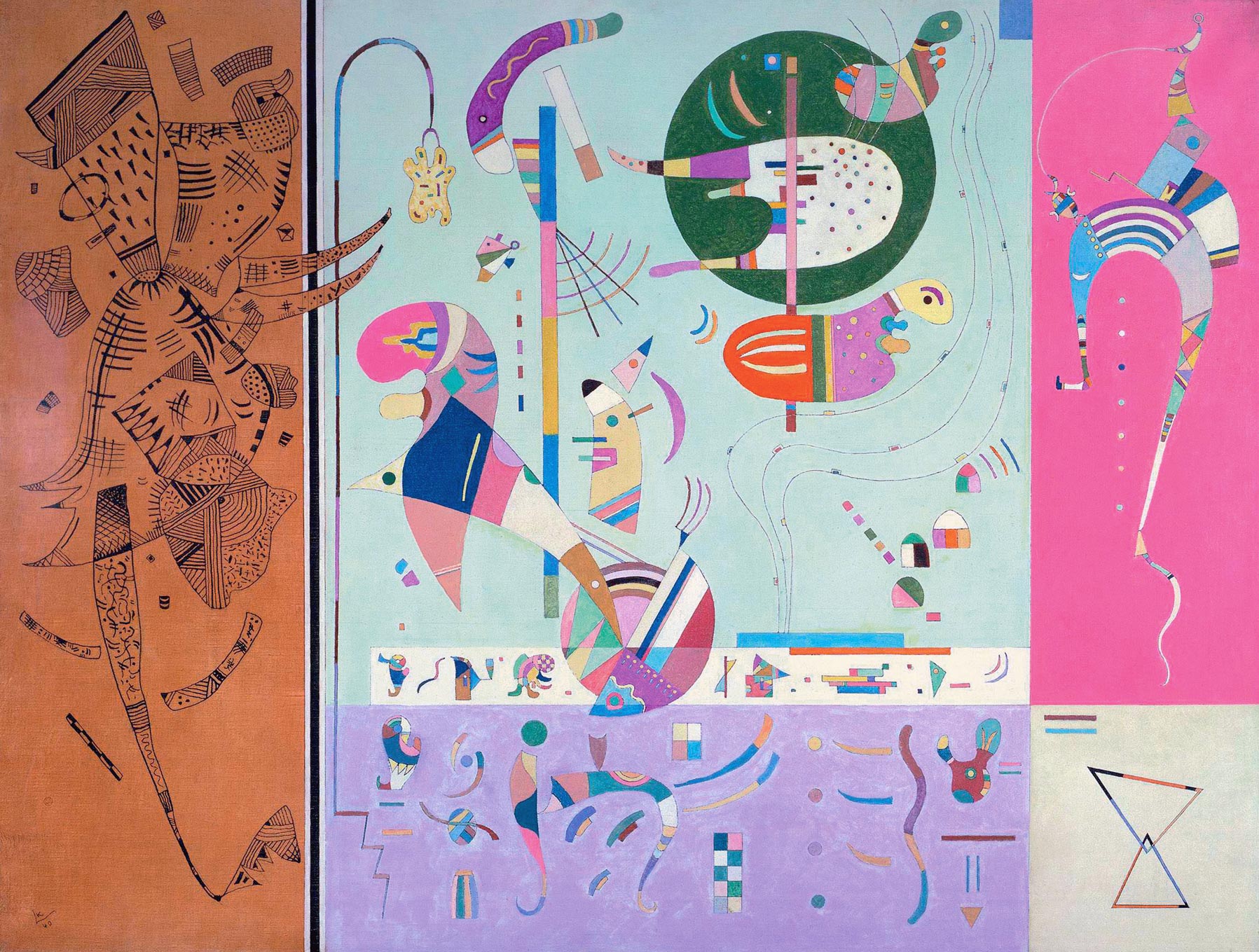
Various Parts (Parties diverses) is a late painting by Wassily Kandinsky from 1940: a landscape canvas of 116.4 x 89.5 cm divided into right-angled fields of colour – brown, pale blue-green, pink and violet – in which small organic creatures float. The original hangs in the Lenbachhaus in Munich under the number AK 16, a permanent loan from the Gabriele Münter and Johannes Eichner Foundation. With us it is made as a hand-painted oil painting reproduction on canvas, in eight sizes or to your own measurement, and before dispatch you receive a photograph of the finished work for approval.
| Title: | Various Parts |
| Other titles: | Parties diverses · Verschiedene Teile · Različni deli |
| Painter: | Wassily Kandinsky (1866–1944) |
| Year: | 1940 |
| Original size: | 116.4 cm x 89.5 cm |
| Original technique: | Oil on canvas |
| Painting style: | Abstract art |
| Location: | Lenbachhaus, Munich (inv. AK 16) |
| Our reproduction: | hand-painted oil on canvas, 8 sizes from 50 x 40 cm to 150 x 120 cm, custom size on request |
Various Parts – Wassily Kandinsky
Is there anything recognisable on the canvas?
No people and no landscape, but shapes the eye reads as living things. The museum calls them organic, amoeba-like microstructures: small bodies with stripes, dots and feelers, of the kind seen under a microscope. On the left stands a tall brown panel carrying a single black drawing, something between a totem and a bird; on the right a pink panel with a light blue figure; along the bottom a violet band with a row of small figures. None of these creatures is an animal you could name, and for that reason we do not call them anything other than what we see: shapes, each floating in its own field.
What is on the canvas?
The canvas is landscape and divided into right-angled fields, which the museum’s entry gives as its basic trait. The left edge is taken by a tall brown-ochre panel across which only a black drawing runs: a long winged figure, with nets, dots and fine patterning, as if cut into wood. A thin dark line separates it. The middle is held by a large pale blue-green field, and there stand the largest creatures in the work: a green disc with a white core and dots, a pink-and-blue form with a beak, an upright striped pole, and a few thin wavy lines drifting to the right. On the right lies a pink field with a pale blue-grey figure built from arcs and striped bands. Along the whole width at the bottom runs a violet band with a row of small figures, and above it a narrow white strip with coloured marks. In the lower right corner sits a light grey field with a black and red triangle. At the lower left is the painter’s monogram with the year.
Why does this painting matter?
By the museum’s entry it is a characteristic work of Kandinsky’s late Paris period, which began with his emigration after the Bauhaus was closed in 1933 and lasted until his death in 1944. The museum describes the composition as divided into differently coloured right-angled fields that emphasise the ultimately symmetrical construction of the individual elements, and calls this duality of halves and opposites a basic trait of Kandinsky’s work – “conflicts in balance”. The same entry speaks of a decorative side recalling modern industrial aesthetics, and of something the museum calls the spirit of the East. The work is in the Lenbachhaus as a permanent loan from the Gabriele Münter and Johannes Eichner Foundation.
What does the work mean?
Here we have more than with the other canvases in this series, because the museum publishes its own reading: opposites held in balance, archetypal microscopic forms, and the decorativeness of the industrial age. And that is exactly what can be seen here: each field has its own colour temperature, and the creatures in it behave differently from those next door. The work tells no story; it sets parts beside one another and lets a relation build between them. The title says it plainly: various parts.
Where does this work sit among the others?
It was made in the same year as Sky Blue, which is kept by the Centre Pompidou in Paris, and both show the same late language: small organic bodies suspended in a quiet field. The difference is the construction – Sky Blue has a single blue ground, while Various Parts is cut into fields that argue with each other. If you want to know where that language came from, compare the canvas with earlier works in our range: Composition IV and Composition VII come from the years when the shapes were still large and dramatic.
How is our hand-painted version made?
This is an art painting made with a brush and oil paint, not with a printer. Every Kandinsky reproduction we paint begins with the large fields of colour – brown, blue-green, pink and violet – because everything else depends on where their edges fall; only then does the painter draw the creatures into each field and carry them through to the last dot. It is the small shapes that are hardest here: on the original they measure a few centimetres and carry lines, dots and lattices that have to be painted with a fine brush. An abstract painting is held together by the relation between its colours and nothing else, so we do not leave it to chance; an oil painting keeps that relation over the years, because paint does not fade the way a print does. For this work we do not yet have studio photographs of our own, so you will not find any on this page – once the next copy is painted we photograph it and the shots come here. Before dispatch every customer receives a photograph of their own finished canvas for approval. Because everything is done by hand, every hand-painted copy is its own piece and no two are quite alike.
Which size for which wall?
If you are unsure: 100 x 80 cm. The 116 x 89 cm size matches the original almost one to one and is a rewarding painting for the living room, above a sofa or a sideboard. The smaller sizes 50 x 40, 70 x 50 and 80 x 60 cm suit a hallway, bedroom or office where the wall is narrow; 90 x 70 and 100 x 80 cm suit a broader wall. The largest sizes 130 x 100 and 150 x 120 cm are for open living spaces and dining rooms; there the small creatures grow enough to be read from across the room. Because the work is built from fields of strong colour, it wants some quiet wall around it.
Custom sizes, stretcher and frame
If none of the eight sizes fits your wall, we paint the work to your measurements and keep the original’s proportions, so the fields stay in the same relation; that is our painting to order. Like every canvas painting we make, this copy is delivered stretched on a wooden stretcher and ready to hang. For the frame use our 3D application: it shows every one of our frame profiles on this motif, so you can compare gold, silver, black, white and natural wood before deciding – the application is for choosing a frame and nothing else. If you want to see how the painting will look on your own wall, that is our separate room-placement service.
Delivery and guarantee
Every copy is made to order in our studio in Slovenia, so allow 15 to 45 days depending on the size chosen. We send it stretched and protected for transport, framed if you chose a frame, across the EU without customs. Before dispatch you receive a photograph of the finished work for approval, and our returns policy applies to every order. The whole range is in the Wassily Kandinsky gallery, and the painter’s path is described in our article about Wassily Kandinsky.
Frequently asked questions
Where is the original?
In the Lenbachhaus in Munich, under the number AK 16; the work is there as a permanent loan from the Gabriele Münter and Johannes Eichner Foundation.
What is depicted?
Nothing representational: right-angled fields of colour holding small organic creatures, which the museum describes as amoeba-like microstructures.
Is Parties diverses the same work as Various Parts?
Yes. Parties diverses, Various Parts and Verschiedene Teile are titles of the same canvas from 1940.
Is this a print?
No. It is a reproduction hand-painted in oil on canvas; the brush strokes can be seen and felt.
Which size should I choose?
For a living room 100 x 80 or 116 x 89 cm, which is almost exactly the size of the original; for other walls see the size guide above.
Can I have a size that is not listed?
Yes, we paint to measure and keep the original’s proportions.
How is it delivered?
Stretched on a stretcher and framed if you chose that, in 15 to 45 days after you approve the photograph of the finished work.
What is it about, briefly?
Opposites held in balance: separate fields of colour, each with its own creatures, set side by side.
Is the original for sale, and what is it worth?
No. The canvas belongs to a public collection in Munich and is not for sale; a hand-painted canvas is the only way to have it at home.
How high should it hang?
The centre at eye level, about 145-150 cm from the floor; above a sofa, 15-25 cm above the back.
Does it work as a gift?
Yes, for someone who likes modern art it is a cheerful choice. If you would rather leave the choice to them, there is a gift voucher.
- Subject: right-angled fields of colour with small organic creatures – 1940
- Original: 116.4 x 89.5 cm, oil on canvas, Lenbachhaus, Munich (inv. AK 16)
- Our version: hand-painted oil on canvas, eight sizes from 50 x 40 to 150 x 120 cm, stretched and framed on request
- Worth knowing: the museum describes the composition as conflicts in balance